 Back
Glycolysis: Pathways, Regulation, and Energy Yield
Study Guide - Smart Notes
 Tailored notes based on your materials, expanded with key definitions, examples, and context.
Glycolysis: Carbon Pathways
Overview of Glycolysis
Glycolysis is a central metabolic pathway in biochemistry, responsible for the breakdown of glucose to pyruvate, generating ATP and NADH. It consists of two main phases: the investment phase (Phase I) and the energy payoff phase (Phase II). The pathway is tightly regulated and has significant implications for cellular energy production and metabolic control.
Entry Metabolite: Glucose
Exit Metabolite: Pyruvate
Key Products: ATP, NADH, H+, H2O
Overall Reaction:
Standard Free Energy Change:
Fates of Glucose
Glucose serves as a primary energy source and can be metabolized through glycolysis to produce pyruvate. The fate of glucose is determined by cellular energy needs and oxygen availability.
Energy Production: Glycolysis converts glucose to pyruvate, generating ATP and NADH.
Metabolic Entry Point: Glucose is phosphorylated and retained in the cell for further metabolism.
Energy Diagram of Glycolysis
The energy diagram of glycolysis illustrates the stepwise decrease in free energy as glucose is converted to pyruvate. This diagram highlights the regulatory points and the overall exergonic nature of the pathway. 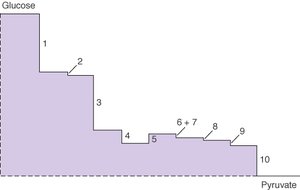
Investment Phase (Phase I) of Glycolysis
The investment phase involves the consumption of ATP to phosphorylate glucose and its intermediates, preparing them for subsequent energy extraction.
ATP Consumption: Two ATP molecules are used to phosphorylate glucose and fructose-6-phosphate.
Key Enzymes: Hexokinase (or glucokinase) and phosphofructokinase (PFK).
Purpose: Traps glucose in the cell and destabilizes it for cleavage.
Energy Payoff Phase (Phase II) of Glycolysis
In the energy payoff phase, ATP and NADH are produced as glucose is converted to pyruvate.
ATP Generation: Four ATP molecules are produced (net gain of two ATP per glucose).
NADH Production: Two NADH molecules are generated, which can be used for further ATP synthesis in aerobic conditions.
Overall Reaction:
Fates of Pyruvate and NADH
The fate of pyruvate and NADH depends on oxygen availability and cellular metabolic needs.
Aerobic Conditions: NADH is re-oxidized in the electron transport chain, producing ATP via oxidative phosphorylation. Pyruvate enters the citric acid cycle.
Anaerobic Conditions: NADH is re-oxidized by lactate dehydrogenase (LDH), converting pyruvate to lactate and regenerating NAD+ for continued glycolysis.
Other Fates: Pyruvate can serve as a precursor for fatty acid, amino acid, and glucose synthesis.
Glycolysis Regulation: Step #1 (Committed Step)
The first committed step of glycolysis is catalyzed by hexokinase (or glucokinase), which phosphorylates glucose to glucose-6-phosphate, trapping it in the cell.
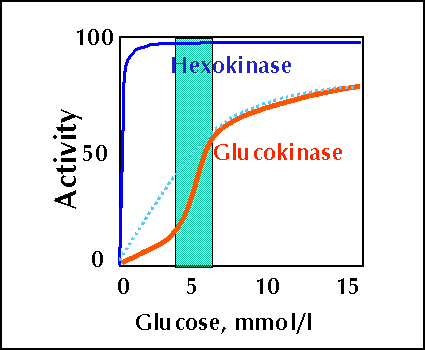
Hexokinase: Low Km (0.1 mM), active at normal cellular glucose concentrations (4 mM).
Glucokinase: Higher Km (10 mM), active only when glucose is abundant.
Regulation: Hexokinase is allosterically inhibited by its product, glucose-6-phosphate.
Importance: Not the primary regulatory site of glycolysis.
Glycolysis Regulation: Step #3 (Rate-Limiting Step)
The rate-limiting step of glycolysis is catalyzed by phosphofructokinase (PFK), which is highly regulated to control glycolytic flux.
PFK: Catalyzes the second priming reaction and is the committed step with a large negative .
Regulation:
ADP promotes fructose-6-phosphate binding.
Phosphoenolpyruvate (PEP) is an allosteric inhibitor.
Fructose-2,6-bisphosphate (F26BP) is an allosteric activator.
PFK activity increases when cellular energy is low and decreases when energy is high.
Pathway Intermediates and Enzyme Inhibition
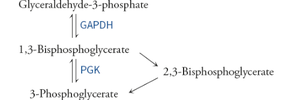
GAPDH Inhibition: Vanadate inhibits glyceraldehyde-3-phosphate dehydrogenase (GAPDH) by interacting with essential —SH groups, not as a phosphate analog.
Effects: Inhibition of GAPDH leads to decreased ATP and 2,3-bisphosphoglycerate production, and altered phosphate levels in red blood cells.
End of Section Questions
PFK Mutant Hypothesis: The serine-to-aspartate substitution at the F26BP binding site abolishes F26BP binding, likely due to charge and structural incompatibility. This impairs allosteric activation of PFK, reducing glycolytic flux.
Role of F26BP: Decline in glucose consumption and ethanol production in mutant yeast reveals that F26BP is essential for activating PFK and maintaining high glycolytic rates under fermentative conditions.
Vanadate Effects: Inhibition of GAPDH decreases ATP and 2,3-bisphosphoglycerate levels, and may increase cellular phosphate due to blocked conversion of glyceraldehyde-3-phosphate.
Summary Table: Glycolysis Regulation and Energy Yield
Step | Enzyme | Regulation | Energy Yield |
|---|---|---|---|
1 | Hexokinase/Glucokinase | Product inhibition (G6P), Km differences | ATP consumed |
3 | Phosphofructokinase (PFK) | Allosteric regulation (ADP, PEP, F26BP) | ATP consumed |
6-7 | GAPDH, PGK | GAPDH inhibited by vanadate | ATP and NADH produced |
10 | Pyruvate kinase | Allosteric regulation | ATP produced |
Additional info: The energy diagram and regulatory steps are critical for understanding how glycolysis is controlled and how metabolic diseases or mutations can impact cellular energy production.
