 Back
BackIntroduction to Biochemistry: Foundations, History, and Scope
Study Guide - Smart Notes
 Tailored notes based on your materials, expanded with key definitions, examples, and context.
Introduction to Biochemistry
Definition and Scope
Biochemistry is a branch of the natural sciences that studies the chemical composition and processes of living organisms, from microorganisms to complex multicellular life forms. It bridges biology and chemistry, focusing on the molecular mechanisms that underlie cellular functions and life processes.
Key Focus: Chemical reactions in living organisms, structure and function of biomolecules, and the molecular basis of life.
Applications: Medicine, agriculture, nutrition, biotechnology, and environmental science.
Learning Objectives
Define biochemistry and describe its core concepts.
Summarize the history and major developments in biochemistry.
Explain the importance and applications of biochemistry.
Identify the main branches and foundations of biochemistry.
History and Developments in Biochemistry
Major Milestones
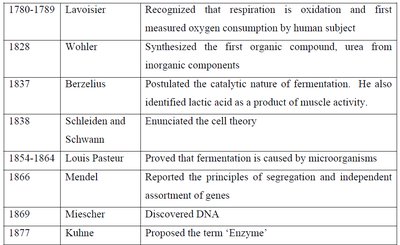
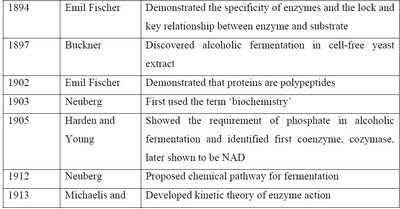
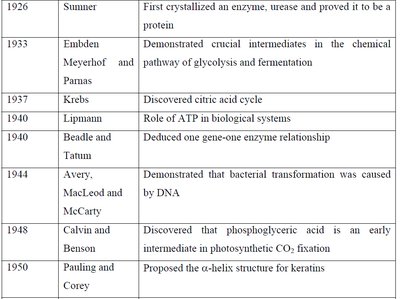
The development of biochemistry as a scientific discipline has been marked by several key discoveries and technological advances. The timeline below highlights significant events and contributors.
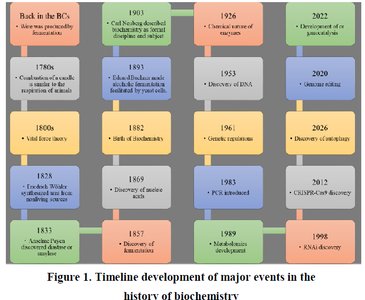
Selected Historical Events and Contributors
Year | Scientist(s) | Contribution |
|---|---|---|
1780-1789 | Lavoisier | Recognized that respiration is oxidation and first measured oxygen consumption by humans. |
1828 | Wöhler | Synthesized the first organic compound (urea) from inorganic components. |
1837 | Berzelius | Postulated the catalytic nature of fermentation; identified lactic acid as a product of muscle activity. |
1869 | Miescher | Discovered DNA. |
1877 | Kuhne | Proposed the term "enzyme". |
1897 | Buchner | Discovered alcoholic fermentation in cell-free yeast extract. |
1926 | Sumner | First crystallized an enzyme (urease) and proved it to be a protein. |
1937 | Krebs | Discovered the citric acid cycle. |
1953 | Watson & Crick | Proposed the double-helical model for DNA structure. |
1958 | Meselson & Stahl | Confirmed the semi-conservative replication of DNA. |
1984 | Kary Mullis | Developed the polymerase chain reaction (PCR). |
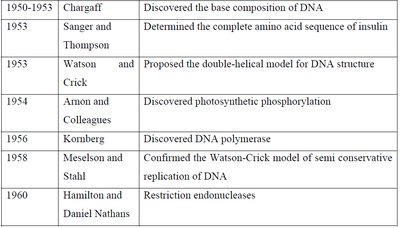
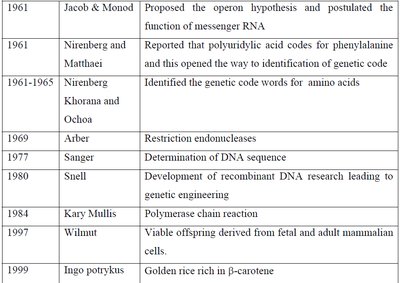
Example: The discovery of DNA's structure by Watson and Crick in 1953 revolutionized genetics and molecular biology, providing the foundation for modern biotechnology and genetic engineering.
Importance of Biochemistry
Central Role in Science and Society
Biochemistry is essential for understanding the molecular basis of life and has broad applications in health, agriculture, industry, and environmental management.
Explains cellular chemical reactions and metabolic pathways.
Describes enzyme functions and mechanisms.
Identifies and characterizes biomolecules such as proteins, nucleic acids, carbohydrates, and lipids.
Provides insights into physiological processes like digestion, respiration, and excretion.
Supports advances in food science, nutrition, and biotechnology.
Enables genetic manipulation and the development of new therapies and diagnostics.
Foundations of Biochemistry
Core Foundations
The foundations of biochemistry are categorized into four main areas, each contributing to our understanding of life at the molecular level.
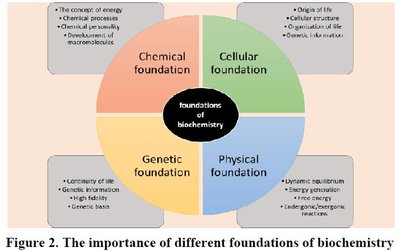
Chemical Foundation: Focuses on energy concepts, chemical processes, and the structure and development of macromolecules.
Cellular Foundation: Explores the origin and organization of life, cellular structure, and the evolution of cells.
Physical Foundation: Involves dynamic equilibrium, energy generation, and the physical principles underlying biochemical reactions.
Genetic Foundation: Addresses the continuity of life, genetic information, and the molecular basis of heredity.
Organization of Life
Hierarchical Structure
Life is organized in a hierarchical manner, from the smallest subatomic particles to the entire biosphere. Understanding this organization is crucial for studying biochemistry at different levels.
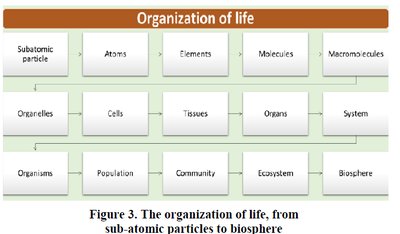
Subatomic particles → Atoms → Elements → Molecules → Macromolecules
Organelles → Cells → Tissues → Organs → Systems
Organisms → Populations → Communities → Ecosystems → Biosphere
Scope of Biochemistry
Foundations, Importance, Careers, and Future Directions
The scope of biochemistry encompasses its foundational principles, practical importance, career opportunities, and future prospects.
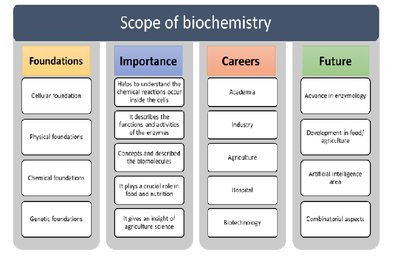
Foundations: Cellular, physical, chemical, and genetic bases.
Importance: Understanding cellular reactions, enzyme functions, biomolecules, and applications in health and agriculture.
Careers: Academia, industry, agriculture, hospitals, biotechnology.
Future: Advances in enzymology, food/agriculture development, artificial intelligence, and combinatorial approaches.
Main Branches of Biochemistry
Overview of Key Branches
Structural Biochemistry: Studies the chemical architecture of biological macromolecules, especially proteins and nucleic acids. Example: Determining protein structure from amino acid sequence.
Physical Biochemistry: Applies physical chemistry and mathematical modeling to biomolecules and biochemical reactions.
Clinical Biochemistry: Analyzes chemicals in bodily fluids for medical diagnosis and treatment.
Bio-organic Chemistry: Focuses on organic compounds from living organisms and their biochemical roles.
Enzymology: Investigates enzymes, their mechanisms, kinetics, and regulation.
Metabolic Biochemistry: Studies metabolic pathways, bioenergetics, and metabolic diseases.
Xenobiotics: Examines the metabolism of foreign compounds and their effects (pharmacology and toxicology).
Immunology: Explores immune responses and antibody production.
Endocrinology: Studies hormones, their biosynthesis, and signaling mechanisms.
Neurochemistry: Investigates molecules involved in neuronal activity and neurotransmission.
Chemotaxonomy: Classifies organisms based on chemical composition.
Chemical Ecology: Studies chemical interactions among organisms.
Molecular Genetics and Genetic Engineering: Focuses on genes, their expression, and manipulation.
Molecular Biology: Examines molecular processes in living organisms, especially macromolecules.
Cell Biology: Studies cell structure, function, and life cycle.
Bioinformatics: Applies information technology to biological data analysis and pattern discovery.
Examples and Applications
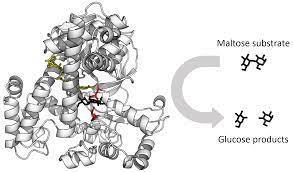
Enzyme Function
Enzymes are biological catalysts that accelerate chemical reactions in cells. For example, the enzyme amylase catalyzes the breakdown of starch into glucose.
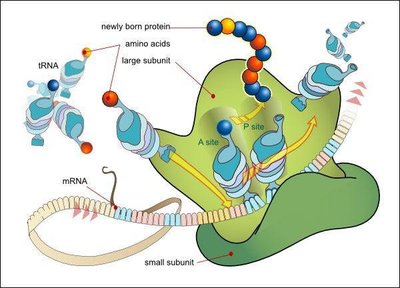
Cellular Processes
Cells are the fundamental units of life, carrying out essential biochemical processes such as metabolism, energy production, and genetic information transfer.
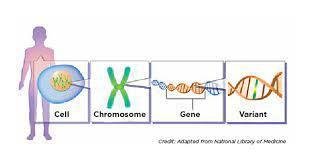
Genetic Information
Genetic information is stored in DNA and organized into genes, which are expressed to produce proteins and regulate cellular functions.
Bioinformatics
Bioinformatics integrates biology, mathematics, and computer science to analyze biological data, such as DNA sequences, and solve complex biological problems.

Summary Table: Major Foundations and Applications of Biochemistry
Foundation | Key Concepts | Applications |
|---|---|---|
Chemical | Energy, chemical processes, macromolecules | Metabolism, drug design |
Cellular | Cell structure, origin of life | Cell biology, physiology |
Physical | Equilibrium, energy generation | Thermodynamics, kinetics |
Genetic | Genetic information, heredity | Genomics, genetic engineering |
Additional info: The above content integrates foundational knowledge, historical context, and modern applications, providing a comprehensive introduction suitable for college-level biochemistry students.
