 Back
BackIntroduction to Enzyme Kinetics: Principles and Mathematical Models
Study Guide - Smart Notes
 Tailored notes based on your materials, expanded with key definitions, examples, and context.
Enzyme Kinetics: Fundamental Concepts
Definition and Scope
Enzyme kinetics is the study of the rates at which enzymatic reactions occur and the factors that influence these rates. It provides insight into how enzymes function, their mechanisms, and how their activity can be regulated or altered under various conditions.
Kinetics in biochemistry refers to measuring and analyzing the rate of chemical or biochemical reactions.
The rate of enzyme activity is defined as the change in concentration of substrate or product per unit time.
Factors Affecting Enzyme Activity
Several factors influence the activity of enzymes, affecting the rate at which they catalyze reactions:
Enzyme concentration
Ligand concentration (including substrates, inhibitors, and activators)
pH
Ionic strength
Temperature
Importance of Kinetic Studies
Studying enzyme kinetics is crucial for understanding enzyme function and regulation:
Provides information on enzyme mechanisms
Reveals the role of enzymes under cellular conditions
Offers clues to enzyme regulation in vivo
Helps identify amino acid residues in the active site
Useful in drug screening and comparison of enzymes
Rate of Reaction and Mathematical Representation
Basic Rate Equation
The rate of a reaction is determined by the concentration of reactants and the rate constant:
In enzymology, reactants are called substrates.
The rate equation for a unimolecular (first-order) reaction is:
$ V_0 = k [S] $
where V0 is the initial rate, k is the first-order rate constant (units: s-1), and [S] is substrate concentration.
Unit of Enzyme Activity
Enzyme activity is quantified as follows:
One unit of enzyme activity is the amount of enzyme that produces one micromole of product per minute.
Expressed as: $ 1 \text{ enzyme unit} = \frac{\mu\text{mole}}{\text{min}} $
Measurement of Enzyme Activity
By the rate of substrate disappearance: $ \frac{d[S]}{dt} $
By the rate of product appearance: $ \frac{d[P]}{dt} $
Enzyme Kinetics: Hyperbolic Relationship
Hyperbolic Curve of Enzyme Activity
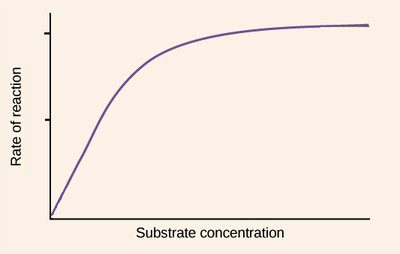
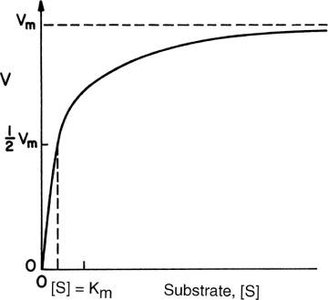
The relationship between enzyme activity (rate of reaction) and substrate concentration is typically hyperbolic, reflecting the saturation of enzyme active sites as substrate concentration increases.
Michaelis-Menten Model
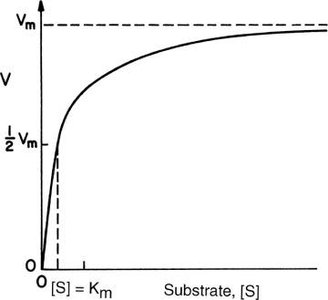
The Michaelis-Menten equation describes the hyperbolic relationship between substrate concentration and reaction rate:
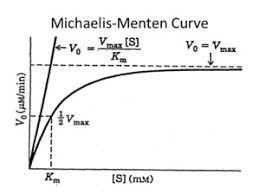
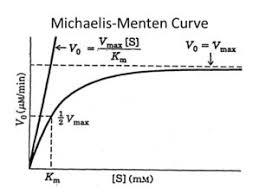
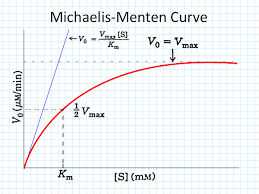
At low substrate concentrations ([S] << Km), the rate increases linearly with [S].
At high substrate concentrations ([S] >> Km), the rate approaches a maximum value (Vmax).
At [S] = Km, the rate is half of Vmax.
Enzyme-Substrate Interaction
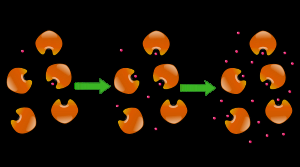
The enzyme-substrate complex formation is central to understanding enzyme kinetics. The process involves substrate binding, transition state formation, and product release.
Mathematical Representation of Kinetic Curves
Linear and Parabolic Equations
Different mathematical models can represent reaction rates:
Linear relationship: $ Y = mX + C $
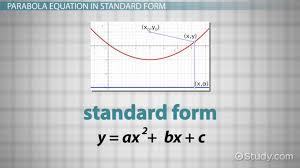
Parabolic relationship: $ Y = aX^2 + bX + C $
Michaelis-Menten Equation
The Michaelis-Menten equation is the standard model for enzyme kinetics:
$ V_0 = \frac{V_{max} [S]}{K_m + [S]} $
Special Cases of Michaelis-Menten Equation
When [S] << Km: $ V_0 \approx \frac{V_{max}}{K_m} [S] $ (linear relationship)
When [S] >> Km: $ V_0 \approx V_{max} $ (rate approaches maximum)
When [S] = Km: $ V_0 = \frac{1}{2} V_{max} $
Mathematical Manipulation of Rate Equations
Solving for Variables
Any term in the Michaelis-Menten equation can be isolated to solve for unknowns, such as substrate concentration, maximum velocity, or Michaelis constant, depending on experimental data.
Example: Solving for [S] when V0, Vmax, and Km are known.
Additional info: The Michaelis-Menten model is foundational for understanding enzyme kinetics and is widely used in biochemistry for characterizing enzyme behavior and drug development.
