 Back
BackLigand-Gated Ion Channels 2
Study Guide - Smart Notes
 Tailored notes based on your materials, expanded with key definitions, examples, and context.
Ligand-Gated Ion Channels (LGICs)
Basics of LGICs
Ligand-gated ion channels (LGICs) are essential membrane proteins that convert chemical signals (ligand binding) into electrical signals (ion flow) in excitable cells. They play a critical role in fast synaptic transmission in the nervous system.
Gating Mechanism: LGICs open in response to the binding of specific ligands (neurotransmitters) rather than changes in membrane voltage.
Ion Selectivity: Channels may conduct cations (excitatory, e.g., nAChRs, AMPARs, NMDARs, ASICs) or anions (inhibitory, e.g., GABAARs, GlyRs).
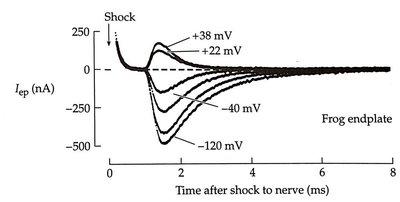
Current Dependence: The current through LGICs depends on membrane voltage due to the driving force on permeable ions, described by the equation:
Transient Response: Currents are transient due to rapid ligand binding/unbinding and desensitization.
Structure and Function of LGICs
LGICs are multi-subunit complexes with distinct structural features depending on their family. Ligand binding induces a conformational change, opening the channel pore and allowing ion flow.
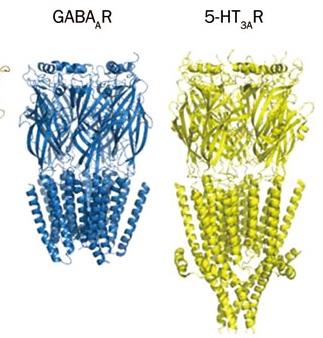
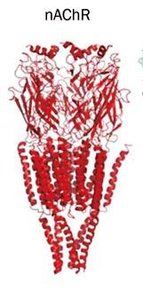
Cys-loop Receptors: Pentameric channels with 4 transmembrane (TM) segments per subunit. Includes nAChRs, 5HT3Rs, GABAARs, GlyRs.
Glutamatergic Receptors: Tetrameric channels with 3 TM segments and a pore-lining segment per subunit. Includes AMPARs, Kainate, NMDARs.
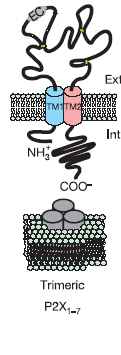
P2X/ASICs: Trimeric channels with 2 TM segments per subunit.
Pharmacology of LGICs
LGICs are major drug targets. Pharmacological agents can act as agonists, antagonists, or allosteric modulators. Endogenous ligands and orthosteric agonists define channel function and naming.
Receptor | Ligand | Other Agonists | Antagonists | Allosteric Modulators |
|---|---|---|---|---|
nAChRs | Acetylcholine | Nicotine, Carbachol | Curare, α-bungarotoxin | Benzodiazepines, Barbiturates |
5-HT3Rs | Serotonin | --- | Setrons | Anesthetics, Ethanol |
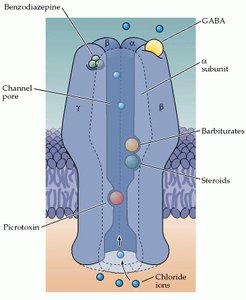
GABAARs | GABA | Muscimol | Bicuculline, Picrotoxin | Benzodiazepines, Barbiturates, Neurosteroids |
GlyRs | Glycine | β-alanine, Taurine | Strychnine | Anesthetics, Ethanol |
Cys-Loop Receptors
Structure and Classification
Cys-loop receptors are named for a conserved extracellular cysteine loop. They are pentameric, with each subunit containing four TM segments. Excitatory cys-loop receptors include nAChRs and 5HT3Rs; inhibitory ones include GABAARs and GlyRs.
Excitatory: nAChRs, 5HT3Rs (cation-conducting)
Inhibitory: GABAARs, GlyRs (anion-conducting)
Endogenous Ligands: Acetylcholine, Serotonin, GABA, Glycine
Functional Roles
Mediate fast excitatory and inhibitory neurotransmission in CNS and PNS
Drug targets for anesthetics, sedatives, and neuroactive compounds
Glutamatergic Ligand-Gated Ion Channels
Types and Structure
Glutamatergic LGICs are the primary excitatory channels in the CNS. They include AMPA, Kainate, and NMDA receptors, all tetrameric with three TM segments and a pore loop per subunit.
AMPA Receptors: Fast kinetics, permeable to Na+, K+, sometimes Ca2+
Kainate Receptors: Fast kinetics, similar ion permeability, regulate neurotransmitter release
NMDA Receptors: Slow kinetics, permeable to Na+, K+, Ca2+; require co-agonist (glycine or D-serine) and exhibit voltage-dependent Mg2+ block
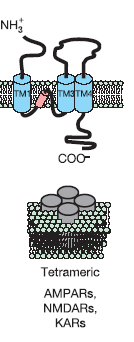
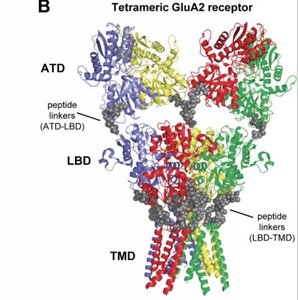
Channel Kinetics and Desensitization
Glutamate receptors desensitize rapidly, especially AMPA and Kainate types. NMDA receptors desensitize more slowly and are critical for synaptic plasticity.
AMPA/Kainate: Rapid desensitization, fast excitatory postsynaptic potentials (EPSPs)
NMDA: Slow desensitization, Ca2+ influx, long-term potentiation (LTP)
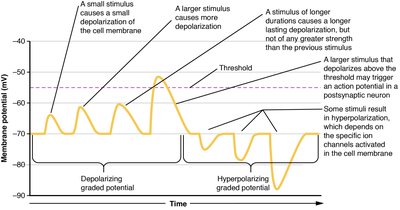
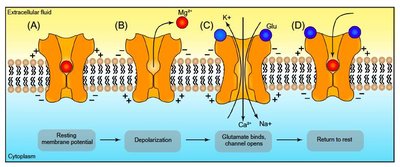
NMDA Receptor Activation and Mg2+ Block
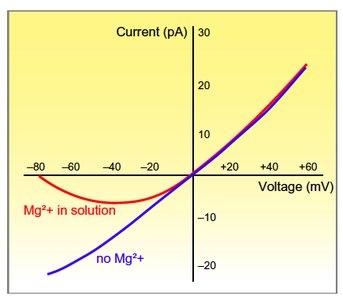
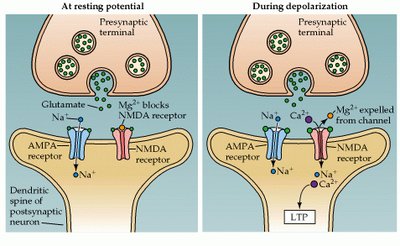
NMDA receptors require both ligand binding (glutamate and glycine/D-serine) and membrane depolarization to relieve Mg2+ block. This makes them detectors of coincident pre- and post-synaptic activity.
Mg2+ Block: At resting potential, Mg2+ blocks the channel; depolarization removes Mg2+, allowing ion flow.
Coincidence Detection: NMDA activation requires both neurotransmitter release and postsynaptic depolarization.
Ca2+ Influx: Supports second messenger signaling and LTP.
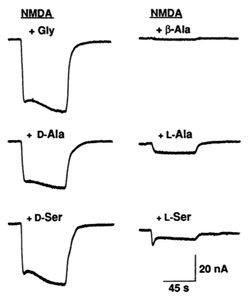
P2X Family and Acid-Sensing Ion Channels (ASICs)
Structure and Function
P2X and ASICs are trimeric, non-selective cation channels. P2X channels are activated by ATP, while ASICs are activated by protons (H+).
P2X: Involved in nociception, taste, vascular tone, platelet aggregation, bladder contraction, macrophage activation, apoptosis
ASICs: Contribute to pain perception, cell death in acidosis, taste sensation
Pharmacology
Receptor | Ligand | Antagonists | Allosteric Modulators |
|---|---|---|---|
P2X | ATP | Suramin, PPADS | pH (+), Zn2+ (+), Ethanol (-) |
ASICs | H+ | Psalmotoxin, Amiloride | NSAIDs (-), many others |
Summary and Key Concepts
LGICs are critical for fast synaptic transmission and are major drug targets.
Cys-loop, glutamatergic, and P2X/ASIC families differ in structure, ligand specificity, and function.
Excitatory/inhibitory effects depend on ion selectivity.
NMDA receptors are unique in requiring both ligand binding and depolarization for activation.
Pharmacological modulation of LGICs underlies many therapeutic and toxic effects.
