 Back
BackLigand-Gated Ion Channels 1
Study Guide - Smart Notes
 Tailored notes based on your materials, expanded with key definitions, examples, and context.
Ligand-Gated Ion Channels (LGICs)
Introduction to Ligand-Gated Ion Channels
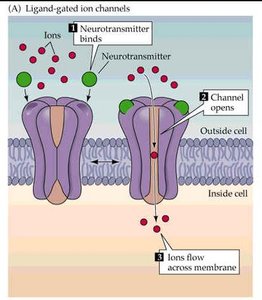
Ligand-gated ion channels (LGICs) are essential membrane proteins that mediate rapid synaptic transmission by converting chemical signals into electrical signals. These channels open in response to the binding of specific ligands, such as neurotransmitters, allowing ions to flow across the cell membrane and alter the membrane potential.
Ligands: Can include neurotransmitters, hormones, proteins, synthetic ligands, and gases.
Mechanism: Ligand binding induces a conformational change, opening the channel and permitting ion flow.
Effect: Ion flow can depolarize (excite) or hyperpolarize (inhibit) the cell, depending on the channel's ion selectivity.
Families and Structure of LGICs
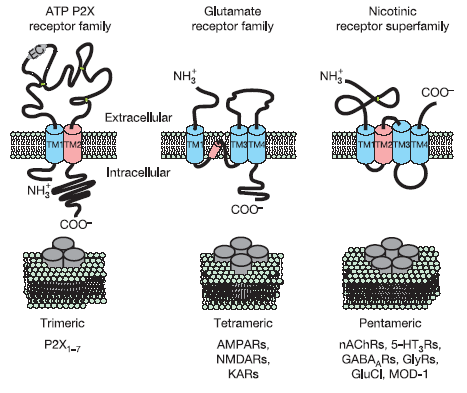
LGICs are classified into three main families based on their structure and subunit composition. Each family has distinct numbers of transmembrane segments and subunits required to form a functional channel.
ATP P2X Receptor Family: Trimeric structure (3 subunits).
Glutamate Receptor Family: Tetrameric structure (4 subunits).
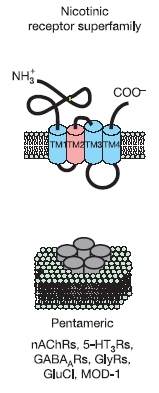
Nicotinic Receptor Superfamily (Cys-loop receptors): Pentameric structure (5 subunits).
All LGICs are multimeric, with 3–5 subunits assembling to form the channel pore.
Ion Selectivity and Function
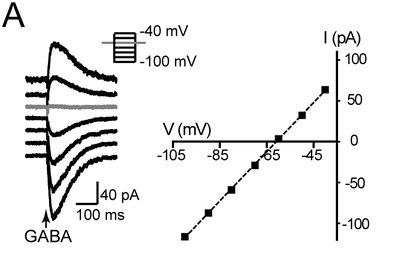
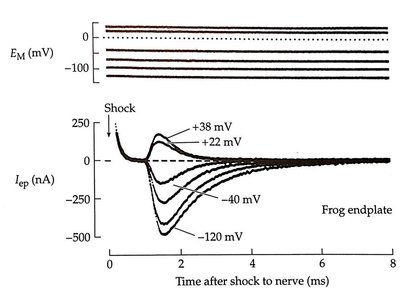
LGICs can be either cation-permeable (excitatory) or anion-permeable (inhibitory). The direction and magnitude of ion flow depend on the reversal (Nernst) potential for the permeant ion and the membrane potential.
Cation Channels: Conduct Na+, K+, and sometimes Ca2+; typically cause depolarization.
Anion Channels: Conduct Cl- (and sometimes HCO3-); typically cause hyperpolarization.
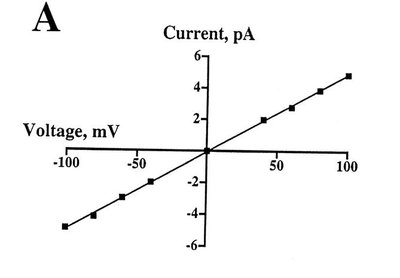
Current-Voltage Relationship: LGICs show a linear I-V relationship, indicating constant conductance and lack of voltage gating.
Physiological Role: Fast Synaptic Transmission
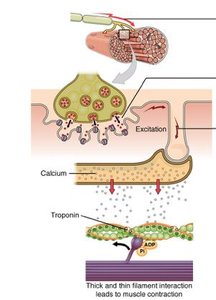
LGICs are critical for fast synaptic transmission, especially at the neuromuscular junction (NMJ) and throughout the central and peripheral nervous systems.
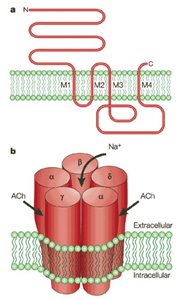
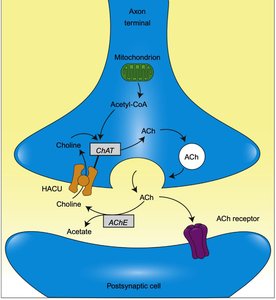
Example: Acetylcholine (ACh) released at the NMJ binds to nicotinic ACh receptors (nAChRs), causing cation influx and muscle cell depolarization.
Excitatory Transmission: Mediated by nAChRs in the PNS and by glutamate receptors in the CNS.
Inhibitory Transmission: Mediated by GABAA receptors in the CNS.
Channel Gating and Kinetics
LGIC channel opening is transient, determined by ligand binding and unbinding, as well as desensitization mechanisms.
Transient Opening: Channels open when ligand binds and close when ligand unbinds or is cleared.
Desensitization: Channels can enter a non-conducting state even while ligand is bound; recovery requires ligand removal.
Example: Glutamate receptors desensitize rapidly, similar to voltage-gated channel inactivation.
Pharmacology of LGICs
LGICs are important drug targets, with various pharmacological agents modulating their activity.
Agonists: Bind to the orthosteric (endogenous ligand) site and open the channel.
Antagonists: Inhibit channel opening; can be competitive (bind orthosteric site) or non-competitive (bind elsewhere).
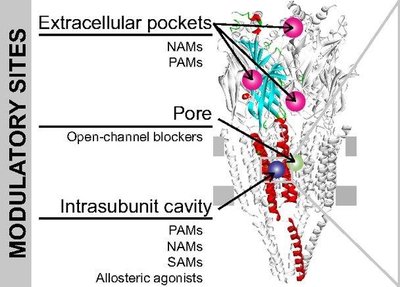
Allosteric Modulators: Bind to non-orthosteric sites and modulate channel activity (PAMs enhance, NAMs inhibit).
Cys-Loop Receptors (Nicotinic Receptor Superfamily)
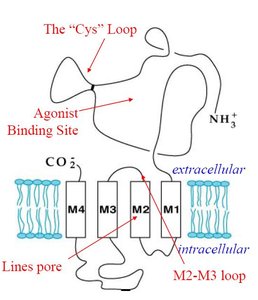
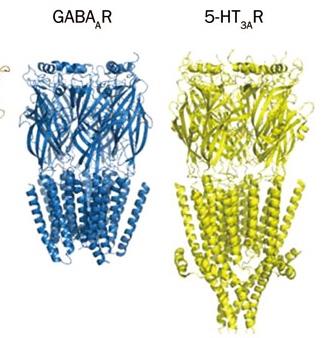
Cys-loop receptors are a major LGIC family, named for a conserved cysteine-cysteine loop in their structure. They include both excitatory and inhibitory channels.
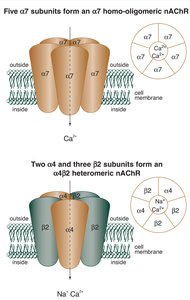
Excitatory: nAChRs, 5-HT3Rs, ZACs (permeable to Na+, K+, sometimes Ca2+).
Inhibitory: GABAARs, GlyRs (permeable to Cl-).
Structure: Pentameric (5 subunits), each with 4 transmembrane segments; M2 lines the pore.
Cys-loop: Disulfide bond in the N-terminal tail, involved in ligand binding.
Nicotinic Acetylcholine Receptors (nAChRs)
nAChRs are prototypical cys-loop receptors, mediating excitatory transmission at the NMJ and throughout the nervous system.
Endogenous Ligand: Acetylcholine (ACh).
Agonists: Nicotine, carbachol, varenicline.
Antagonists: Curare, α-bungarotoxin (competitive); mecamylamine (non-competitive).
Allosteric Modulators: Ivermectin (PAM), others in development.
AChE Inhibitors: Donepezil, galantamine (increase ACh by inhibiting breakdown).
Inhibitory Cys-Loop Receptors: GABAA Receptors
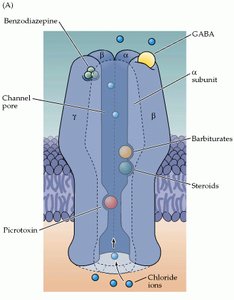
GABAA receptors are the main inhibitory LGICs in the CNS, permeable to Cl- and highly diverse in subunit composition.
Endogenous Ligand: GABA.
Agonists: Muscimol.
Antagonists: Bicuculline, flumazenil (competitive); picrotoxin (non-competitive).
Positive Allosteric Modulators (PAMs): Benzodiazepines (e.g., diazepam), barbiturates, anesthetics, ethanol, neurosteroids.
Function: Mediate fast inhibitory synaptic transmission, modulated by many clinically important drugs.
Summary Table: Cys-Loop Receptor Pharmacology
The following table summarizes the main ligands, agonists, antagonists, and allosteric modulators for major cys-loop receptors:
Receptor | Ligand | Other Agonists | Antagonists | Allosteric Modulators | Other |
|---|---|---|---|---|---|
nAChRs | Acetylcholine | Nicotine, carbachol, varenicline | Curare (comp), α-bungarotoxin (comp), mecamylamine (noncomp) | Benzodiazepines, barbiturates, anesthetics, ethanol, neurosteroids | AChE inhibitors |
5-HT3 | Serotonin | — | “Setrons” (comp) | Anesthetics, ethanol, neurosteroids | SRIs |
GABAA | GABA | Muscimol | Bicuculline (comp), picrotoxin (noncomp) | Benzodiazepines, barbiturates, anesthetics, ethanol, neurosteroids | — |
Gly | Glycine | β-alanine, taurine, L-serine, proline | Strychnine (comp) | Anesthetics, ethanol, neurosteroids | — |
Key Equations
Current through LGICs:
Membrane current equation (including LGICs):
Summary and Review Questions
How are LGICs gated?
Why does the current through the channels depend on membrane voltage?
Why are currents through LGICs transient?
What determines excitatory/inhibitory effects of channel opening?
What is the importance of LGICs?
How can the channels be targeted pharmacologically?
What is the structure of cys-loop receptors?
Which cys-loop receptors are excitatory? Which are inhibitory?
What are the endogenous ligands?
