 Back
BackLipid Transport and Utilization in Biochemistry
Study Guide - Smart Notes
 Tailored notes based on your materials, expanded with key definitions, examples, and context.
Lipid Transport and Utilization
Overview of Lipid Storage and Energy Utilization
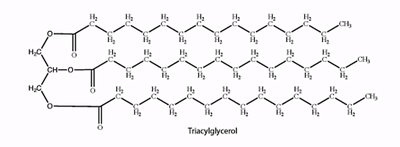
Lipids, primarily in the form of triacylglycerols, are the major energy storage molecules in most organisms. Their highly reduced hydrocarbon chains allow for efficient energy extraction through oxidation. In mammals, lipids can constitute 5% to 25% or more of body weight, with most energy stored as triacylglycerols in adipose tissue. Glycogen stores are limited, and excess carbohydrates are converted to fats for long-term storage.
Triacylglycerols are the main storage form of energy, providing more energy per gram than proteins or carbohydrates.
The brain cannot use fats directly for energy; during starvation, it relies on ketone bodies derived from fatty acids.
On average, 40% of daily human energy comes from dietary triacylglycerols (recommended intake is no more than 30%).
Fuel | Weight (g) | Energy Content (kJ/g) | Total Energy (kJ) |
|---|---|---|---|
Triacylglycerols | ~15,000 | 37 | 555,000 |
Protein | ~6,000 | 17 | 100,000 |
Glycogen | ~400 | 17 | 6,800 |
Glucose | ~20 | 17 | 340 |
Total Fuel Stores | 662,140 | ||
Sources of Triacylglycerols
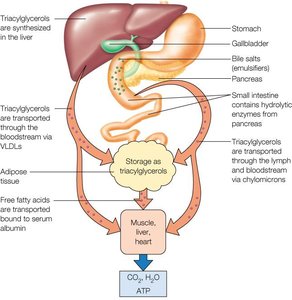
Triacylglycerols in the body originate from three main sources:
Dietary intake (digested in the stomach and intestines)
Synthesis in the liver
Storage in adipocytes (fat cells)
Digestion, Mobilization, and Transport of Fats
Digestion and Absorption of Dietary Fats
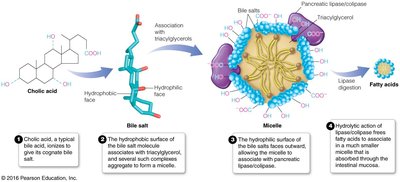
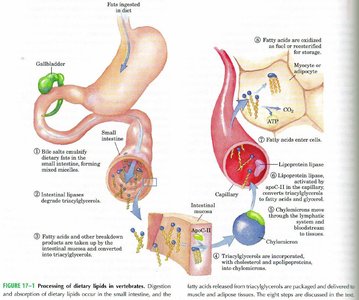
Fats are hydrophobic and require emulsification for digestion and absorption. Bile salts, synthesized in the liver and stored in the gallbladder, act as amphipathic detergents to solubilize dietary fats into micelles. Pancreatic lipase/colipase then hydrolyzes triacylglycerols into fatty acids and monoacylglycerols, which are absorbed by the intestinal mucosa.
Bile salts have hydrophobic and hydrophilic faces, allowing them to form micelles with lipids.
Pancreatic lipase breaks down triacylglycerols into absorbable units.
Absorbed fatty acids are re-esterified into triacylglycerols and packaged into chylomicrons for transport.
Transport of Lipids in the Blood
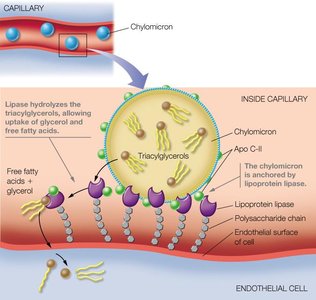
Because fatty acids are not water-soluble, they are transported in the blood as components of lipoprotein particles or bound to serum albumin. Chylomicrons, formed in the intestines, transport dietary triacylglycerols through the lymph and bloodstream. Lipoprotein lipase on capillary surfaces hydrolyzes triacylglycerols in chylomicrons, releasing fatty acids for uptake by tissues.
Chylomicrons transport dietary fats; remnants are taken up by the liver.
Very Low Density Lipoproteins (VLDL) transport endogenous triacylglycerols from the liver.
Fatty acids released from adipocytes are transported bound to serum albumin.
Lipoproteins and Cholesterol Transport
Types and Functions of Lipoproteins
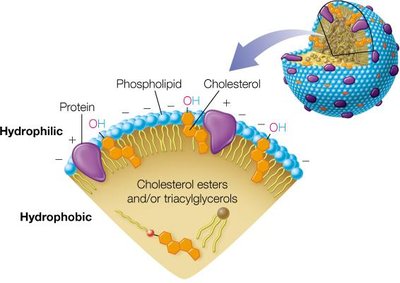
Lipoproteins are complexes of lipids and proteins that transport hydrophobic molecules in the aqueous environment of blood. They are classified by density:
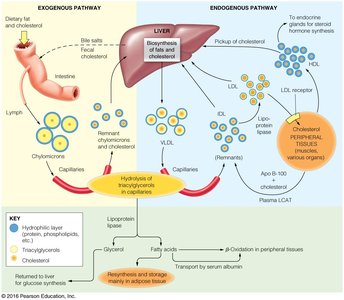
Chylomicrons: Transport dietary triacylglycerols and cholesterol from the intestines.
VLDL (Very Low Density Lipoprotein): Transports triacylglycerols from the liver to tissues.
IDL (Intermediate Density Lipoprotein): Transitional form between VLDL and LDL.
LDL (Low Density Lipoprotein): Delivers cholesterol to peripheral tissues; high levels are associated with atherosclerosis.
HDL (High Density Lipoprotein): Collects cholesterol from tissues and returns it to the liver ("good cholesterol").
LDL, HDL, and Atherosclerosis
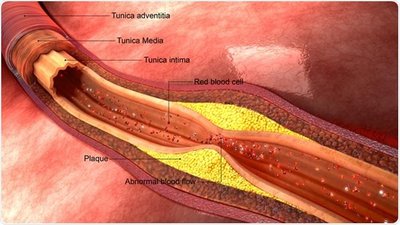
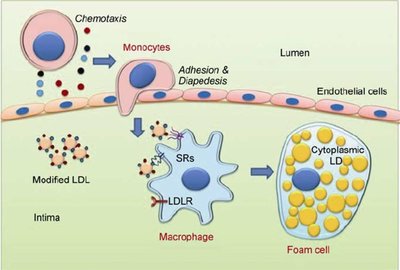
LDL particles can undergo oxidative modification, leading to their accumulation in blood vessel walls. These modified LDL particles are taken up by macrophages, forming foam cells and contributing to the development of atherosclerotic plaques, which can restrict blood flow and lead to cardiovascular disease.
Oxidized LDL is recognized by monocytes, which differentiate into macrophages and ingest the LDL, forming foam cells.
Accumulation of foam cells leads to plaque formation in arteries.
LDL Uptake and Cellular Cholesterol Regulation
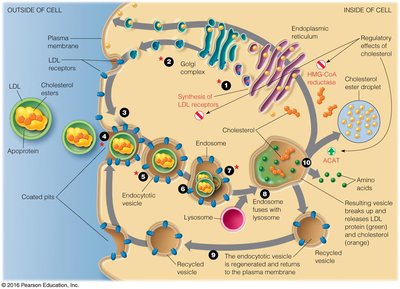
LDL particles are internalized by cells through receptor-mediated endocytosis. The apoprotein B-100 on LDL is recognized by the LDL receptor, leading to uptake and delivery of cholesterol for membrane synthesis or storage. The number of LDL receptors on the cell surface regulates cholesterol uptake.
Receptor-mediated endocytosis ensures efficient cholesterol delivery to cells.
Cholesterol can be stored as cholesterol esters or used for membrane synthesis.
LDL receptor synthesis is regulated by cellular cholesterol levels.
Mobilization of Triacylglycerols from Adipose Tissue
Hormonal Regulation of Lipolysis
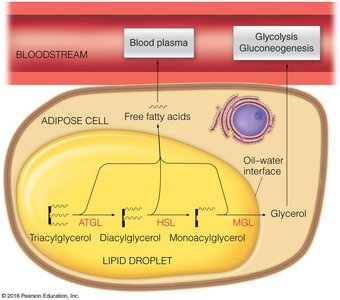
When blood glucose is low, the hormone glucagon is released, stimulating the breakdown of triacylglycerols in adipocytes. This process involves the activation of protein kinase A (PKA), which phosphorylates and activates lipases such as adipose triacylglyceride lipase (ATGL), hormone-sensitive lipase (HSL), and monoacylglycerol lipase (MGL). The resulting free fatty acids are released into the bloodstream, bound to serum albumin, and transported to tissues for oxidation and ATP production.
Glucagon triggers cAMP production, activating PKA and lipolysis.
ATGL, HSL, and MGL sequentially hydrolyze triacylglycerols to free fatty acids and glycerol.
Free fatty acids are transported to tissues for energy production.
Summary Table: Key Lipid Transport Pathways
Pathway | Main Lipoprotein | Function |
|---|---|---|
Exogenous | Chylomicron | Transports dietary fats from intestine to tissues |
Endogenous | VLDL, LDL | Transports fats synthesized in liver to tissues |
Reverse Cholesterol Transport | HDL | Returns cholesterol from tissues to liver |
Additional info: Lipid metabolism is tightly regulated by hormonal signals (insulin, glucagon, epinephrine) and is essential for maintaining energy homeostasis, membrane synthesis, and signaling functions in cells.
