 Back
BackLipids: Structure, Biosynthesis, and Oxidation
Study Guide - Smart Notes
 Tailored notes based on your materials, expanded with key definitions, examples, and context.
Lipids: Structure and Biological Functions
Definition and Classification
Lipids are a chemically diverse group of hydrophobic or amphipathic molecules that are insoluble in water but soluble in organic solvents. They serve a variety of essential biological functions:
Energy Storage: Fats and oils store metabolic energy efficiently due to their high caloric content.
Structural Components: Phospholipids and sterols are major constituents of biological membranes, providing structural integrity and fluidity.
Other Functions: Lipids also act as enzyme cofactors, electron carriers, light-absorbing pigments, hydrophobic anchors for proteins, chaperones for membrane protein folding, emulsifying agents, hormones, and intracellular messengers.
Fatty Acids: Structure and Nomenclature
Fatty acids are carboxylic acids with hydrocarbon chains typically ranging from 4 to 36 carbons (C4–C36). They may be saturated (no double bonds) or unsaturated (one or more double bonds). Some fatty acids contain additional functional groups such as hydroxyl or methyl branches.
Nomenclature: Fatty acids are denoted by the number of carbons and double bonds, e.g., palmitic acid (16:0), oleic acid (18:1).
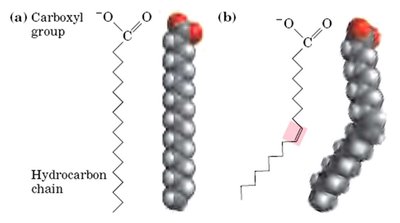
Fatty Acid Biosynthesis
Overview and Energetics
Fatty acid biosynthesis is an endergonic and reductive process, requiring ATP for energy and NADPH as a reducing agent. The pathway is distinct from fatty acid degradation, involving different enzymes and cellular compartments.
Key Intermediate: Malonyl-CoA, a three-carbon compound, is the essential building block for fatty acid synthesis.
Compartmentalization: Synthesis occurs in the cytosol, while degradation (β-oxidation) occurs in the mitochondrial matrix.
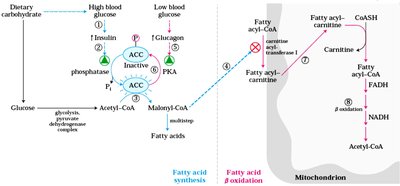
Formation of Malonyl-CoA
Malonyl-CoA is synthesized from acetyl-CoA by the enzyme acetyl-CoA carboxylase (ACC) in an irreversible, ATP-dependent reaction. This is the committed step in fatty acid biosynthesis.
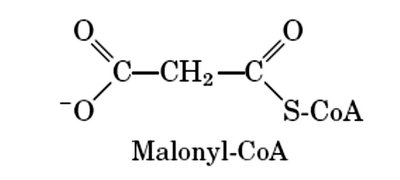
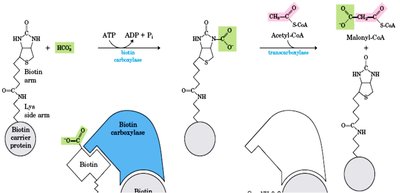
Fatty Acid Synthase Complex and Chain Elongation
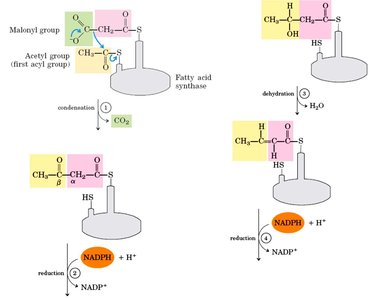
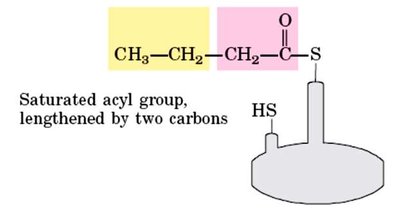
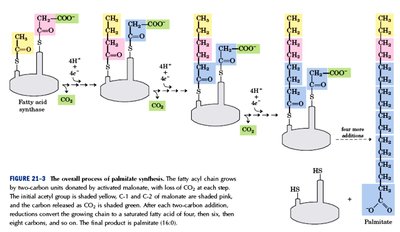
The fatty acid synthase complex catalyzes the sequential addition of two-carbon units from malonyl-CoA to a growing acyl chain, with each cycle involving condensation, reduction, dehydration, and a second reduction step. NADPH provides the reducing power.
Condensation: Acetyl group (starter) and malonyl group (extender) are joined, releasing CO2.
Reduction: The β-keto group is reduced to a hydroxyl group.
Dehydration: Water is removed, creating a double bond.
Second Reduction: The double bond is reduced, forming a saturated acyl group extended by two carbons.
Shuttle Mechanism for Acetyl-CoA
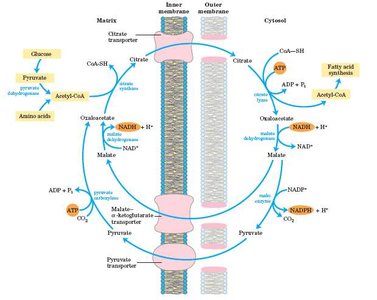
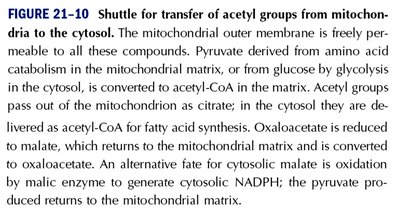
Acetyl-CoA required for fatty acid synthesis is generated in the mitochondrial matrix but must be transported to the cytosol. This is achieved via the citrate shuttle, which also provides NADPH for biosynthesis.
Fatty Acid Oxidation (β-Oxidation)
Overview and Stages
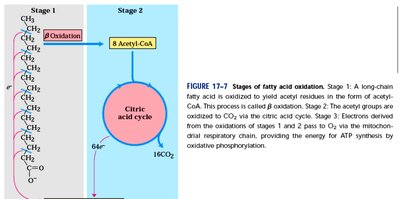
Fatty acid oxidation is a catabolic process that occurs in the mitochondrial matrix, converting fatty acids into acetyl-CoA, NADH, and FADH2. The process consists of three main stages:
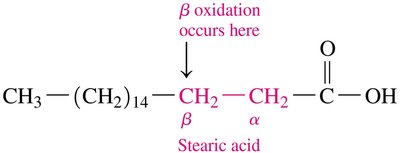
β-Oxidation: Sequential removal of two-carbon units as acetyl-CoA.
Citric Acid Cycle: Oxidation of acetyl-CoA to CO2.
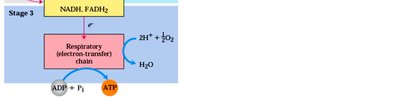
Electron Transport Chain: NADH and FADH2 donate electrons for ATP synthesis.
Activation and Transport of Fatty Acids
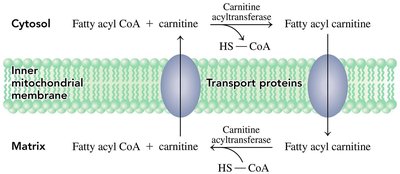
Fatty acids are activated in the cytosol by conversion to fatty acyl-CoA, a process requiring ATP. The activated fatty acyl-CoA is then transported into the mitochondrial matrix via the carnitine shuttle system.
Activation: Fatty acid + CoA + ATP → Fatty acyl-CoA + AMP + 2Pi
Carnitine Shuttle: Fatty acyl group is transferred to carnitine for transport across the inner mitochondrial membrane, then transferred back to CoA in the matrix.

β-Oxidation Cycle: Four Key Reactions
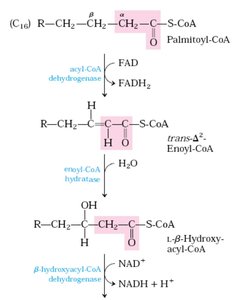
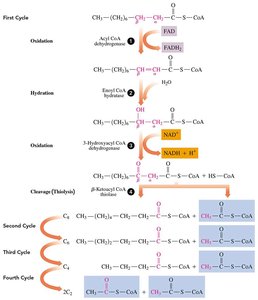
Each cycle of β-oxidation shortens the fatty acyl-CoA by two carbons, producing one acetyl-CoA, one NADH, and one FADH2. The four steps are:
Oxidation 1: Acyl-CoA dehydrogenase forms a trans double bond between α and β carbons, producing FADH2.
Hydration: Enoyl-CoA hydratase adds water across the double bond, forming a hydroxyl group on the β carbon.
Oxidation 2: 3-Hydroxyacyl-CoA dehydrogenase oxidizes the hydroxyl group to a keto group, producing NADH.
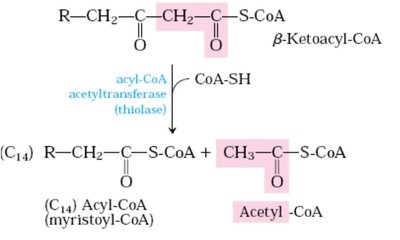
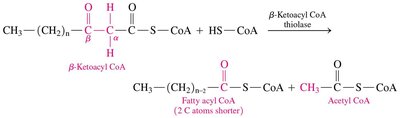
Thiolysis: β-Ketoacyl-CoA thiolase cleaves the bond, releasing acetyl-CoA and a shortened fatty acyl-CoA.



Energy Yield and Cycle Repeats
The number of β-oxidation cycles is one less than the number of acetyl-CoA units produced. For example, palmitic acid (C16) yields 8 acetyl-CoA and undergoes 7 cycles of β-oxidation.
Odd-Numbered Fatty Acids: Final cycle yields one propionyl-CoA (C3) and one acetyl-CoA.
Oxidation of Unsaturated Fatty Acids
Unsaturated fatty acids require additional enzymes (isomerases and reductases) to convert cis double bonds to trans, allowing entry into the β-oxidation pathway. These modifications result in slightly less energy yield due to bypassing FADH2 production in some cycles.
Summary Table: β-Oxidation Steps and Products
Step | Enzyme | Reaction | Product |
|---|---|---|---|
1. Oxidation | Acyl-CoA dehydrogenase | Formation of trans double bond | FADH2 |
2. Hydration | Enoyl-CoA hydratase | Addition of H2O | 3-Hydroxyacyl-CoA |
3. Oxidation | 3-Hydroxyacyl-CoA dehydrogenase | Oxidation of hydroxyl to keto | NADH |
4. Thiolysis | β-Ketoacyl-CoA thiolase | Cleavage by CoA | Acetyl-CoA + shortened acyl-CoA |
Example Calculation
Palmitic Acid (C16): Complete β-oxidation yields 8 acetyl-CoA (16/2), requiring 7 cycles (16/2 – 1 = 7).
Additional info: The above notes integrate textbook-level explanations, relevant equations, and visual aids to provide a comprehensive overview of lipid structure, biosynthesis, and oxidation, suitable for undergraduate biochemistry students.
