 Back
BackLysozyme Catalysis and Enzyme Mechanisms Study Guide
Study Guide - Smart Notes
 Tailored notes based on your materials, expanded with key definitions, examples, and context.
Q1. Where does lysozyme cleave a 6-sugar substrate of repeating NAM and NAG units?
Background
Topic: Enzyme specificity and substrate recognition
This question tests your understanding of lysozyme's substrate specificity and the exact bond it cleaves in a peptidoglycan chain composed of alternating N-acetylglucosamine (NAG) and N-acetylmuramic acid (NAM) units.
Key Terms:
NAG: N-acetylglucosamine
NAM: N-acetylmuramic acid
Lysozyme: An enzyme that hydrolyzes the β(1→4) glycosidic bond between NAM and NAG in bacterial cell walls.
Step-by-Step Guidance
Identify the repeating units in the substrate: NAG(A)-NAM(B)-NAG(C)-NAM(D)-NAG(E)-NAM(F).
Recall that lysozyme cleaves the β(1→4) glycosidic bond between NAM and NAG.
Determine which bond in the sequence corresponds to the typical cleavage site for lysozyme.
Mark the bond between the appropriate units (do not mark yet; think about which bond is between NAM and NAG).
Try solving on your own before revealing the answer!
Final Answer:
Lysozyme cleaves the bond between NAM(D) and NAG(E), so you should draw an "X" through the bond between these units.
This is the β(1→4) glycosidic bond targeted by lysozyme in peptidoglycan.
Q2. Briefly describe the Phillips Model for lysozyme catalysis of peptidoglycan cleavage.
Background
Topic: Enzyme mechanism and catalysis
This question is about the Phillips Model, which explains how lysozyme catalyzes the hydrolysis of the glycosidic bond in its substrate. Understanding this model is important for grasping enzyme-substrate interactions and catalytic strategies.
Key Terms:
Phillips Model: A mechanistic model describing how lysozyme distorts its substrate and facilitates bond cleavage.
Substrate distortion: The enzyme forces the substrate into a strained conformation, making the bond more susceptible to hydrolysis.
General acid/base catalysis: Lysozyme uses amino acid residues to donate/accept protons during the reaction.
Step-by-Step Guidance
Recall that the Phillips Model involves lysozyme binding to the substrate and distorting the sugar ring at the cleavage site.
Identify the key amino acid residues involved in catalysis (e.g., Glu35 and Asp52).
Understand how substrate distortion lowers the activation energy for bond cleavage.
Consider how lysozyme uses acid/base catalysis to facilitate hydrolysis of the glycosidic bond.
Summarize the sequence of events in the Phillips Model without giving the full description yet.
Try solving on your own before revealing the answer!
Final Answer:
The Phillips Model proposes that lysozyme distorts the substrate, positioning the bond for cleavage. Glu35 acts as an acid, donating a proton, while Asp52 stabilizes the transition state, facilitating hydrolysis of the glycosidic bond.
This model explains how lysozyme lowers the activation energy and increases reaction rate.
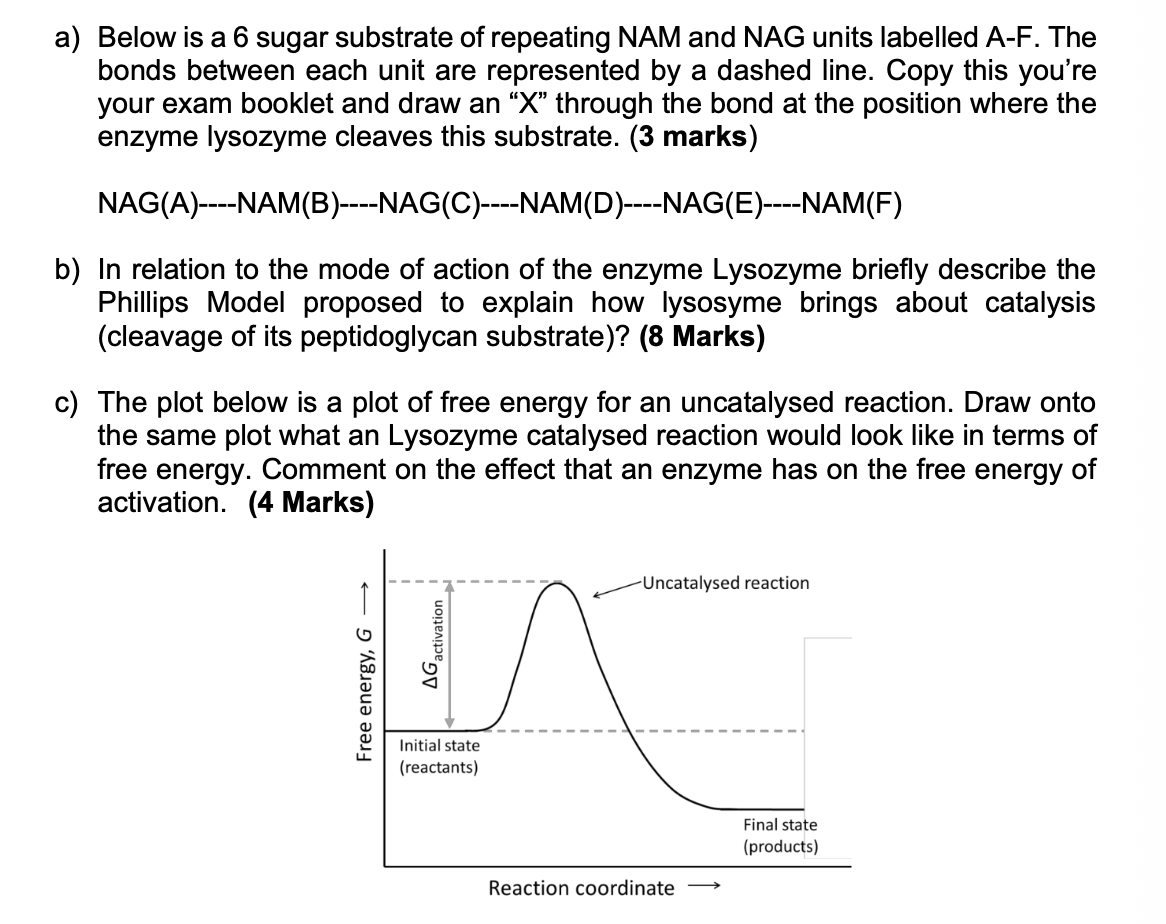
Q3. Draw and explain the effect of lysozyme catalysis on the free energy plot compared to an uncatalysed reaction.
Background
Topic: Enzyme kinetics and thermodynamics
This question tests your understanding of how enzymes affect the activation energy of a reaction, as visualized in a free energy diagram.
Key Terms and Formulas:
Activation energy (): The energy barrier that must be overcome for a reaction to proceed.
Free energy (): The energy available to do work in a system.
Enzyme-catalysed reaction: A reaction where the enzyme lowers the activation energy but does not change the overall free energy difference between reactants and products.
Step-by-Step Guidance
Examine the provided plot showing the free energy profile for an uncatalysed reaction.
Recall that an enzyme lowers the activation energy () but does not affect the initial or final free energy () of reactants or products.
Draw a second curve on the plot with a lower peak, representing the catalysed reaction.
Comment on how the enzyme affects the activation energy and the rate of reaction, but not the overall free energy change ().
Try solving on your own before revealing the answer!
Final Answer:
The catalysed reaction curve has a lower activation energy peak. Lysozyme lowers , making the reaction faster, but the free energy difference between reactants and products remains unchanged.
Enzymes speed up reactions by lowering the energy barrier, not by changing the overall energy released or consumed.
