 Back
BackNoncovalent Interactions and Hydrogen Bonding in Biochemistry
Study Guide - Smart Notes
 Tailored notes based on your materials, expanded with key definitions, examples, and context.
Noncovalent Interactions in Biomolecules
Overview of Noncovalent Interactions
Noncovalent interactions are essential for the structure, stability, and function of biomolecules. These interactions are generally weaker than covalent bonds but are crucial for dynamic biological processes such as protein folding, enzyme-substrate binding, and nucleic acid base pairing.
Charge–charge interactions (ionic bonds): Electrostatic attractions between oppositely charged groups.
Hydrogen bonds: Attractive interactions between a hydrogen atom covalently bonded to an electronegative atom (donor) and another electronegative atom (acceptor).
van der Waals interactions: Weak attractions due to transient dipoles in molecules.
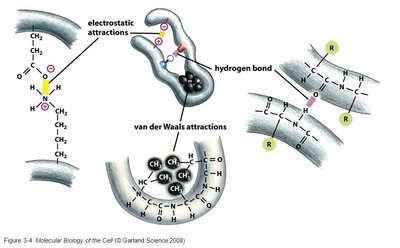
Relative Strengths of Noncovalent Interactions
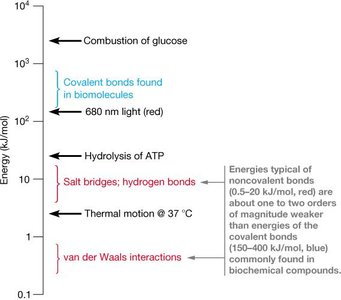
The strength of noncovalent interactions varies, influencing their biological roles. Charge–charge interactions are typically the strongest, followed by hydrogen bonds, with van der Waals interactions being the weakest.
Type of Interaction | Approximate Energy (kJ/mol) |
|---|---|
Charge–charge | 13 to 17 |
Hydrogen bond | 2 to 21 |
van der Waals | 0.4 to 0.8 |
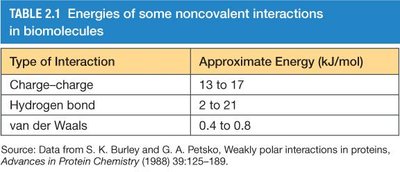
Example: Salt bridges in proteins are stabilized by charge–charge interactions, while the double helix of DNA is stabilized by hydrogen bonds between bases and van der Waals interactions between stacked bases.
Types and Models of Noncovalent Interactions
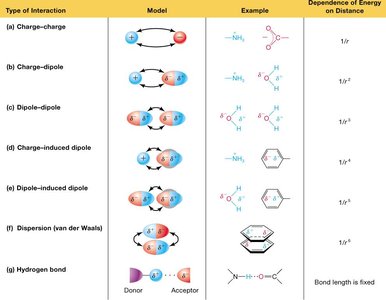
Noncovalent interactions can be classified based on the nature of the interacting species and their dependence on distance.
Type of Interaction | Model | Example | Dependence of Energy on Distance |
|---|---|---|---|
Charge–charge | Ion–ion | Na+ and Cl– | 1/r |
Charge–dipole | Ion–dipole | NH3 and H2O | 1/r2 |
Dipole–dipole | Dipole–dipole | H2O and H2O | 1/r3 |
Charge–induced dipole | Ion–induced dipole | NH3 and benzene | 1/r4 |
Dipole–induced dipole | Dipole–induced dipole | H2O and benzene | 1/r5 |
Dispersion (van der Waals) | London dispersion | Benzene stacking | 1/r6 |
Hydrogen bond | Donor–acceptor | O–H···O | Bond length is fixed |
Hydrogen Bonding in Biomolecules
Nature and Importance of Hydrogen Bonds
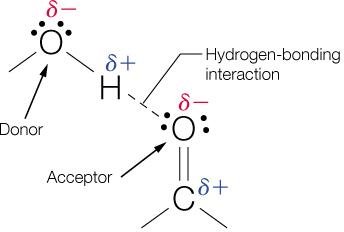
Hydrogen bonds are directional interactions that play a critical role in stabilizing the structures of proteins and nucleic acids. They are formed when a hydrogen atom covalently bonded to an electronegative atom (such as O or N) interacts with another electronegative atom.
Donor: The group supplying the hydrogen atom (e.g., –OH or –NH).
Acceptor: The electronegative atom with a lone pair (e.g., O or N).
Hydrogen Bonds in DNA Base Pairing
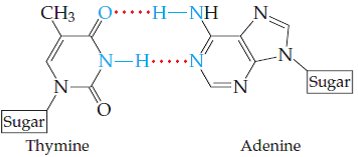
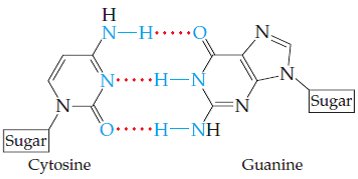
Hydrogen bonds are responsible for the specificity of base pairing in DNA. Adenine pairs with thymine via two hydrogen bonds, while guanine pairs with cytosine via three hydrogen bonds, contributing to the stability of the DNA double helix.
A–T pair: Two hydrogen bonds
G–C pair: Three hydrogen bonds
Hydrogen Bonds in Protein Structure
Hydrogen bonds stabilize secondary structures such as alpha helices and beta sheets in proteins. The precise geometry and strength of these bonds are crucial for maintaining protein conformation and function.
Alpha helix: Stabilized by hydrogen bonds between backbone amide and carbonyl groups.
Beta sheet: Stabilized by hydrogen bonds between adjacent polypeptide chains.
Biological Significance of Noncovalent Interactions
Role in Molecular Recognition and Signal Transduction
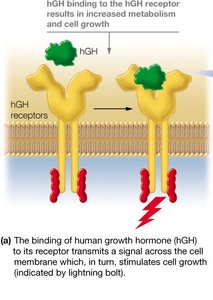
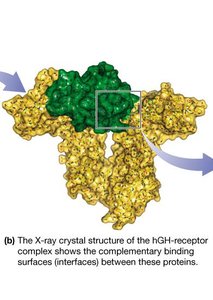
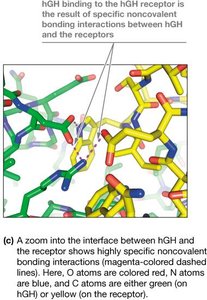
Noncovalent interactions are fundamental to molecular recognition processes, such as hormone-receptor binding and enzyme-substrate specificity. These interactions allow for reversible and highly specific binding events necessary for cellular signaling and regulation.
Example: Human growth hormone (hGH) binds to its receptor via specific noncovalent interactions, triggering a signaling cascade that promotes cell growth.
Energetics of Noncovalent Interactions
The energies of noncovalent interactions are typically much lower than those of covalent bonds, allowing for the dynamic assembly and disassembly of biomolecular complexes. This property is essential for processes such as enzyme catalysis, DNA replication, and cellular signaling.
Summary Table: Major Noncovalent Interactions in Biochemistry
Interaction Type | Biological Example | Relative Strength |
|---|---|---|
Charge–charge | Salt bridges in proteins | Strongest |
Hydrogen bond | DNA base pairing, protein secondary structure | Intermediate |
van der Waals | Base stacking in DNA, protein folding | Weakest |
Additional info: The specificity and reversibility of noncovalent interactions are critical for the regulation of biological processes, enabling complex molecular recognition and signaling networks in living systems.
