 Back
BackPhotosynthesis: Structure, Mechanism, and Types
Study Guide - Smart Notes
 Tailored notes based on your materials, expanded with key definitions, examples, and context.
Photosynthesis
Overview of Photosynthesis
Photosynthesis is a fundamental biological process performed by plants, algae, and some bacteria, converting light energy into chemical energy stored in glucose. This process is essential for life on Earth, as it provides energy and organic molecules for most organisms.
Definition: Photosynthesis is the process by which organisms use sunlight to synthesize nutrients from carbon dioxide and water.
General Equation:
Location: Occurs in the chloroplasts of plant cells.
Key Structures: Chloroplasts contain thylakoid membranes where light reactions occur.
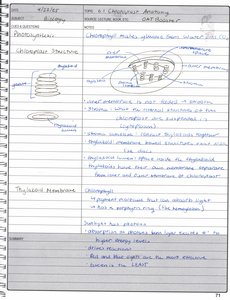
Chloroplast Structure
Organization and Function
Chloroplasts are specialized organelles in plant cells responsible for photosynthesis. Their internal structure is optimized for capturing light and facilitating the biochemical reactions of photosynthesis.
Thylakoid Membranes: Flattened sacs where light-dependent reactions take place.
Stroma: Fluid surrounding thylakoids, site of the Calvin cycle (light-independent reactions).
Grana: Stacks of thylakoids that increase surface area for light absorption.
Light-Dependent Reactions
Mechanism and Components
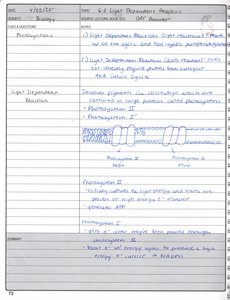
Light-dependent reactions occur in the thylakoid membranes and require sunlight. They produce ATP and NADPH, which are used in the Calvin cycle.
Photosystems: Complexes of proteins and pigments (chlorophyll) that absorb light energy.
Electron Transport Chain: Transfers electrons, generating ATP and NADPH.
Key Products: Oxygen (O2), ATP, NADPH.
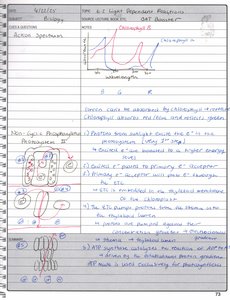
Action Spectrum and Light Absorption
Absorption of Light by Chlorophyll
The action spectrum shows the effectiveness of different wavelengths of light in driving photosynthesis. Chlorophyll absorbs light most efficiently in the blue and red regions.
Chlorophyll a and b: Main pigments involved in light absorption.
Accessory Pigments: Carotenoids broaden the spectrum of light absorbed.
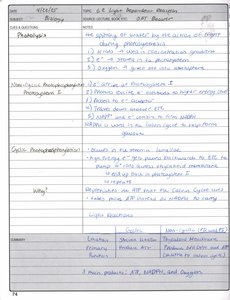
Non-Cyclic and Cyclic Photophosphorylation
ATP and NADPH Production
Photophosphorylation refers to the synthesis of ATP using the energy from light.
Non-Cyclic Photophosphorylation: Involves both Photosystem II and Photosystem I, produces ATP, NADPH, and O2.
Cyclic Photophosphorylation: Involves only Photosystem I, produces ATP but not NADPH or O2.
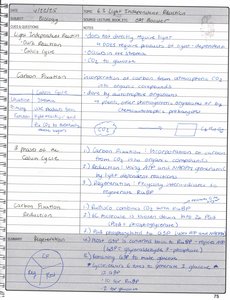
Light-Independent Reactions (Calvin Cycle)
Carbon Fixation and Reduction
The Calvin cycle occurs in the stroma and uses ATP and NADPH to fix carbon dioxide into glucose.
Carbon Fixation: CO2 is incorporated into organic molecules.
Reduction: ATP and NADPH reduce 3-phosphoglycerate to glyceraldehyde-3-phosphate (G3P).
Regeneration: RuBP is regenerated to continue the cycle.
Types of Photosynthesis
C3, C4, and CAM Pathways
Plants have evolved different mechanisms to optimize photosynthesis under various environmental conditions.
C3 Photosynthesis: Most common, uses Calvin cycle directly.
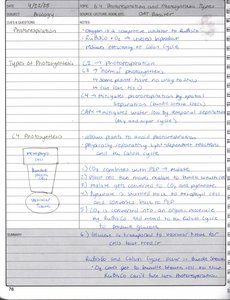
C4 Photosynthesis: Adapted to high light and temperature, separates initial CO2 fixation and Calvin cycle in different cell types.
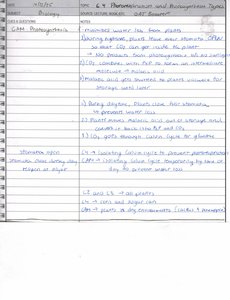
CAM Photosynthesis: Adapted to arid environments, fixes CO2 at night and uses it during the day.
Comparison of Photosynthetic Pathways
Key Differences
Pathway | CO2 Fixation | Adaptation |
|---|---|---|
C3 | Directly in Calvin cycle | Temperate climates |
C4 | Spatial separation (mesophyll and bundle sheath cells) | High light, high temperature |
CAM | Temporal separation (night and day) | Arid environments |
Example: Corn is a C4 plant, while cacti are CAM plants.
Summary
Photosynthesis is a complex, multi-step process essential for life. Understanding its mechanisms, structures, and adaptations is crucial for biochemistry and biology students. Key products: Glucose, ATP, NADPH, and oxygen. Key structures: Chloroplasts, thylakoid membranes, photosystems. Key pathways: C3, C4, and CAM photosynthesis.
