 Back
Recombinant DNA Technology: Study Notes for Biochemistry
Study Guide - Smart Notes
 Tailored notes based on your materials, expanded with key definitions, examples, and context.
Recombinant DNA Technology
Introduction to Recombinant DNA Technology
Recombinant DNA technology enables the manipulation and expression of genes in host organisms, allowing for the production of proteins, study of gene function, and development of biotechnological applications. The process begins with identifying the gene of interest, often using protein sequence data, and proceeds through cloning, expression, and purification.
Central Dogma: Information flows from DNA to RNA to protein.
Gene Identification: Protein sequence is used to search genomic databases for the corresponding gene.
Prokaryotic vs. Eukaryotic Genes: Prokaryotic genes are easier to clone due to the absence of introns.
Applications: Production of recombinant proteins (e.g., insulin), gene tagging, and functional studies.
Example: Recombinant human insulin production in E. coli, which does not require glycosylation.
Plasmids and Vectors
Structure and Function of Expression Plasmids
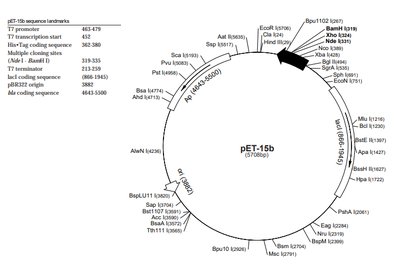
Plasmids are circular DNA molecules used as vectors to carry and express genes in host cells. Expression plasmids contain several functional elements essential for gene expression and selection.
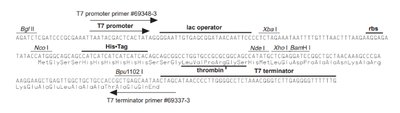
Promoter: Drives transcription of the inserted gene (e.g., T7 promoter).
Ribosome Binding Site (rbs): Initiates translation.
Affinity Tag: Facilitates protein purification (e.g., His-tag).
Protease Site: Allows tag removal (e.g., thrombin site).
Multiple Cloning Site (MCS): Contains restriction sites for gene insertion.
LacI Coding Sequence: Encodes the Lac repressor for regulated expression.
Origin of Replication: Ensures plasmid replication in host cells.
Antibiotic Resistance Marker: Enables selection of transformed cells (e.g., bla gene for β-lactamase).
Example: The pET-15b vector contains all these elements for efficient gene expression and selection.
Restriction Endonucleases and Cloning
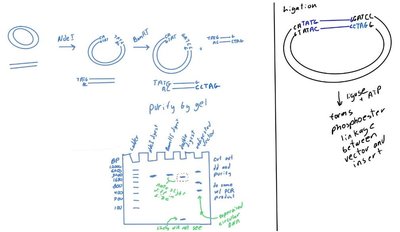
Restriction enzymes recognize specific palindromic DNA sequences and cleave both strands, generating overhangs (sticky ends) for ligation. The number and type of overhangs depend on the enzyme used.
Palindromic Recognition Sites: Sequences read the same 5'→3' on both strands.
Example: NdeI (CATATG) leaves a 2-base 5' overhang; BamHI (GGATCC) leaves a 4-base 5' overhang.
Cloning Steps: PCR amplification with restriction-site-bearing primers, double digestion, gel purification, and ligation.
Regulation of Gene Expression: Lac Operon System
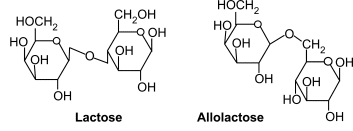
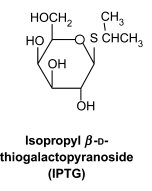
The lac operon system allows controlled expression of recombinant genes. LacI represses transcription until an inducer (allolactose or IPTG) binds, causing dissociation and enabling transcription.
LacI: Repressor protein that binds the operator and blocks transcription.
Inducers: Allolactose (natural) and IPTG (synthetic, non-metabolizable).
IPTG: Used in laboratory settings for reliable induction.
Antibiotic Resistance and Selection
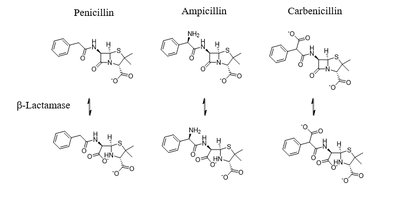
Antibiotic resistance markers (e.g., bla gene encoding β-lactamase) allow selection of transformed cells. β-lactamase hydrolyzes the β-lactam ring in antibiotics, conferring resistance.
β-Lactam Antibiotics: Penicillin, ampicillin, carbenicillin.
β-Lactamase: Enzyme that hydrolyzes the β-lactam ring, inactivating the antibiotic.
Selection: Only cells with the plasmid survive on antibiotic-containing media.
Polymerase Chain Reaction (PCR)
Principles and Steps of PCR
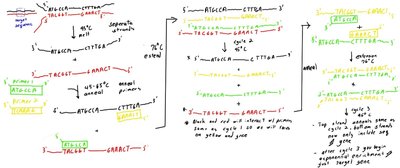
PCR is a technique for amplifying DNA sequences using cycles of denaturation, annealing, and extension. It requires a thermostable DNA polymerase (e.g., Taq polymerase) to withstand high temperatures.
Components: DNA template, primers, dNTPs, DNA polymerase, Mg²⁺ buffer.
Steps: Denaturation (~95°C), annealing (45-65°C), extension (72°C).
Thermostable Polymerase: Taq polymerase is used for its stability at high temperatures.
Equation:
Preparation of cDNA Libraries
cDNA Library Construction for Eukaryotic Genes
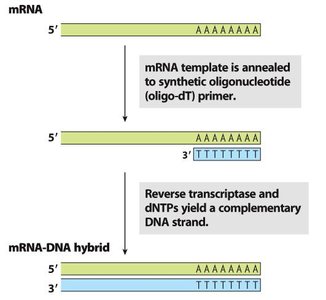
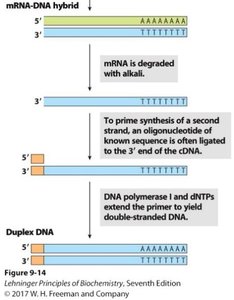
cDNA libraries are prepared from eukaryotic mRNA to enable expression in prokaryotic hosts, bypassing introns. Reverse transcriptase synthesizes complementary DNA from mRNA templates.
Poly-A Tail: Allows annealing of oligo-dT primers.
Reverse Transcriptase: Synthesizes cDNA from mRNA.
Double-Stranded cDNA: Created by DNA polymerase after mRNA degradation.
Generation of Fusion Proteins
Fusion and Chimeric Proteins
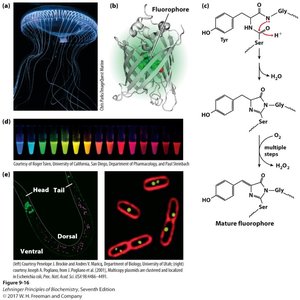
Fusion proteins are engineered by combining tags or functional domains with target proteins. GFP is a widely used fluorescent tag, enabling visualization and tracking of proteins in cells.
Affinity Tags: Facilitate purification (e.g., His-tag, GST).
Fluorescent Proteins: GFP and its variants allow cellular imaging.
GFP Chemistry: Fluorophore formation involves Ser65-Tyr66-Gly67 sequence, ring formation, dehydration, and oxidation.
DNA Sequencing
Sanger Sequencing and Next-Generation Methods
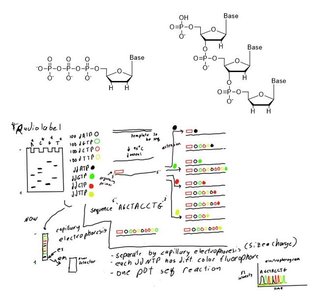
Sanger sequencing uses chain-terminating dideoxynucleotides (ddNTPs) to generate DNA fragments of varying lengths, which are separated and detected by capillary electrophoresis. Next-generation sequencing platforms allow high-throughput analysis of complex genomes.
Components: DNA template, primer, dNTPs, ddNTPs, DNA polymerase.
Chain Termination: ddNTPs lack a 3'-OH group, preventing further extension.
Detection: Fluorescent labels enable automated sequence reading.
Applications: Mutation detection, genome sequencing, pathogen identification.
Equation:
Summary Table: Functional Elements of Expression Plasmids
Element | Function |
|---|---|
Promoter | Initiates transcription |
Ribosome Binding Site | Initiates translation |
Affinity Tag | Protein purification |
Protease Site | Tag removal |
Multiple Cloning Site | Gene insertion |
LacI Coding Sequence | Regulates expression |
Origin of Replication | Plasmid replication |
Antibiotic Resistance Marker | Selection of transformed cells |
Key Concepts and Applications
Recombinant DNA technology enables gene cloning, expression, and protein purification.
Plasmid vectors contain essential elements for gene expression and selection.
PCR amplifies DNA for cloning and diagnostics.
cDNA libraries allow expression of eukaryotic genes in prokaryotes.
Fusion proteins facilitate purification and visualization.
Sanger sequencing is used for DNA analysis; next-generation methods provide high-throughput capabilities.
