 Back
Regulation of Gene Expression in Prokaryotes: Biochemistry Study Notes
Study Guide - Smart Notes
 Tailored notes based on your materials, expanded with key definitions, examples, and context.
Regulation of Gene Expression in Prokaryotes
What is a Gene?
A gene is defined as a region of DNA that can be expressed to produce a final functional product, either a polypeptide or an RNA molecule. Genes are the fundamental units of heredity and encode the instructions for cellular function and structure.
Transcription bubble: During transcription, a local region of DNA (~17 base pairs) is unwound to allow RNA polymerase access to the template strand.
Regulatory DNA sequences: These include promoters, operators, and other elements that control gene expression.
Housekeeping vs. regulated genes: Housekeeping genes are constitutively expressed, while regulated genes can be induced or repressed depending on cellular needs.
Gene Transcription in Bacteria
Transcription is the process by which RNA polymerase synthesizes RNA from a DNA template. In bacteria, this process is tightly regulated to ensure appropriate gene expression.
RNA polymerase: Does not require a primer and initiates RNA synthesis at the transcription start site (TSS).
Template strand: DNA is read in the 3' to 5' direction, and RNA is synthesized in the 5' to 3' direction.
Transcription factors: Proteins that bind to promoters and regulate the activity of RNA polymerase, including activators and repressors.
Transcription terminator: Sequence at the end of the gene that signals the end of transcription.
Transcription Bubble
Only the gene to be transcribed is gradually made single-stranded. The transcription bubble is a region where DNA is unwound, and RNA-DNA duplex forms during transcription.

Regulatory DNA Sequences and Proteins
Gene transcription involves specific DNA sequences and regulatory proteins:
Promoters: DNA sequences upstream of the TSS that are bound by transcription factors and RNA polymerase to initiate transcription.
Transcription start site (TSS): The first nucleotide of the template strand copied into RNA.
Transcription factors (TF): Regulatory proteins that mediate transcription, including activators and repressors.
Transcription terminator: Sequence that signals the end of transcription.
Housekeeping vs. Regulated Genes
Gene expression is controlled to meet the needs of the cell:
Housekeeping genes: Essential for basic cellular function, expressed at constant levels.
Regulated genes: Expression varies; can be inducible (turned on) or repressible (turned off).
Transcriptional Regulation in Bacteria
Bacterial gene expression is regulated at the transcriptional level through negative and positive regulation.
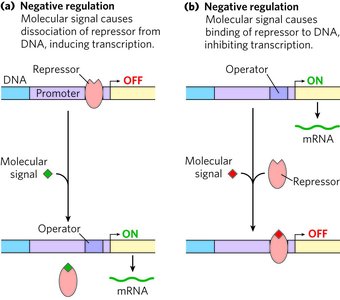
Negative Regulation
Negative regulation involves repressors that inhibit transcription:
A signal may cause a repressor to bind to DNA, shutting down transcription.
Alternatively, a signal may cause the repressor to dissociate, inducing transcription.

Positive Regulation
Positive regulation involves activators that promote transcription:
A signal may cause an activator to bind to DNA, inducing transcription.
Alternatively, a signal may cause the activator to dissociate, shutting down transcription.
Mechanisms of Transcriptional Regulation in Bacteria
Bacteria use several mechanisms to regulate transcription:
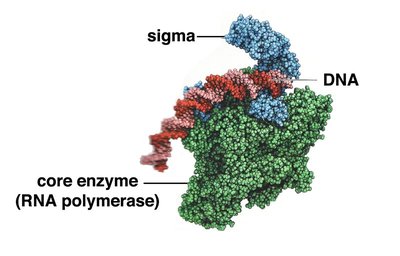
Sigma (σ) factors: Different σ factors direct RNA polymerase to different classes of promoters, allowing expression of specific genes in response to environmental signals.
Transcription factors: Activators and repressors bind to promoters and interact with effector molecules, altering their affinity for DNA.
Promoter Consensus Sequences
Many E. coli promoters have conserved –10 and –35 regions that interact with the σ factor. Mutations in these regions reduce RNA polymerase affinity and gene expression.

Heat Shock Response
Environmental stresses such as heat shock induce transcription of new products to protect the cell. RNA polymerase replaces σ70 with σ32, binding to different promoters and expressing chaperone proteins.

Operons in Bacteria
Bacterial genes with related functions are often organized into operons, which are regulated by a common promoter and transcribed as a single mRNA.
Operon: A cluster of genes under control of a single promoter, transcribed together.
Shine-Dalgarno sequence: Ribosome-binding site preceding each start codon in the operon.

Examples of Inducible Genes: The Lac Operon
The lac operon of E. coli is a classic example of inducible gene expression, allowing the cell to metabolize lactose when glucose is unavailable.
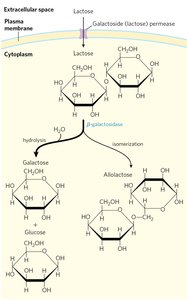
lacZ: Encodes β-galactosidase, which breaks down lactose.
lacY: Encodes galactoside permease, essential for lactose uptake.
lacA: Encodes thiogalactoside trans-acetylase (role not well-defined).
lacI: Encodes the LacI repressor, not part of the operon but adjacent.

Regulatory DNA Sequences of the Lac Operon
P: Common promoter for lacZ, lacY, and lacA.
O1: Main operator, binds LacI repressor.
O2 and O3: Secondary operators, lower affinity for LacI.
CRP binding site: Overlaps the promoter, binds CRP-cAMP complex.
Regulatory Proteins of the Lac Operon
LacI repressor: Binds to operator when lactose is absent, blocking transcription.
CRP (cAMP receptor protein): Binds to DNA only when cAMP is present, facilitating RNA polymerase binding.
cAMP: Synthesized when glucose levels are low, enabling CRP binding.
Mechanism of Regulation
High glucose, no lactose: No cAMP, CRP cannot bind, LacI remains bound, no transcription.
High glucose, high lactose: No cAMP, CRP cannot bind, LacI not bound, weak RNA polymerase binding, low transcription.
No glucose, no lactose: High cAMP, CRP binds, LacI remains bound, no transcription.
No glucose, high lactose: High cAMP, CRP binds, LacI dissociates, strong RNA polymerase binding, high transcription.
Applications of the Lac Operon in Biotechnology
The lacZ gene is used as a selection marker in cloning. Its unique feature is that β-galactosidase must form a homopolymer for activity, but can be split into alpha and omega fragments that complement each other.
Alpha-complementation: Special E. coli strains express omega fragment; plasmid vectors encode alpha fragment. Functional enzyme forms only if both fragments are present.
Blue/white selection: Non-recombinant plasmids produce blue colonies (functional β-gal), recombinant plasmids produce white colonies (no β-gal activity).
IPTG: Induces lac operon expression but is not metabolized.
X-gal: Substrate for β-galactosidase, produces blue product upon cleavage.
Ampicillin: Selects for cells containing plasmid.
Summary Table: Regulation Mechanisms
Regulation Type | Key Protein | Effect | Example |
|---|---|---|---|
Negative | Repressor | Inhibits transcription | LacI in lac operon |
Positive | Activator | Promotes transcription | CRP-cAMP in lac operon |
Example: Lac Operon Regulation
Inducible expression: Lac operon is induced in the presence of lactose and absence of glucose.
Biotechnological application: Used for blue/white screening in cloning experiments.
Additional info:
Housekeeping genes include those encoding ribosomal proteins, RNA polymerase subunits, and metabolic enzymes.
Regulated genes include those involved in stress responses, metabolism of alternative carbon sources, and biosynthesis pathways.
