 Back
BackThe Citric Acid Cycle (TCA Cycle): Structure, Function, and Regulation
Study Guide - Smart Notes
 Tailored notes based on your materials, expanded with key definitions, examples, and context.
The Citric Acid Cycle (TCA Cycle)
Overview and Stages of Aerobic Respiration
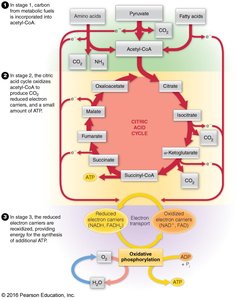
The citric acid cycle, also known as the tricarboxylic acid (TCA) cycle or Krebs cycle, is a central metabolic pathway that completes the oxidation of organic molecules, generating energy and metabolic intermediates. Aerobic respiration can be divided into three main stages:
Stage 1: Carbon from metabolic fuels (amino acids, pyruvate, fatty acids) is converted into acetyl-CoA.
Stage 2: The citric acid cycle oxidizes acetyl-CoA to CO2, producing reduced electron carriers (NADH, FADH2) and a small amount of ATP (or GTP).
Stage 3: Reduced electron carriers are reoxidized in the electron transport chain, generating a proton gradient used to synthesize additional ATP via oxidative phosphorylation. Oxygen serves as the terminal electron acceptor.
Pyruvate Entry into the Mitochondria and Conversion to Acetyl-CoA
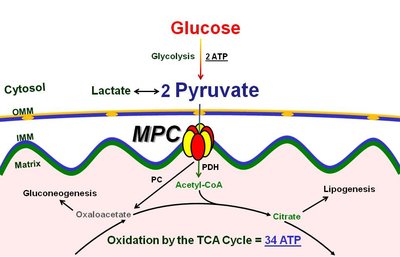
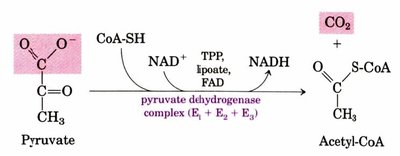
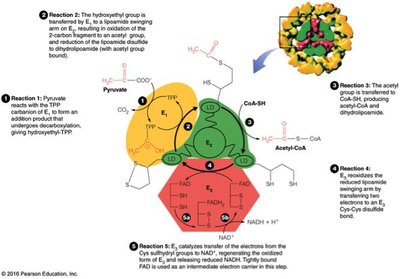
In aerobic organisms, pyruvate produced from glycolysis is transported into the mitochondrial matrix via the mitochondrial pyruvate carrier (MPC). Once inside, pyruvate undergoes oxidative decarboxylation by the pyruvate dehydrogenase complex (PDH) to form acetyl-CoA, CO2, and NADH.
Pyruvate Dehydrogenase Complex: A multi-enzyme complex with three subunits (E1, E2, E3) and several coenzymes (TPP, lipoate, FAD, NAD+, CoA-SH).
Reaction:
ΔG'°: -33.4 kJ/mol (highly exergonic and irreversible)
Reactions of the Citric Acid Cycle
General Features
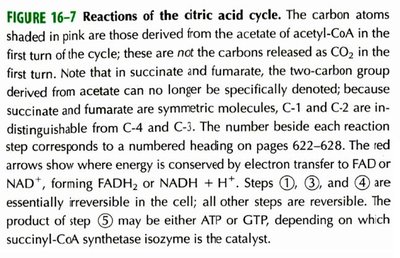
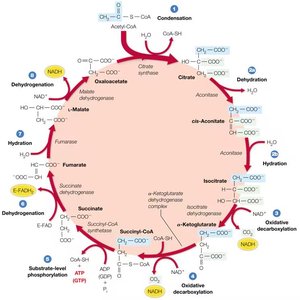
The citric acid cycle consists of eight enzymatic steps, each catalyzed by a specific enzyme. The cycle is amphibolic, serving both catabolic and anabolic roles. Key features include:
Two carbons enter as acetyl-CoA and two are released as CO2 per turn.
Energy is conserved in the form of NADH, FADH2, and GTP/ATP.
Several steps are highly exergonic and essentially irreversible.
Stepwise Reactions and Enzymes
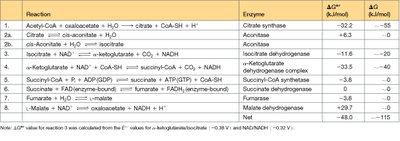
Step | Reaction | Enzyme | ΔG'° (kJ/mol) |
|---|---|---|---|
1 | Acetyl-CoA + oxaloacetate + H2O → citrate + CoA-SH + H+ | Citrate synthase | -32.2 |
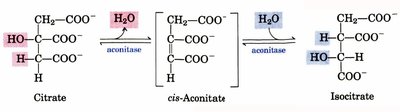
2 | Citrate ⇌ cis-aconitate ⇌ isocitrate | Aconitase | +13.3 |
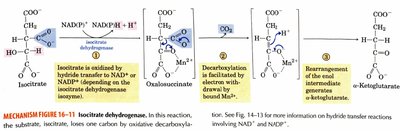
3 | Isocitrate + NAD+ → α-ketoglutarate + CO2 + NADH | Isocitrate dehydrogenase | -20.9 |
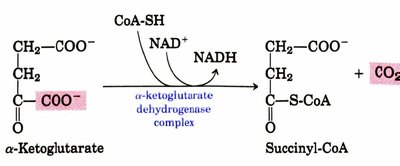
4 | α-Ketoglutarate + CoA-SH + NAD+ → succinyl-CoA + CO2 + NADH | α-Ketoglutarate dehydrogenase | -33.4 |
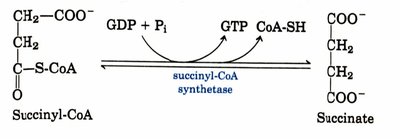
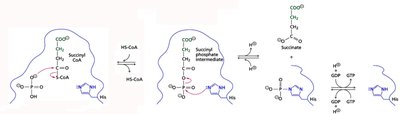
5 | Succinyl-CoA + GDP + Pi ⇌ succinate + GTP + CoA-SH | Succinyl-CoA synthetase | -2.9 |
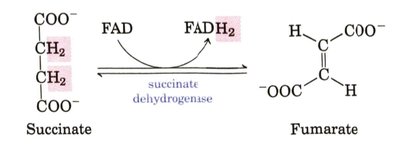
6 | Succinate + FAD ⇌ fumarate + FADH2 | Succinate dehydrogenase | 0 |
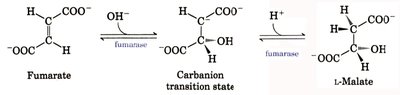
7 | Fumarate + H2O ⇌ malate | Fumarase | -3.8 |
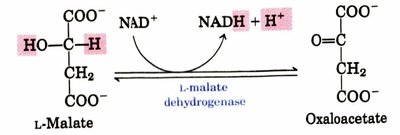
8 | Malate + NAD+ ⇌ oxaloacetate + NADH + H+ | Malate dehydrogenase | +29.7 |
Key Mechanistic Steps
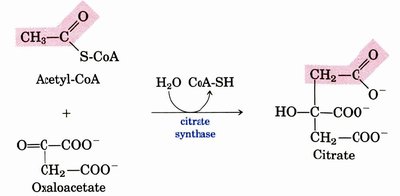
Condensation: Acetyl-CoA and oxaloacetate form citrate (catalyzed by citrate synthase).
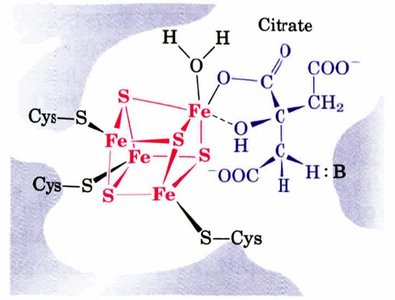
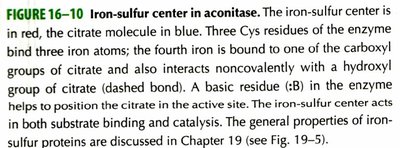
Isomerization: Citrate is converted to isocitrate via cis-aconitate (aconitase, iron-sulfur center).
Oxidative Decarboxylation: Isocitrate and α-ketoglutarate are oxidized, releasing CO2 and generating NADH.
Substrate-Level Phosphorylation: Succinyl-CoA to succinate produces GTP (or ATP).
Dehydrogenation: Succinate to fumarate (FADH2), malate to oxaloacetate (NADH).
Energy Yield and Stoichiometry
Each turn of the cycle yields:
3 NADH
1 FADH2
1 GTP (or ATP)
2 CO2
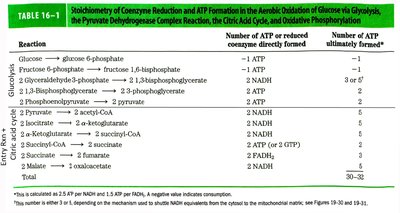
These reduced coenzymes are used in the electron transport chain to generate ATP. The total ATP yield from complete oxidation of one glucose molecule (including glycolysis, PDH, TCA, and oxidative phosphorylation) is approximately 30–32 ATP.
Amphibolic Role and Regulation of the TCA Cycle
Amphibolic Nature and Metabolic Connections
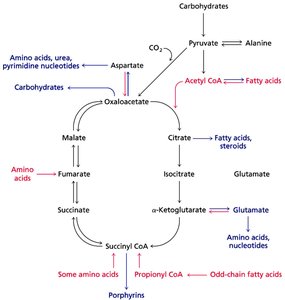
The TCA cycle is amphibolic, serving both catabolic (energy-yielding) and anabolic (biosynthetic) functions. Intermediates are precursors for amino acids, nucleotides, and other biomolecules. Anaplerotic reactions replenish cycle intermediates withdrawn for biosynthesis.
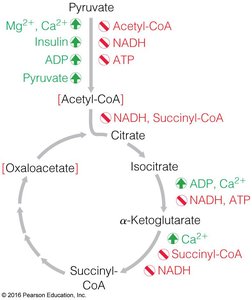
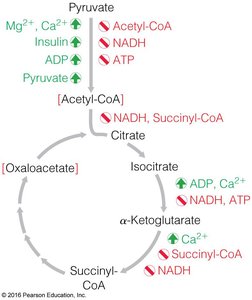
Regulation of the TCA Cycle
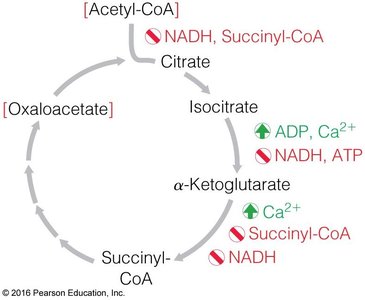
The TCA cycle is tightly regulated to meet cellular energy demands. Regulation occurs at key irreversible steps:
Pyruvate dehydrogenase complex (inhibited by ATP, NADH, acetyl-CoA; activated by ADP, pyruvate, Ca2+)
Citrate synthase (inhibited by ATP, NADH, succinyl-CoA, citrate)
Isocitrate dehydrogenase (activated by ADP, Ca2+; inhibited by ATP, NADH)
α-Ketoglutarate dehydrogenase (inhibited by NADH, succinyl-CoA; activated by Ca2+)
Anaplerotic Reactions
To maintain cycle function, intermediates are replenished by anaplerotic reactions. In animals, the main anaplerotic reaction is the carboxylation of pyruvate to oxaloacetate by pyruvate carboxylase:
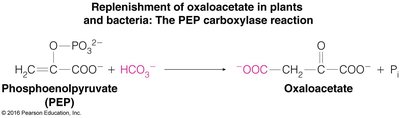
In plants and bacteria, phosphoenolpyruvate carboxylase catalyzes a similar reaction:
Electron Transport Chain and Oxidative Phosphorylation
Overview
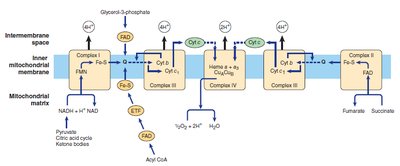
Reduced electron carriers (NADH, FADH2) generated by the TCA cycle donate electrons to the electron transport chain (ETC) in the inner mitochondrial membrane. The ETC consists of four protein complexes (I–IV) and two mobile carriers (ubiquinone and cytochrome c). Electron transfer is coupled to proton pumping, generating a proton gradient used by ATP synthase (Complex V) to produce ATP.
Iron-Sulfur Proteins
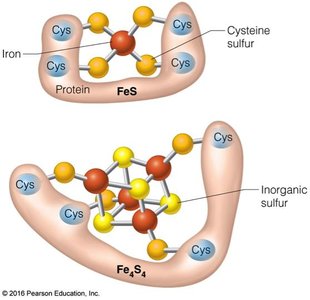
Iron-sulfur (Fe-S) clusters are important cofactors in the ETC, facilitating electron transfer. They are found in Complexes I, II, and III.
Summary Table: ATP Yield from Glucose Oxidation
Pathway Step | ATP/NADH/FADH2 Produced | ATP Yield |
|---|---|---|
Glycolysis | 2 ATP, 2 NADH | 5 or 7 |
Pyruvate to Acetyl-CoA | 2 NADH | 5 |
TCA Cycle (2 turns) | 6 NADH, 2 FADH2, 2 GTP | 20 |
Total | 30–32 |
Key Terms and Concepts
Acetyl-CoA: Central metabolic intermediate entering the TCA cycle.
NADH/FADH2: Reduced electron carriers used in oxidative phosphorylation.
Oxidative phosphorylation: ATP synthesis driven by the electron transport chain and proton gradient.
Anaplerotic reactions: Pathways that replenish TCA cycle intermediates.
Amphibolic pathway: A pathway with both catabolic and anabolic functions.
