 Back
BackTranscription: From Genome Organization to RNA Synthesis in Prokaryotes and Eukaryotes
Study Guide - Smart Notes
 Tailored notes based on your materials, expanded with key definitions, examples, and context.
Transcription: The Flow of Genetic Information
Introduction to Transcription
Transcription is the process by which genetic information encoded in DNA is copied into RNA. This is a fundamental step in the central dogma of molecular biology, which describes the flow of genetic information from DNA to RNA to protein. Transcription is essential for gene expression and is tightly regulated in both prokaryotic and eukaryotic cells.
The Genome and DNA Organization
Genome Structure in Prokaryotes and Eukaryotes
Genome: The complete set of DNA in an organism, including all of its genes.
Prokaryotes: Typically possess a single, circular DNA molecule and may contain additional small DNA circles called plasmids.
Eukaryotes: Contain linear DNA molecules organized into chromosomes, which are associated with histone proteins and localized in the nucleus. Eukaryotes may also have mitochondrial (and in plants, chloroplast) genomes.
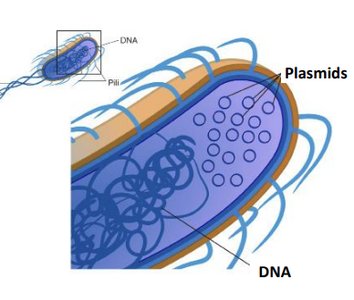
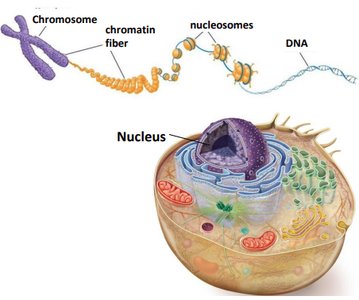
Chromosome Structure and DNA Packaging
Chromosomes are composed of DNA and proteins, with histones playing a key role in DNA packaging.
DNA wraps around histone octamers to form nucleosomes, the basic unit of chromatin structure.
Nucleosomes further coil and fold to form higher-order chromatin structures, ultimately resulting in highly compacted chromosomes during cell division.
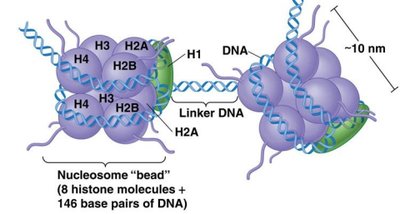
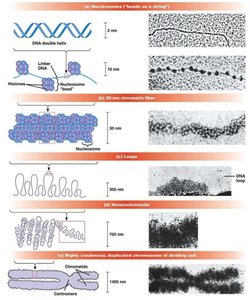
Chromosome Number and Genomic Diversity
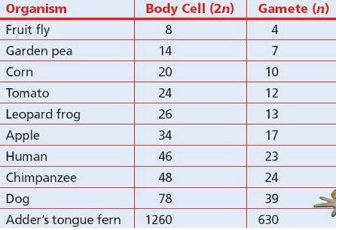
The number of chromosomes is constant within a species but varies between species.
Most cells are diploid (2n), containing two copies of each chromosome; gametes are haploid (n).
Closely related species often have similar chromosome numbers.
The Central Dogma of Molecular Biology
Flow of Genetic Information
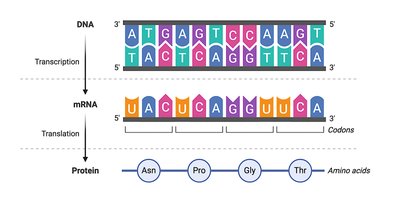
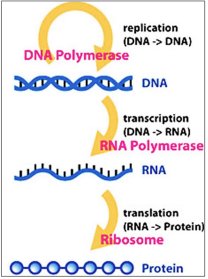
The central dogma describes the unidirectional flow of genetic information: DNA is transcribed into RNA, which is then translated into protein. This process ensures that the genetic code is expressed as functional proteins.
Transcription: Synthesis of RNA from a DNA template.
Translation: Synthesis of proteins using the information in mRNA.
Types and Structure of RNA
Major Types of RNA
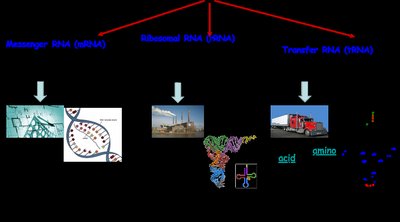
Messenger RNA (mRNA): Carries genetic information from DNA to ribosomes for protein synthesis.
Ribosomal RNA (rRNA): Structural and catalytic component of ribosomes.
Transfer RNA (tRNA): Brings amino acids to the ribosome during translation.
Other RNAs: Catalytic RNAs, small inhibitory RNAs, and others involved in regulation and processing.
RNA Structure
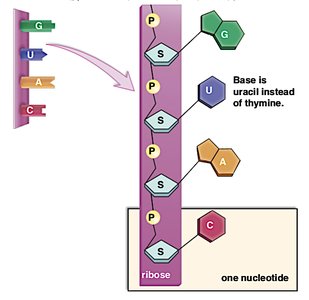
RNA is typically single-stranded and composed of nucleotides with a ribose sugar-phosphate backbone.
The bases are adenine (A), cytosine (C), guanine (G), and uracil (U), with uracil replacing thymine (T) found in DNA.
Base pairing in RNA: A pairs with U, C pairs with G.
DNA Organization: Genes, Exons, and Introns
Gene Structure and Organization
Gene: A segment of DNA that encodes a functional product (protein or RNA).
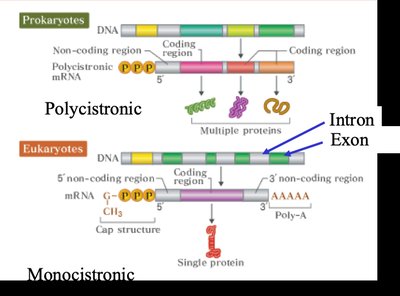
Genes are divided into coding (exons) and non-coding (introns) sequences.
In prokaryotes, genes are often organized in operons (polycistronic), while eukaryotic genes are typically monocistronic and interrupted by introns.
Reading Frames and Gene Expression
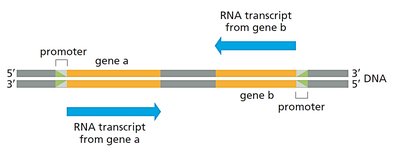
Genes have defined start (initiation), punctuation, and stop points for transcription.
Some genes can overlap or be read from opposite DNA strands.
Transcription: Mechanism and Regulation
Overview of Transcription
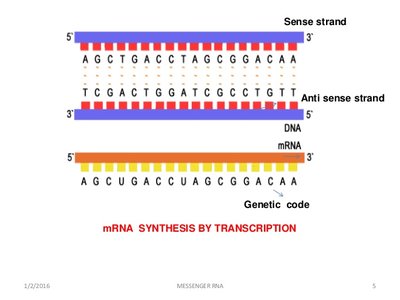
Transcription involves copying the genetic code from one DNA strand (template or anti-sense strand) into a complementary RNA sequence.
The non-template (sense) strand has the same sequence as the RNA (except T is replaced by U).
Location of Transcription
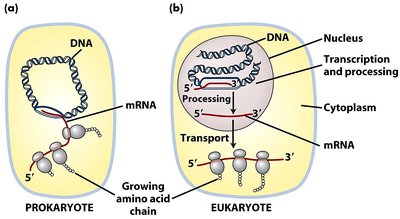
In prokaryotes, transcription and translation occur in the cytoplasm.
In eukaryotes, transcription occurs in the nucleus, while translation occurs in the cytoplasm.
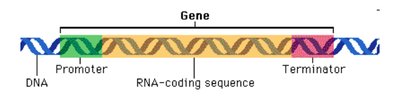
Structure of a Protein-Coding Gene
Promoter: DNA sequence where RNA polymerase binds to initiate transcription.
Coding sequence: Contains the information for the polypeptide chain.
Terminator: Sequence signaling the end of transcription.
Prokaryotic Transcription
RNA Polymerase and Initiation
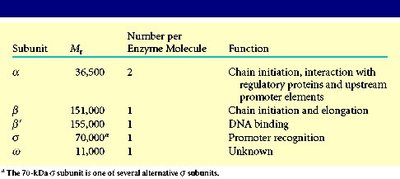
Prokaryotes have a single RNA polymerase responsible for all RNA synthesis.
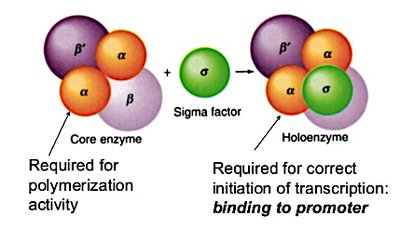
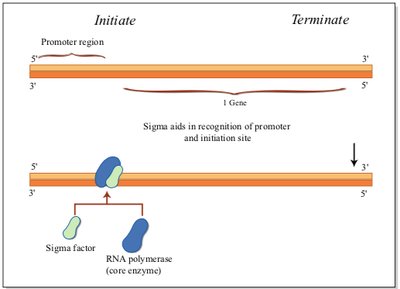
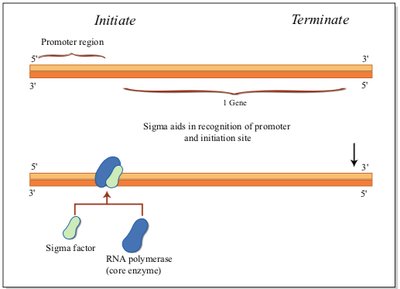
The RNA polymerase holoenzyme consists of a core enzyme and a sigma (σ) factor, which is required for promoter recognition and initiation.
Promoter Recognition and Binding
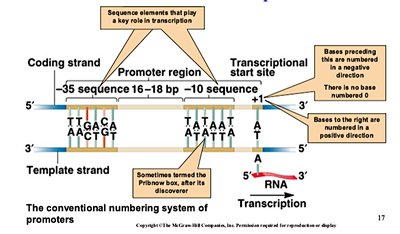
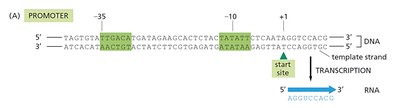
Prokaryotic promoters typically have consensus sequences at -35 and -10 positions relative to the transcription start site (+1).
The -10 region is also known as the Pribnow box.
Sigma factors help RNA polymerase recognize specific promoter sequences.
Initiation and Elongation
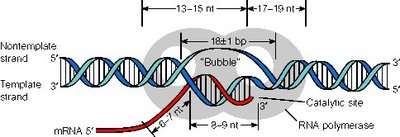
RNA polymerase binds the promoter, unwinds the DNA, and begins RNA synthesis without a primer.
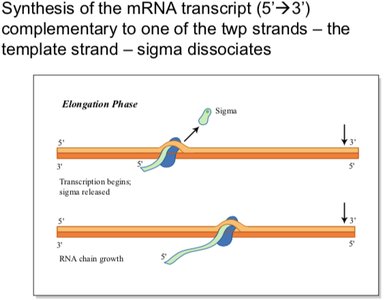
After synthesizing a short RNA, the sigma factor dissociates, and the core enzyme continues elongation.
RNA is synthesized in the 5' to 3' direction, complementary to the template strand.
Termination
Two main mechanisms: intrinsic (hairpin loop) termination and rho-dependent termination.
Intrinsic termination involves the formation of a stem-loop structure in the RNA, causing RNA polymerase to dissociate.
Rho-dependent termination requires the rho protein to release the RNA transcript from the DNA template.
Eukaryotic Transcription
RNA Polymerases and Promoters
Eukaryotes have three RNA polymerases: I (rRNA), II (mRNA and some snRNA), and III (tRNA and other small RNAs).
Promoters contain core elements such as the TATA box, initiator (Inr), CAAT box, and GC box.
Transcription factors (e.g., TFIID, TBP, TAFs) are required for RNA polymerase II to initiate transcription.
Initiation, Elongation, and Termination
The pre-initiation complex (PIC) includes RNA polymerase II and general transcription factors.
Elongation proceeds as RNA polymerase II synthesizes RNA in the 5' to 3' direction.
Termination occurs at variable sites, often signaled by an AAUAAA sequence, followed by RNA processing.
RNA Processing in Eukaryotes
Primary transcripts (pre-mRNA) undergo capping (5' cap), polyadenylation (3' poly-A tail), and splicing (removal of introns).
Splicing is performed by the spliceosome, allowing for alternative splicing and increased protein diversity.
Comparison: Prokaryotic vs. Eukaryotic Transcription
Prokaryotes have a single RNA polymerase; eukaryotes have three.
Prokaryotic transcription is coupled with translation; eukaryotic transcription is separated from translation by the nuclear envelope.
Eukaryotic genes contain introns and require extensive RNA processing; prokaryotic genes are typically uninterrupted.
Regulation of transcription is more complex in eukaryotes due to chromatin structure and regulatory sequences.
Summary Table: Key Differences Between Prokaryotic and Eukaryotic Transcription
Feature | Prokaryotes | Eukaryotes |
|---|---|---|
RNA Polymerases | One | Three (I, II, III) |
Location | Cytoplasm | Nucleus |
Promoter Elements | -10, -35 regions | TATA box, Inr, CAAT, GC box |
RNA Processing | Minimal | Capping, polyadenylation, splicing |
Introns | Absent | Present |
Transcription & Translation | Coupled | Separated |
Conclusion
Transcription is a highly regulated process that ensures the accurate transfer of genetic information from DNA to RNA. While the basic mechanism is conserved, significant differences exist between prokaryotic and eukaryotic transcription, reflecting the complexity of gene regulation in higher organisms. Understanding these processes is fundamental to molecular biology and biochemistry.
