 Back
Water: Structure, Properties, and Its Role in Biochemistry
Study Guide - Smart Notes
 Tailored notes based on your materials, expanded with key definitions, examples, and context.
Water and Life on Earth
Importance of Water in Biological Systems
Water is fundamental to life, serving as the primary solvent in biological systems and facilitating numerous biochemical reactions. Its unique properties make it indispensable for cellular structure, function, and homeostasis.
Water-based Life: All known life forms depend on water for survival, growth, and metabolism.
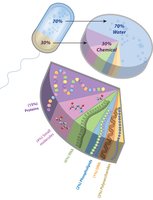
Distribution in Cells: Cells are composed of approximately 70% water, which supports biochemical processes and molecular interactions.
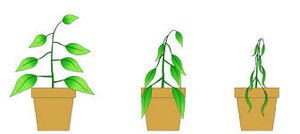
Example: Dehydration in plants and animals leads to impaired function and can be fatal.

Water on Mars and Extraterrestrial Life
Water as a Requirement for Life
The search for water on Mars and other planets is driven by the understanding that water is essential for life as we know it. The presence of water increases the possibility of finding life or supporting future human exploration.
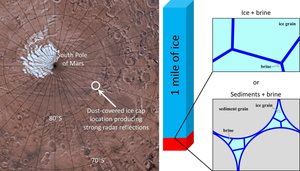
Water on Mars: Evidence of ice and brine on Mars suggests potential habitats for life.
Example: Dust-covered ice caps and brine sediments are studied for signs of water.

Structure and Polarity of Water
Polarity of the Water Molecule
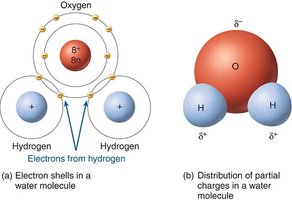
Water is a polar molecule due to the difference in electronegativity between oxygen and hydrogen atoms. This polarity results in an uneven distribution of charge, with oxygen bearing a partial negative charge and hydrogen bearing a partial positive charge.
Electron Distribution: Oxygen attracts electrons more strongly, creating a dipole.
Partial Charges: The oxygen atom is δ–, and the hydrogen atoms are δ+.
Shape and Bond Angles
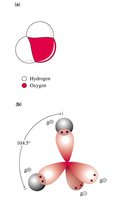
The water molecule is V-shaped, with a bond angle of 104.5°. Two orbitals of oxygen form covalent bonds with hydrogen, while two remain as unshared electron pairs. This geometry is responsible for water's unique properties.
Bond Angle: 104.5° between hydrogen atoms.
Unshared Electron Pairs: Contribute to the molecule's polarity and reactivity.
Polarity of Small Molecules
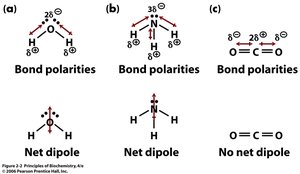
The geometry of polar covalent bonds in water and other molecules creates permanent dipoles. In water and ammonia, the dipoles do not cancel, making them polar. In carbon dioxide, the dipoles cancel, resulting in a nonpolar molecule.
Water: Permanent dipole due to V-shape.
Ammonia: Permanent dipole due to pyramidal shape.
Carbon Dioxide: No net dipole due to linear geometry.
Hydrogen Bonding in Water
Nature of Hydrogen Bonds
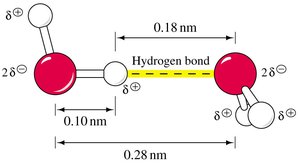
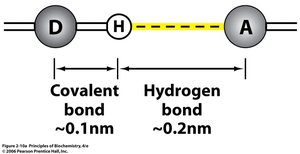
Hydrogen bonds are a type of noncovalent interaction formed between the slightly positive hydrogen atom of one water molecule and the slightly negative oxygen atom of another. These bonds are crucial for water's properties and biological functions.
Bond Length: Hydrogen bonds are about twice as long as covalent bonds.
Intermolecular Bonds: Hydrogen bonds form between molecules, while covalent bonds form within molecules.
Hydrogen Bonding Capacity
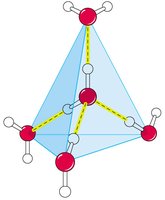
Each water molecule can participate in four hydrogen bonds: two as a donor and two as an acceptor. This extensive bonding network is responsible for water's high cohesion, surface tension, and other physical properties.
Hydrogen Donor: Water donates hydrogen in two bonds.
Hydrogen Acceptor: Water accepts hydrogen in two bonds.
Molecular Organization of Ice
Structure of Ice
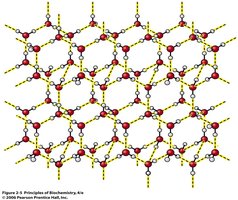
In ice, water molecules form an open, hexagonal lattice, with each molecule hydrogen-bonded to four others. This regularity contributes to the strength and lower density of ice compared to liquid water.
Hexagonal Lattice: Every water molecule is hydrogen-bonded to four others.
Irregularity in Liquid Water: Hydrogen bonding in liquid water is less regular.
Thermal Properties of Water
Specific Heat
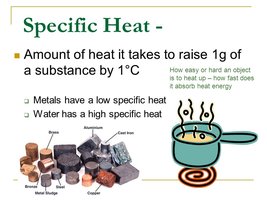
Specific heat is the amount of heat required to raise the temperature of 1 gram of a substance by 1°C. Water has a high specific heat, allowing it to resist temperature changes and stabilize cellular environments.
High Specific Heat: Water absorbs or releases large amounts of heat with little temperature change.
Biological Importance: Minimizes temperature fluctuations in cells.
Heat of Vaporization
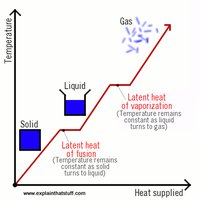
Water's heat of vaporization is much higher than many other liquids. A large amount of heat is required to evaporate water because hydrogen bonds must be broken. This property is important for temperature regulation in organisms.
Evaporation: Absorbs significant heat, making perspiration an effective cooling mechanism.
Solubility and Interactions in Water
Ionic and Polar Substances
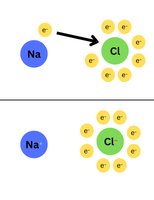
Ionic and polar substances dissolve readily in water due to its polarity. Water can surround ions, forming solvation spheres, and facilitate processes like osmosis and the generation of osmotic pressure.
Electrolytes: Substances that ionize in water.
Hydrophilic: Water-loving substances.
Osmosis: Movement of solvent across a membrane toward higher solute concentration.
Solubility of Nonpolar Substances
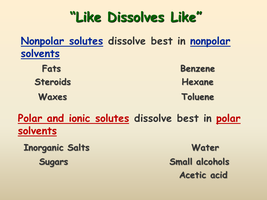
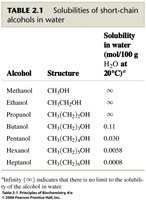
Nonpolar substances are generally insoluble in water, while polar substances are soluble. The principle "like dissolves like" explains why polar and ionic solutes dissolve best in polar solvents like water.
Nonpolar Solutes: Fats, steroids, waxes dissolve in nonpolar solvents.
Polar Solutes: Inorganic salts, sugars, small alcohols dissolve in water.
Weak Noncovalent Interactions
Charge-Charge Interactions
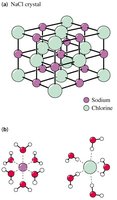
Charge-charge interactions are the strongest noncovalent forces and can extend over greater distances. Water can weaken these interactions, as seen in the dissolution of ionic compounds like NaCl.
Electrostatic Forces: Hold ions together in crystals.
Solvation Sphere: Water molecules surround ions, weakening their interactions.
Hydrogen Bonds in Biomolecules
Hydrogen bonds can occur both intramolecularly and intermolecularly, stabilizing structures such as DNA through base pairing.
Example: Hydrogen bonding between guanine and cytosine in DNA.
Van der Waals Forces
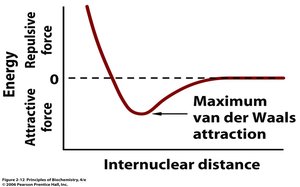
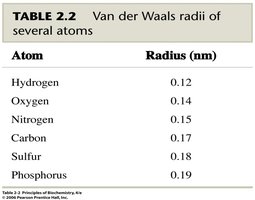
Van der Waals forces are short-range interactions between permanent and transient dipoles. They include both attractive and repulsive components and are important for molecular stability.
Maximum Attraction: Occurs at optimal internuclear distance.
Repulsive Component: Prevents nuclei from coming too close.
Hydrophobic Interactions
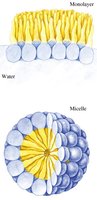
Hydrophobic interactions involve the association of nonpolar molecules in aqueous solution. These interactions are not bonds but are critical for the formation of structures like micelles and biological membranes.
Micelles: Aggregates of amphipathic molecules stabilized by hydrophobic interactions.
Summary Table of Noncovalent Interactions
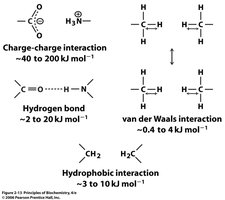
Different types of noncovalent interactions contribute to the stability of biomolecules.
Interaction | Energy (kJ mol-1) |
|---|---|
Charge–charge | 40–200 |
Hydrogen bond | 2–20 |
Van der Waals | 0.4–4 |
Hydrophobic | 3–10 |
Water as a Nucleophile
Reactivity of Water
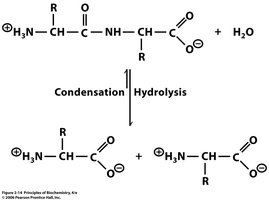
Water's electron-rich oxygen atom makes it a nucleophile, capable of participating in hydrolysis reactions. Hydrolysis is the cleavage of bonds by water, while condensation is the reverse process.
Nucleophile: Electron-rich species seeking electron-deficient (electrophilic) partners.
Example: Hydrolysis of peptide bonds in proteins.
Ionization of Water and pH
Ionization and Equilibrium
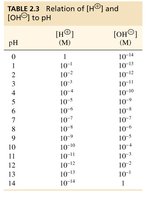
Water ionizes to form hydronium (H3O+) and hydroxide (OH-) ions. The equilibrium constant (Keq) and ion product (Kw) describe this process quantitatively.
Equilibrium Equation:
Ion Product: at 25°C
pH Scale
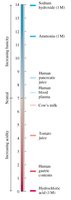
pH is a logarithmic measure of hydrogen ion concentration. Pure water has a pH of 7, and the scale ranges from 0 (acidic) to 14 (basic).
Formula:
Neutral pH: [H+] = [OH-] = M
Acid Dissociation Constants and pKa
Acid Strength and Dissociation
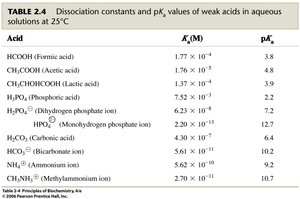
Acids are proton donors, and their strength is measured by the acid dissociation constant (Ka). Strong acids dissociate completely, while weak acids do not. The pKa is the logarithmic form of Ka.
Formula:
Lower pKa: Indicates a stronger acid.
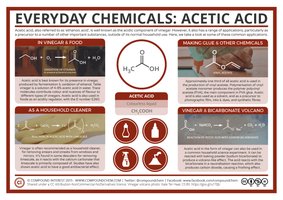
pH versus pKa
pH measures the acidity of a solution, while pKa measures the acid strength of a compound. Both are logarithmic quantities and are related through titration experiments.
Formula for pH:
Formula for pKa:
Henderson-Hasselbalch Equation
Relationship Between pH and pKa
The Henderson-Hasselbalch equation relates the pH of a solution to the pKa of a weak acid and the ratio of its conjugate base to acid concentrations.
Equation:
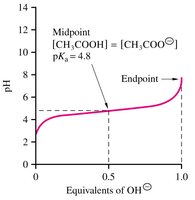
Midpoint: When [A-] = [HA], pH = pKa.
Titration Curves of Weak Acids
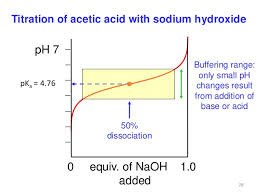
Titration of Acetic Acid
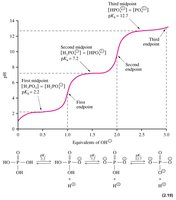
Titration curves illustrate the change in pH as a weak acid is neutralized by a base. The inflection point occurs when the concentrations of acid and conjugate base are equal, and pH equals pKa.
Inflection Point: pH = pKa at midpoint.
Endpoint: All acid converted to conjugate base.
Biological Buffer Systems
Buffering Capacity
Buffered solutions resist changes in pH upon addition of small amounts of acid or base. Biological buffers are essential for maintaining stable pH in cells and bodily fluids.
Example: Blood is buffered by the bicarbonate system.
Blood as a Biological Buffer
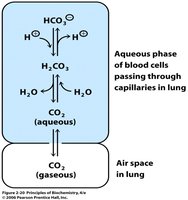
The pH of blood is regulated by the ratio of bicarbonate (HCO3-) to carbon dioxide (CO2) in the lungs. Changes in pH are compensated by shifts in these concentrations.
Physiological pH: Blood pH is maintained around 7.4.
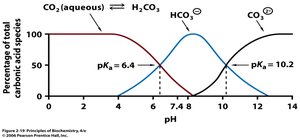
Carbonic Acid System: At pH 7.4, concentrations of carbonic acid and bicarbonate are substantial, while carbonate is negligible.
 ----------------------------------------
