 Back
BackActive Transport exam


 07:06
07:06
Terms in this set (24)
Active Transport
The movement of molecules against their concentration gradient, requiring energy.
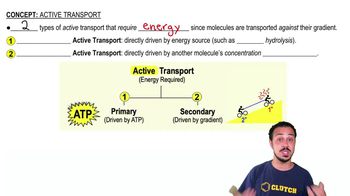
What are the two main types of active transport?
Primary active transport and secondary active transport.
Primary Active Transport
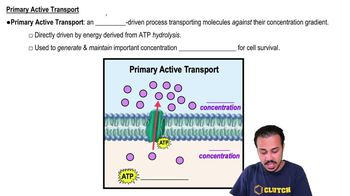
A type of active transport that directly uses ATP hydrolysis to move molecules against their concentration gradient.
What is an example of primary active transport?
The sodium-potassium pump.
Secondary Active Transport
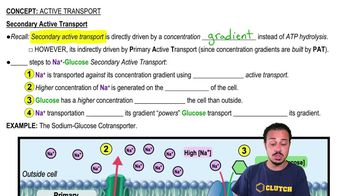
A type of active transport that uses the concentration gradient of another molecule to move substances against their concentration gradient.
How does secondary active transport differ from primary active transport?
Secondary active transport is driven by another molecule's concentration gradient, not directly by ATP hydrolysis.
Sodium-Potassium Pump
A primary active transport mechanism that moves 3 sodium ions out of the cell and 2 potassium ions into the cell.
What is the role of ATP in primary active transport?
ATP provides the energy needed to move molecules against their concentration gradient.
Antiporter
A type of transporter that moves two different ions or molecules in opposite directions across a membrane.
What is the function of the sodium-potassium pump?
To maintain high potassium and low sodium concentrations inside the cell.
How many sodium ions are exported by the sodium-potassium pump?
Three sodium ions.
How many potassium ions are imported by the sodium-potassium pump?
Two potassium ions.
What mnemonic can help remember the function of the sodium-potassium pump?
Think of a pumpkin: 'pump K+ in' to remember potassium is pumped into the cell.
Sodium-Glucose Transporter
A secondary active transport mechanism that uses the sodium gradient to transport glucose against its concentration gradient.
What drives secondary active transport?
The concentration gradient of another molecule, such as sodium.
How is the sodium gradient maintained for secondary active transport?
By primary active transport mechanisms like the sodium-potassium pump.
What happens to sodium ions in secondary active transport?
They move down their concentration gradient, releasing energy.
What happens to glucose in the sodium-glucose transporter?
It is transported against its concentration gradient into the cell.
What is the role of ATP in the sodium-potassium pump?
ATP hydrolysis provides the energy to pump sodium out and potassium in.
What is the concentration gradient?
The difference in the concentration of a substance across a space or membrane.
What is the function of membrane proteins in active transport?
They facilitate the movement of molecules against their concentration gradient.
What is ATP hydrolysis?
The process of breaking down ATP to release energy.
What is the role of the sodium-potassium pump in cells?
To help maintain the cell's electrochemical gradient and volume.
What is the significance of active transport in cells?
It is crucial for maintaining cellular processes and homeostasis.