 Back
BackAtoms- Smallest Unit of Matter definitions


 02:13
02:13
Terms in this set (24)
Atoms
The smallest unit of matter, consisting of a nucleus surrounded by electrons, forming the basic building block of all chemical elements.
Matter
Anything that occupies space and has mass, encompassing both living and nonliving entities, composed of at least one chemical element.
Mass
The amount of matter in an object, measured in kilograms or grams, which determines its resistance to acceleration and the gravitational force it experiences.
Chemical Element
A pure substance consisting of only one type of atom, fundamental to all matter, both living and nonliving.
Pure Substance
A substance composed of only one type of atom, maintaining consistent chemical properties throughout.
Atom
The smallest unit of matter, consisting of a nucleus surrounded by electrons, forming the basic building block of chemical elements.
Diamond
A crystalline form of carbon where each atom is tetrahedrally bonded to four other carbon atoms, creating an extremely hard and transparent structure.
Carbon
A fundamental element in all living organisms, forming the backbone of organic molecules, including proteins, carbohydrates, and nucleic acids.
Oxygen
A diatomic molecule essential for respiration and energy production in living organisms, comprising 21% of Earth's atmosphere.
Hydrogen
A light, essential element in living organisms, consisting of one proton and one electron, often found in water and organic compounds.
Proton
A subatomic particle with a positive charge, a mass of 1 atomic mass unit (AMU), and located in the nucleus of an atom.
Atomic Mass Unit (amu)
A unit of mass used to express atomic and molecular weights, defined as one-twelfth the mass of a carbon-12 atom.
Neutron
A subatomic particle found in the nucleus of an atom, it has no electric charge and a mass similar to that of a proton.
Electron
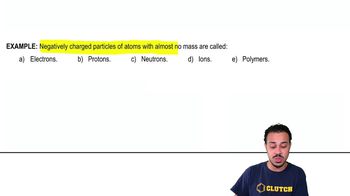
A subatomic particle with a negative charge, orbiting the nucleus of an atom in energy shells, crucial for chemical bonding and electricity.
Periodic Table
A tabular arrangement of chemical elements, organized by increasing atomic number, electron configurations, and recurring chemical properties, essential for understanding matter's composition and behavior.
Bulk Elements
The six most abundant elements in living organisms: carbon, hydrogen, nitrogen, oxygen, phosphorus, and sulfur, making up 97% of their mass.
Trace Elements
Elements essential for life but required in minute quantities.
Mass Number
The total number of protons and neutrons in an atom's nucleus.
Atomic Number
The number of protons in an atom's nucleus, determining the element's identity and position on the periodic table.
Energy Shells
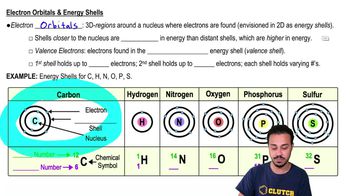
Regions around an atom's nucleus where electrons are likely to be found, with each region corresponding to a specific energy level.
Electron Orbitals
Regions around an atom's nucleus where electrons are likely to be found, each with a specific energy level and shape, influencing chemical bonding and properties.
Octet Rule
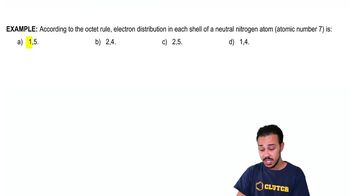
Atoms are most stable when their outermost electron shell is full, typically with 8 electrons, making them less reactive.
Valence Shell
The outermost electron shell of an atom, which determines its chemical reactivity and bonding behavior.
Subatomic Particles
Particles smaller than an atom, including protons, neutrons, and electrons, which make up the structure of atoms and determine their properties.