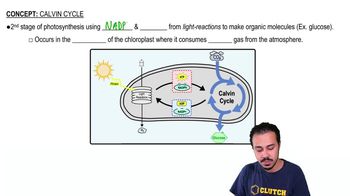
Which molecules produced by the light reactions are used to power the Calvin Cycle?
ATP and NADPH produced by the light reactions are used to power the Calvin Cycle.
What are the three phases of the Calvin Cycle?
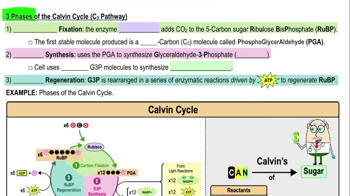
The three phases of the Calvin Cycle are carbon fixation, G3P synthesis, and RuBP regeneration.
What is the first stable molecule produced during the carbon fixation phase of the Calvin Cycle?
The first stable molecule produced is a 3-carbon molecule called phosphoglyceraldehyde (PGA).
What is the role of G3P in the Calvin Cycle?
G3P (glyceraldehyde 3-phosphate) is a precursor molecule used to build glucose.
What happens to the G3P molecules that are not used to make glucose?
The remaining G3P molecules are used to regenerate RuBP in the Calvin Cycle.
Which phase of the Calvin Cycle requires ATP and NADPH?
The G3P synthesis phase requires ATP and NADPH.
What are the reactants of the Calvin Cycle?
The reactants of the Calvin Cycle are CO2, ATP, and NADPH.
In which part of the chloroplast do the light reactions and the Calvin Cycle occur, respectively?
Light reactions occur in the thylakoids, while the Calvin Cycle occurs in the stroma.
What is the significance of the stroma in the Calvin Cycle?
The stroma is the fluid-filled space in the chloroplast where the Calvin Cycle takes place.
What energy sources drive the reactions of the Calvin Cycle?
ATP and NADPH from the light reactions provide the energy for the Calvin Cycle.
What is the role of NADPH in the Calvin Cycle?
NADPH provides reducing power (electrons) for the synthesis of G3P.
What is the difference between the stroma and stomata?
The stroma is the fluid inside the chloroplast where the Calvin Cycle occurs, while stomata are pores on leaves for gas exchange.
What happens during the G3P synthesis phase of the Calvin Cycle?
PGA is converted into G3P using ATP and NADPH.
How does the Calvin Cycle contribute to the overall process of photosynthesis?
The Calvin Cycle uses energy from light reactions to fix carbon and produce glucose, completing photosynthesis.
How many turns of the Calvin Cycle are required to produce one glucose molecule?
Six turns of the Calvin Cycle are required to produce one glucose molecule.
What would happen if RuBP were not regenerated in the Calvin Cycle?
The Calvin Cycle would stop because there would be no RuBP to fix new CO2.
Which molecules are directly required for the carbohydrate-synthesizing reactions of photosynthesis in the Calvin Cycle?
The carbohydrate-synthesizing reactions of the Calvin Cycle directly require ATP, NADPH, and carbon dioxide (CO2).
From what source does most of a plant's biomass originate during photosynthesis?
Most of a plant's biomass comes from carbon dioxide (CO2) in the atmosphere, which is fixed into organic molecules like glucose during the Calvin Cycle.
What is the basic role of carbon dioxide (CO2) in photosynthesis?
The basic role of CO2 in photosynthesis is to serve as the carbon source that is fixed and incorporated into organic molecules such as glucose during the Calvin Cycle.
How is carbon dioxide (CO2) utilized in the Calvin Cycle of photosynthesis?
In the Calvin Cycle, CO2 is attached to ribulose bisphosphate (RuBP) by the enzyme RuBisCO during carbon fixation, providing the carbon atoms that are ultimately used to synthesize glucose.
What is the role of NADPH in the Calvin Cycle of photosynthesis?
NADPH provides the reducing power (electrons) needed for the synthesis of glyceraldehyde 3-phosphate (G3P), a precursor to glucose, during the Calvin Cycle.
What happens to carbon during photosynthesis?
During photosynthesis, carbon from atmospheric CO2 is fixed and incorporated into organic molecules, ultimately forming glucose through the Calvin Cycle.
How does the Calvin Cycle contribute to the increase in plant biomass?
The Calvin Cycle converts atmospheric CO2 into glucose and other organic molecules, which are used to build plant tissues and contribute to the increase in plant biomass.
 Back
Back
 10:58
10:58