 Back
BackClasses of Signaling Receptors definitions

 00:52
00:52
Terms in this set (16)
Receptors Biomolecules
Often proteins that change shape upon binding to specific ligands, initiating a cellular response. They can be located on the cell surface or within the cell.
Proteins
Biomolecules that change conformation upon binding to specific ligands, facilitating various cellular processes, including signal transduction, metabolism, and structural support.
Conformation
The three-dimensional shape or structure of a protein or molecule, which can change upon binding to a ligand or signaling molecule.
Ligand
A molecule that binds specifically to a receptor, causing the receptor to change conformation and initiate a cellular response.
Signaling Molecule
A chemical that binds to a specific receptor, triggering a cellular response, and can be hydrophilic or hydrophobic, affecting cells with corresponding surface or intracellular receptors.
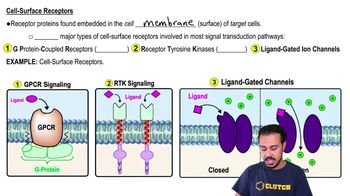
Cell Surface Receptors
Proteins embedded in the cell membrane that bind specific ligands, triggering a conformational change to initiate intracellular signaling pathways.
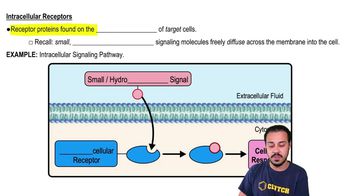
Intracellular Receptors
Receptors located within the cell that bind to lipid-soluble signaling molecules, allowing them to directly influence gene expression by interacting with DNA in the nucleus.
Signal Transduction Pathways
A series of molecular events where a cell converts an external signal into a functional response, often involving receptor activation, signal amplification, and cellular changes.
G Protein Coupled Receptors
Cell surface receptors that activate intracellular G proteins upon ligand binding, initiating various signal transduction pathways.
GPCRs
Transmembrane proteins that bind extracellular ligands, activating intracellular G proteins to trigger various cellular responses.
Receptor Tyrosine Kinases
Cell surface receptors that, upon ligand binding, dimerize and autophosphorylate tyrosine residues, initiating intracellular signaling cascades.
RTKs
Cell surface receptors that, upon ligand binding, dimerize and autophosphorylate tyrosine residues, initiating intracellular signaling cascades.
Domains
Distinct functional and structural regions of a protein, often responsible for specific interactions or activities, such as binding ligands or catalyzing reactions.
Ligand Gated Ion Channels
Membrane proteins that open to allow ion flow when a specific molecule binds, altering the channel's conformation.
Phosphorylation Cascade
A series of protein phosphorylation events where each kinase activates another, amplifying the signal and leading to a cellular response.
Signal Transduction
The process by which a cell converts an external signal into a functional change via receptor-ligand interactions, often involving a cascade of molecular events.