 Back
BackDiscovering the Structure of DNA definitions


 06:24
06:24
Terms in this set (14)
DNA
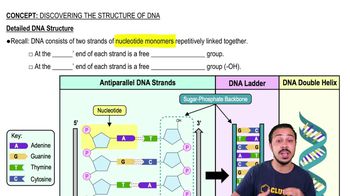
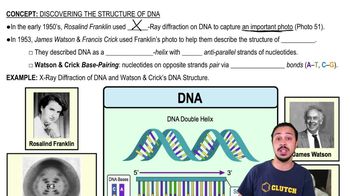
A molecule that stores genetic information, consisting of two strands forming a double helix, with adenine pairing with thymine and cytosine pairing with guanine, ensuring consistent width.
Rosalind Franklin
A pioneering scientist who used X-ray diffraction to capture images revealing DNA's double helix structure, but was not formally credited for her crucial contribution to its discovery.
Watson
A scientist credited with co-discovering the double helix structure of DNA, alongside Crick, using data from Rosalind Franklin's X-ray diffraction images.
Crick
A scientist who, along with Watson, is credited with discovering the double helix structure of DNA.
X-Ray Diffraction
A technique using X-rays to determine the atomic and molecular structure of a crystal, revealing the 3D arrangement of atoms within the crystal.
Double Helix
A twisted ladder-like structure formed by two strands of nucleotides, where complementary bases pair to maintain a consistent width, crucial for DNA's stability and function.
Adenine
A purine base in DNA and RNA that pairs with thymine in DNA and uracil in RNA through hydrogen bonds, ensuring consistent DNA width and complementary base pairing.
Thymine
A pyrimidine base in DNA that pairs with adenine via two hydrogen bonds, ensuring consistent DNA helix width and complementary base pairing.
Cytosine
A nitrogenous base in DNA and RNA that pairs with guanine through three hydrogen bonds, contributing to the molecule's consistent width and complementary base pairing.
Guanine
A purine base in DNA and RNA that pairs with cytosine through three hydrogen bonds, contributing to the molecule's stability and consistent width.
Hydrogen Bonds
Weak interactions between a hydrogen atom in one molecule and an electronegative atom (like oxygen or nitrogen) in another, crucial for DNA's double helix stability and complementary base pairing.
Complimentary Bases
Complementary bases are pairs of DNA nucleotides where adenine bonds with thymine and cytosine bonds with guanine, ensuring a consistent double helix structure.
Nucleotides
Molecular building blocks of DNA and RNA, consisting of a nitrogenous base, a five-carbon sugar, and one or more phosphate groups, crucial for encoding genetic information and energy transfer.
Complementary Base Pairing In DNA
specific hydrogen bonding between adenine-thymine and cytosine-guanine ensures a consistent double helix width and accurate replication.