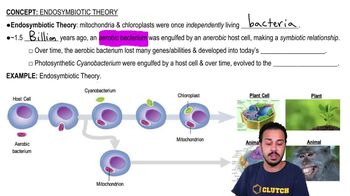
Theory suggesting mitochondria and chloroplasts originated from free-living prokaryotes that were engulfed by ancestral eukaryotic cells, forming a symbiotic relationship.
Mitochondria
Organelle in eukaryotic cells, evolved from aerobic bacteria, responsible for producing energy (ATP) through cellular respiration, requiring oxygen to function.
Chloroplasts
Photosynthetic organelles in eukaryotic cells, believed to have originated from cyanobacteria, responsible for converting light energy into chemical energy via photosynthesis.
Prokaryotic Organisms
Single-celled organisms lacking a nucleus and membrane-bound organelles, often considered the ancestors of mitochondria and chloroplasts in eukaryotic cells.
Eukaryotic Cells
Cells with a nucleus and membrane-bound organelles, believed to have evolved through endosymbiosis, incorporating prokaryotic organisms like mitochondria and chloroplasts.
Prokaryote
A unicellular organism lacking a nucleus and membrane-bound organelles, typically smaller and simpler than eukaryotes, often found in extreme environments.
Eukaryote
An organism with cells containing a nucleus and membrane-bound organelles, believed to have evolved through endosymbiosis of prokaryotic cells.
Cyanobacteria
Photosynthetic prokaryotes that produce oxygen and are believed to be ancestors of chloroplasts in eukaryotic cells.
Photosynthetic Bacteria
Bacteria that perform photosynthesis, converting light energy into chemical energy, and are believed to be ancestors of chloroplasts in eukaryotic cells.
Aerobic Bacteria
Bacteria that require oxygen for growth and energy production, often involved in processes like cellular respiration.
Anaerobic Bacteria
Bacteria that thrive in environments devoid of oxygen, often using fermentation or anaerobic respiration for energy production.
Cellular Respiration
The process by which cells convert glucose and oxygen into energy (ATP), carbon dioxide, and water, primarily occurring in the mitochondria.
Oxygen
A diatomic molecule essential for aerobic respiration, enabling energy production in mitochondria by acting as the final electron acceptor in the electron transport chain.
 Back
Back

 06:58
06:58