 Back
BackEukaryotic Post-Transcriptional Regulation definitions


 01:56
01:56
Terms in this set (25)
Eukaryotic Cells
Cells with a nucleus and membrane-bound organelles, allow compartmentalization of functions and complex regulation of gene expression.
Post Transcriptional Regulation
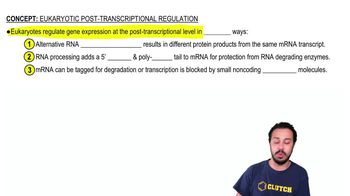
Regulation of gene expression in eukaryotes after transcription, involving alternative RNA splicing, mRNA processing (5' cap and poly-A tail), and mRNA degradation or translation inhibition by small RNAs.
Gene Expression
The process by which information from a gene is used to synthesize functional gene products, such as proteins, often involving transcription and translation.
Alternative RNA Splicing
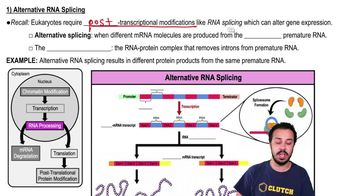
A process where a single mRNA transcript is spliced in various ways to produce different protein variants, enhancing protein diversity without increasing the number of genes.
mRNA
A molecule that carries genetic information from DNA to ribosomes, where it is translated into proteins, and is protected by a 5' cap and poly-A tail to prevent degradation.
Transcript
An RNA copy of a gene's DNA sequence, produced during transcription, which can be processed and modified before being translated into a protein.
RNA Processing
Modification of pre-mRNA in eukaryotes, including splicing out introns, adding a 5' cap, and a poly-A tail, to produce mature mRNA for translation.
5 Prime Cap
A modified guanine nucleotide added to the 5' end of eukaryotic mRNA to protect it from degradation and assist in ribosome binding during translation.
Poly A Tail
A sequence of adenine nucleotides added to the 3' end of eukaryotic mRNA to protect it from degradation and assist in export from the nucleus.
Degrading Enzymes
Enzymes that break down RNA molecules, protecting cells from viral RNA and regulating gene expression by degrading unprotected mRNA.
Non Coding RNA Molecules
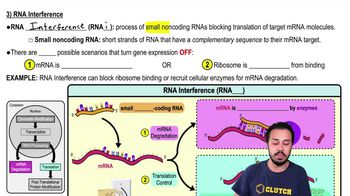
Small RNA molecules that bind to mRNA, preventing its translation by blocking ribosome attachment, thus regulating gene expression post-transcriptionally.
Introns
Noncoding segments of RNA that are removed during RNA splicing, allowing exons to be joined together to form a mature mRNA transcript.
Exons
Segments of mRNA that are retained during RNA splicing and code for proteins.
Protein Products
Proteins synthesized from the same mRNA transcript through alternative RNA splicing, resulting in diverse functional variants.
Genome
The complete set of an organism's DNA, including all of its genes, which contains the instructions for building and maintaining that organism.
RNA Interference
A process where small RNA molecules bind to mRNA, preventing its translation by blocking ribosome binding, thus regulating gene expression post-transcriptionally.
Translation
The process where ribosomes synthesize proteins using mRNA as a template, converting nucleotide sequences into amino acid sequences.
Ribosome
A cellular structure that synthesizes proteins by translating mRNA sequences into polypeptide chains, essential for gene expression and cellular function.
Small Interfering RNA
A short double-stranded RNA that binds to and degrades mRNA, preventing its translation into protein.
MicroRNA
Small, non-coding RNA molecules that bind to mRNA, preventing its translation by blocking ribosome attachment, thus regulating gene expression post-transcriptionally.
Complementary Base Pairs
Nitrogenous bases in DNA and RNA that pair specifically (A with T/U, and C with G) via hydrogen bonds, ensuring accurate replication and transcription.
tRNA
A molecule that carries amino acids to the ribosome during protein synthesis, matching its anticodon with codons on the mRNA to ensure correct amino acid sequence.
rRNA
A type of RNA that forms the core structural and functional components of ribosomes, essential for protein synthesis in all living organisms.
Ribosomal Subunits
Two distinct structures within ribosomes, one large and one small, that assemble around mRNA to facilitate protein synthesis by coordinating tRNA and catalyzing peptide bond formation.
Dicer
An enzyme that cleaves double-stranded RNA into small fragments, facilitating RNA interference and gene silencing.