Pearson+ LogoPearson+ Logo
Back

Evidence of Evolution quiz #3

Control buttons has been changed to "navigation" mode.
1/19
  • How do vestigial structures serve as evidence for evolution, and can you provide an example?

    Vestigial structures are traits that have lost most or all of their ancestral function, indicating evolutionary change over time. An example is the pelvic girdle in snakes, which no longer serves its original purpose but remains as a reduced structure, showing descent from ancestors with functional legs.
  • How do fossils provide evidence for both broad evolutionary patterns and specific evolutionary transitions, such as the evolution of whales?

    Fossils show changes in organisms over time, with older layers containing different species than those found today, demonstrating broad evolutionary patterns. They also reveal specific transitions, such as fossils of ancient whales with intermediate leg structures, supporting the idea that whales evolved from land-dwelling ancestors.
  • What is homology and how does it provide evidence for evolution?

    Homology is the presence of similar traits or structures in different species due to shared ancestry. It provides evidence for evolution by showing that these species inherited these traits from a common ancestor.
  • How do the upper limb bones of tetrapods illustrate the concept of homology?

    Despite different functions, tetrapods like whales, horses, and humans have similar upper limb bone structures, indicating they share a common ancestor. This similarity in structure, despite differences in use, is evidence of homology.
  • What is the difference between homology and analogy in evolutionary biology?

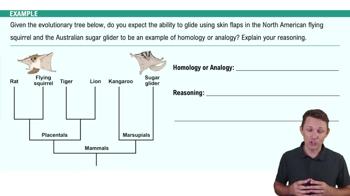
    Homology refers to traits inherited from a common ancestor, while analogy refers to traits that are similar in function but evolved independently in different lineages. Analogous traits can confuse evolutionary relationships because they do not indicate common ancestry.
  • What are vestigial structures and how do they support the theory of evolution?

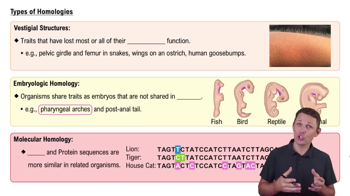
    Vestigial structures are traits that have lost most or all of their ancestral function, indicating evolutionary change over time. Examples include the pelvic girdle in snakes and human goosebumps, showing descent from ancestors with different lifestyles.
  • How does embryologic homology provide evidence for common ancestry among vertebrates?

    Embryologic homology is seen when embryos of different vertebrates share similar features, such as pharyngeal arches and tails, even if these features are not present in adults. This suggests these species share a distant common ancestor.
  • What is molecular homology and why is it important in modern evolutionary biology?

    Molecular homology refers to similarities in DNA or protein sequences among related organisms. It is important because it allows scientists to construct evolutionary trees and determine relationships based on genetic evidence.
  • How do fossils provide evidence for broad evolutionary patterns?

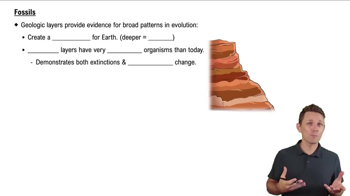
    Fossils found in different geologic layers show that older layers contain different species than those found today, demonstrating that species have changed and new species have appeared over time. This supports the idea of evolution and extinction.
  • How do fossils demonstrate specific evolutionary transitions, such as the evolution of whales?

    Fossils show a sequence of intermediate forms, such as ancient whales with leg structures, supporting the hypothesis that whales evolved from land-dwelling ancestors. This provides direct evidence for specific evolutionary changes over time.
  • How does embryology provide evidence for evolution?

    Embryology provides evidence for evolution by showing that embryos of different species share similar traits during early development, such as pharyngeal arches and tails, indicating a common ancestry.
  • What types of evidence are commonly used to support the theory of evolution?

    Common types of evidence for evolution include homology (structural, embryological, and molecular similarities), vestigial structures, and fossils.
  • What is convergent evolution?

    Convergent evolution is the process where unrelated organisms independently evolve similar traits due to similar environmental pressures, resulting in analogous structures with different evolutionary origins.
  • How are homologous structures evidence for evolution?

    Homologous structures are evidence for evolution because they show similar underlying anatomy in different species, suggesting these species inherited the structures from a common ancestor.
  • How does embryology support the theory of evolution?

    Embryology supports the theory of evolution by revealing that diverse organisms share similar features during early development, which points to a shared evolutionary origin.
  • How do homologous structures provide evidence for evolution?

    Homologous structures provide evidence for evolution by demonstrating that different species have similar anatomical features due to descent from a common ancestor, even if the features serve different functions.
  • How is radioactive dating important for providing evidence for evolution?

    Radioactive dating is important for providing evidence for evolution because it allows scientists to determine the age of fossils and rock layers, helping to establish the timeline of evolutionary changes.
  • How does embryology support evolution?

    Embryology supports evolution by showing that embryos of different species exhibit similar structures and developmental patterns, indicating they share a common ancestry.
  • What is the significance of vestigial structures in understanding evolution?

    Vestigial structures are significant in understanding evolution because they are reduced or nonfunctional traits inherited from ancestors, demonstrating how species have changed over time.