Skip to main content
General Biology
My Course
Learn
Exam Prep
AI Tutor
Study Guides
Textbook Solutions
Flashcards
Explore
Try the app
My Course
Learn
Exam Prep
AI Tutor
Study Guides
Textbook Solutions
Flashcards
Explore
Try the app
Back
Experimental Design exam
1 student found this helpful
You can tap to flip the card.
Experiment
You can tap to flip the card.
👆
Experiment
A scientific procedure designed to test a hypothesis, involving independent and dependent variables.
Track progress
Control buttons has been changed to "navigation" mode.
1/30
Related flashcards
Related practice
Recommended videos
Experimental Design definitions
Experimental Design
8 Terms
Experimental Design quiz #1
Experimental Design
27 Terms
Experimental Design quiz #2
Experimental Design
20 Terms
Experimental Design
1. Introduction to Biology
7 problems
Topic
Jason
Scientific Method
1. Introduction to Biology
7 problems
Topic
Jason
1. Introduction to Biology
6 topics
8 problems
Chapter
Jason
07:36
Variables
15490
views
285
rank
2
comments
02:50
Experimental Design Example 1
10416
views
216
rank
1
comments
07:42
Negative & Positive Controls
14382
views
225
rank
Terms in this set (30)
Hide definitions
Experiment
A scientific procedure designed to test a hypothesis, involving independent and dependent variables.
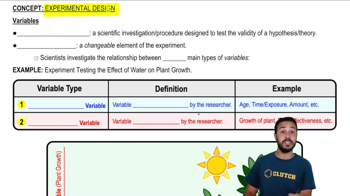
Independent Variable
A variable controlled or modified by the researcher in an experiment.
Dependent Variable
A variable that is measured or investigated by the researcher.
Control Group
A group in an experiment that is used to prevent false positives and false negatives.
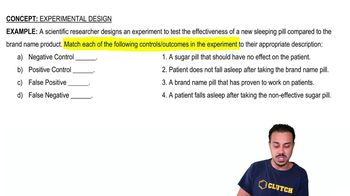
What is a false positive?
An outcome that falsely indicates the presence of a result.
What is a false negative?
An outcome that falsely indicates the absence of a result.
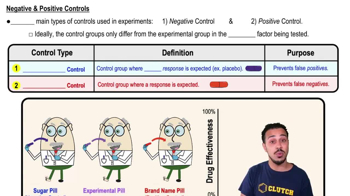
Negative Control
A control group where no response is expected, used to prevent false positives.
Positive Control
A control group where a response is expected, used to prevent false negatives.
What is the purpose of a negative control?
To prevent false positives.
What is the purpose of a positive control?
To prevent false negatives.
Placebo
A fake pill, often used as a negative control in experiments.
What is an example of an independent variable?
The amount of time someone is exposed to a chemical.
What is an example of a dependent variable?
The growth of a plant.
How do scientists prevent false positives and negatives?
By using control groups, including negative and positive controls.
What is measured on the y-axis of a graph in an experiment?
The dependent variable.
What is controlled on the x-axis of a graph in an experiment?
The independent variable.
What is the role of a placebo in an experiment?
To act as a negative control, ensuring no response is expected.
What is the role of a brand name pill in an experiment?
To act as a positive control, ensuring a response is expected.
What does a well-designed experiment contain?
Control groups to prevent false positives and false negatives.
What is the relationship between independent and dependent variables?
The independent variable is controlled by the researcher, while the dependent variable is measured.
What is an example of a negative control?
Using a sugar pill in a drug effectiveness study.
What is an example of a positive control?
Using a proven brand name pill in a drug effectiveness study.
What does a false positive indicate?
The presence of a result when there is none.
What does a false negative indicate?
The absence of a result when there is one.
Why are control groups important in experiments?
They help ensure accurate results by preventing false positives and negatives.
What is the expected response of a negative control?
No response.
What is the expected response of a positive control?
A response.
How can the effectiveness of a new drug be tested?
By comparing it against a placebo (negative control) and a proven drug (positive control).
What does the independent variable represent in a graph?
The factor controlled or modified by the researcher, usually on the x-axis.
What does the dependent variable represent in a graph?
The factor measured by the researcher, usually on the y-axis.
 BackBack
 07:36
07:36