Biodiversity loss. Extinction events lead to a significant loss in biodiversity.
What poses the greatest risk for species extinction?
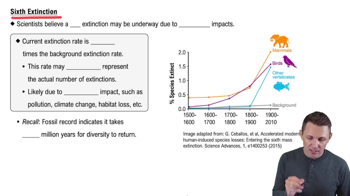
Human activity. The current potential sixth extinction is driven by human activities such as pollution and habitat loss.
Which scenario would most likely result in the extinction of one or more species? A) Introduction of a new predator B) Stable climate conditions C) Increase in food supply D) Expansion of habitat
A) Introduction of a new predator. New predators can lead to competition and extinction of existing species.
Which clade is believed to have died out among birds, non-avian dinosaurs, mammals, and insects?
Non-avian dinosaurs. Non-avian dinosaurs went extinct during the Cretaceous extinction event.
What causes an extinction cascade?
Loss of a keystone species. The extinction of a keystone species can lead to a cascade of extinctions in the ecosystem.
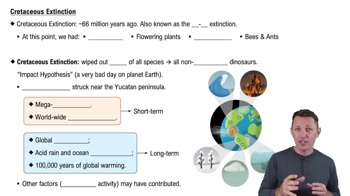
What is the impact hypothesis related to the Cretaceous extinction event?
The impact hypothesis suggests that a meteorite struck Earth, causing massive environmental changes leading to the extinction of many species, including non-avian dinosaurs.
What is the 'great dying' referring to in the context of extinctions?
The 'great dying' refers to the Permian extinction event, which wiped out approximately 96% of marine species and 70% of terrestrial species due to volcanic activity.
What is the potential sixth extinction, and what is driving it?
The potential sixth extinction is believed to be underway due to human activities, with extinction rates far exceeding historical averages.
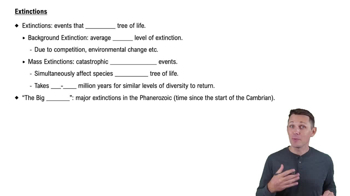
What is the difference between background extinction and mass extinction, and what are the main causes of each?
Background extinction refers to the normal, sporadic loss of species due to factors like competition and environmental changes, while mass extinction is a rare, catastrophic event that wipes out a large percentage of species across many groups, often caused by events like volcanic eruptions or meteorite impacts.
What caused the Cretaceous (KT) extinction event, and which major groups of organisms were most affected?
The Cretaceous extinction, about 66 million years ago, was primarily caused by a meteorite impact near the Yucatan Peninsula, leading to fires, global winter, acid rain, and long-term climate change. It wiped out about 75% of all species, including most non-avian dinosaurs.
How long does it typically take for biodiversity to recover after a mass extinction, and what does this imply for current and future species diversity?
It typically takes 5 to 100 million years for biodiversity to recover to previous levels after a mass extinction, meaning that the loss of species today could result in millions of years with reduced diversity on Earth.
 Back
Back
 04:55
04:55