What are the primary factors that limit net primary production (NPP) in aquatic ecosystems, and how do they influence productivity?
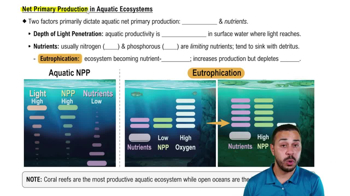
The primary factors limiting NPP in aquatic ecosystems are light and nutrients (mainly nitrogen and phosphorus). Light availability decreases with depth, so surface waters have higher productivity due to more light for photosynthesis. Nutrients are often limited in surface waters but can increase NPP when added.
How does eutrophication affect oxygen levels and aquatic life in aquatic ecosystems?
Eutrophication increases nutrient levels, boosting NPP and supporting more life. However, when organisms die, their decay consumes oxygen, leading to oxygen depletion. This can create low-oxygen environments where aerobic organisms, like fish, cannot survive.
Which environmental factors increase net primary production (NPP) in terrestrial ecosystems, and which ecosystems are the most and least productive?
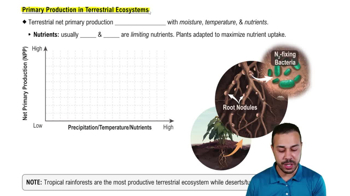
NPP in terrestrial ecosystems increases with higher moisture, temperature, and nutrient availability (especially nitrogen and phosphorus). Tropical rainforests are the most productive due to high precipitation and temperature, while deserts and tundras are the least productive because of low precipitation and/or low temperatures.
What adaptation helps some terrestrial plants maximize nitrogen uptake, and why is this important for NPP?
Some terrestrial plants form mutualistic relationships with nitrogen-fixing bacteria in root nodules. These bacteria convert unusable nitrogen gas into forms plants can use, increasing nitrogen availability and supporting higher NPP.
What are the two primary factors that limit net primary production (NPP) in aquatic ecosystems?
The two primary limiting factors are light and nutrients, mainly nitrogen and phosphorus.
How does light availability change with depth in aquatic ecosystems, and how does this affect NPP?
Light availability decreases with depth, so surface waters have higher NPP due to more light for photosynthesis.
What is eutrophication and how does it impact oxygen levels in aquatic ecosystems?
Eutrophication is the process of nutrient enrichment, which increases NPP but leads to oxygen depletion as decaying organisms consume oxygen.
Which environmental factors increase NPP in terrestrial ecosystems?
NPP in terrestrial ecosystems increases with higher moisture, temperature, and nutrient availability, especially nitrogen and phosphorus.
What adaptation helps some terrestrial plants maximize nitrogen uptake, and why is this important?
Some plants form mutualistic relationships with nitrogen-fixing bacteria in root nodules, which convert nitrogen gas into usable forms, supporting higher NPP.
Which terrestrial ecosystems are the most and least productive, and why?
Tropical rainforests are the most productive due to high precipitation and temperature, while deserts and tundras are the least productive because of low precipitation and/or low temperatures.
What are three environmental factors that affect the rate of photosynthesis in ecosystems?
The three main environmental factors that affect the rate of photosynthesis are light availability, nutrient availability (especially nitrogen and phosphorus), and temperature.
Which single essential nutrient most commonly limits productivity in both aquatic and terrestrial ecosystems?
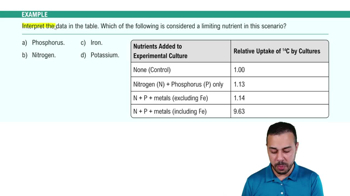
Nitrogen is the single essential nutrient that most commonly limits productivity in both aquatic and terrestrial ecosystems, though phosphorus can also be limiting.
Where does the majority of photosynthesis on Earth occur?
The majority of photosynthesis on Earth occurs in the surface waters of aquatic ecosystems, particularly in oceans, due to their vast area and light penetration.
Which factor least influences the rate of photosynthesis in aquatic ecosystems compared to others?
In aquatic ecosystems, temperature generally has less influence on the rate of photosynthesis compared to light and nutrient availability.
List three factors that affect the rate of photosynthesis in terrestrial ecosystems.
The rate of photosynthesis in terrestrial ecosystems is affected by moisture, temperature, and nutrient availability (especially nitrogen and phosphorus).
What are the three main factors that impact photosynthesis in aquatic ecosystems?
The three main factors impacting photosynthesis in aquatic ecosystems are light penetration, nutrient availability (nitrogen and phosphorus), and, to a lesser extent, temperature.
What environmental factors can limit the rate of photosynthesis in plants?
Environmental factors that can limit the rate of photosynthesis in plants include insufficient light, low nutrient levels (especially nitrogen and phosphorus), and suboptimal temperature or moisture.
Name three environmental factors that can affect photosynthesis in both aquatic and terrestrial ecosystems.
Three environmental factors that can affect photosynthesis in both aquatic and terrestrial ecosystems are light availability, nutrient availability (nitrogen and phosphorus), and temperature.
What term describes the total rate of photosynthesis in a given area?
The total rate of photosynthesis in a given area is called net primary production (NPP).
How is net primary production (NPP) defined in ecology?
Net primary production (NPP) is defined as the total rate at which photosynthetic organisms produce organic compounds in an area, minus the energy they use for respiration.
What three factors affect the rate of photosynthesis in ecosystems?
The rate of photosynthesis in ecosystems is affected by light availability, nutrient availability (especially nitrogen and phosphorus), and temperature.
What are common limiting factors for plant growth in terrestrial ecosystems?
Common limiting factors for plant growth in terrestrial ecosystems include low moisture, low temperature, and insufficient nutrients, particularly nitrogen and phosphorus.
Which factors affect the rate of photosynthesis in aquatic and terrestrial ecosystems?
The rate of photosynthesis in aquatic and terrestrial ecosystems is affected by light availability, nutrient availability (nitrogen and phosphorus), and temperature.