Back

Genetic Drift quiz #2

Control buttons has been changed to "navigation" mode.
1/23
  • How do natural disasters contribute to genetic drift?

    Natural disasters can cause population bottlenecks, drastically reducing population size and accelerating genetic drift, leading to significant shifts in allele frequencies.
  • What is genetic drift?

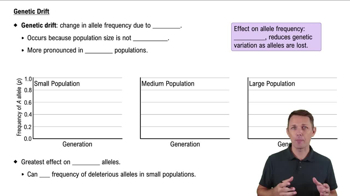
    Genetic drift is a random change in allele frequency due to chance, particularly pronounced in small populations, leading to the loss of genetic variation.
  • Which phenomenon usually only affects very small populations?

    Genetic drift
  • What describes the founder effect?

    The founder effect occurs when a small group from a population establishes a new population, leading to allele frequencies that reflect the founders' genetic makeup.
  • Which is a consequence of a population that has undergone a bottleneck?

    A population bottleneck can lead to reduced genetic variation and significant changes in allele frequencies due to accelerated genetic drift.
  • What effect do you think genetic drift would have on the genetic diversity of a population?

    Genetic drift tends to reduce genetic diversity by causing random loss of alleles, especially in small populations.
  • What is true about genetic drift regarding its effect on populations?

    It is more pronounced in small populations
  • Which statement accurately describes genetic drift?

    Genetic drift is a random change in allele frequencies due to chance, with more pronounced effects in small populations.
  • Why is genetic drift aptly named?

    Genetic drift is aptly named because it involves random 'drifting' of allele frequencies due to chance events.
  • What is the difference between gene flow and genetic drift?

    Gene flow involves the transfer of alleles between populations, while genetic drift is the random change in allele frequencies within a population.
  • What is a correct statement about genetic drift?

    Genetic drift can lead to random changes in allele frequencies, especially in small populations, and can result in the loss of genetic variation.
  • In what situation is genetic drift most likely to cause evolution?

    Small isolated population
  • What is an example of the founder effect?

    A small group of individuals establishing a new population
  • What is an example of genetic drift?

    A small population losing alleles due to chance
  • What factor does not cause genetic drift?

    A) Random mating
  • What is an example of genetic drift resulting from the founder effect?

    B) A new population established by a few individuals
  • What is the difference between genetic drift and gene flow?

    Genetic drift is the random change in allele frequencies within a population, while gene flow involves the movement of alleles between populations.
  • How does genetic drift affect small populations differently than large populations?

    Genetic drift has a more pronounced effect in small populations, leading to larger and more rapid changes in allele frequencies compared to large populations.
  • Which of these best describes genetic drift? A) Predictable changes in allele frequencies B) Random changes in allele frequencies C) Changes due to natural selection D) Changes due to gene flow

    B) Random changes in allele frequencies
  • What describes how genetic drift occurs?

    Genetic drift occurs due to random changes in allele frequencies, often resulting from chance events, especially in small populations.
  • What is an example of genetic drift?

    B) A small population losing alleles due to chance
  • What is genetic drift and how does it differ from natural selection in terms of predictability and effect on allele frequencies?

    Genetic drift is a random change in allele frequency due to chance, especially in small populations. Unlike natural selection, which is predictable and based on fitness differences, genetic drift is unpredictable and can cause alleles to become fixed or lost regardless of their effect on fitness.
  • Why does genetic drift have a greater impact on small populations, and what can happen to neutral and deleterious alleles as a result?

    Genetic drift has a greater impact on small populations because random fluctuations in allele frequencies are more pronounced. This can lead to the fixation or loss of alleles, including neutral alleles (which do not affect fitness) and even deleterious alleles, which may increase in frequency by chance despite being harmful.