 Back
BackHeart Physiology exam

 07:53
07:53
Terms in this set (29)
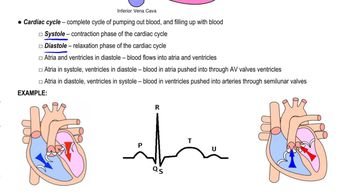
Cardiac Cycle
A complete cycle of pumping out blood (systole) and filling up with blood (diastole).
What is the function of the sinoatrial node?
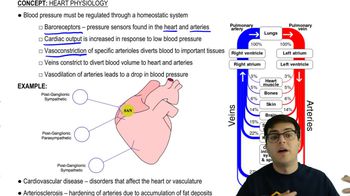
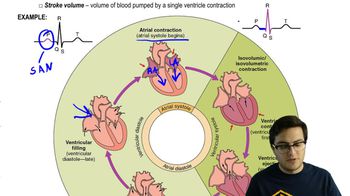
It initiates action potentials that propagate through the heart, leading to coordinated contractions.
Systole
The contraction phase of the cardiac cycle where the heart muscles contract and pump blood.
What is the typical blood pressure reading?
Around 120/80 mmHg.
Diastole
The relaxation phase of the cardiac cycle where the heart fills with blood.
What is the role of baroreceptors?
They detect blood pressure and help maintain homeostasis by adjusting blood volume and vessel diameter.
Systolic Blood Pressure
The highest blood pressure in the arteries during the peak of heart contractions.
What is the function of the atrioventricular node?
It delays the action potential to allow the atria to empty blood into the ventricles before they contract.
Diastolic Blood Pressure
The lowest blood pressure in the arteries during the relaxation phase of the heart.
What are Purkinje fibers?
Fibers that propagate the action potential through the ventricles from the bottom to the top.
Electrocardiogram (ECG)
A recording of the electrical activity of the heart.
What is cardiac output?
The volume of blood pumped per minute by the ventricle.
Stroke Volume
The volume of blood pumped by a single ventricle contraction.
What is hypertension?
Long-term high blood pressure, typically above 140 mmHg systolic.
Arteriosclerosis
The hardening of the arteries due to an accumulation of fat deposits.
What is a myocardial infarction?
A heart attack caused by a blockage in one of the coronary arteries.
Capillaries
Small blood vessels where nutrient and gas exchange occurs with tissues.
What is the role of veins in blood circulation?
Veins return blood to the heart and have valves to prevent backflow.
Intercalated Discs
Specialized structures in heart muscle that connect neighboring cells and contain gap junctions.
What is the function of the aorta?
The largest artery in the body that receives blood from the left ventricle.
Homeostasis in blood pressure
Maintained through baroreceptors, adjusting blood volume and vessel diameter.
What is the significance of the AV node delay?
It allows the atria to completely empty their blood into the ventricles before they contract.
High Density Lipoprotein (HDL)
Referred to as 'good cholesterol' because it scavenges excess cholesterol.
What is a stroke?
Damage to the brain tissue due to a lack of oxygen, often caused by a blocked or ruptured artery.
Low Density Lipoprotein (LDL)
Referred to as 'bad cholesterol' because it delivers cholesterol that can lead to fat deposits in arteries.
What is the role of the pulmonary artery?
It carries deoxygenated blood from the right ventricle to the lungs.
Gap Junctions
Channels between heart cells that allow ions to flow and propagate action potentials.
What is the function of the superior vena cava?
It returns deoxygenated blood from the upper body to the right atrium.
Atrioventricular Valves
Valves that allow blood to flow from the atria to the ventricles.