What is the structure in the center of the chromosome that holds the chromatids together?
The centromere is the structure that holds the chromatids together.
Which substance inhibits cell division?
Taxol
Why do normal cells divide?
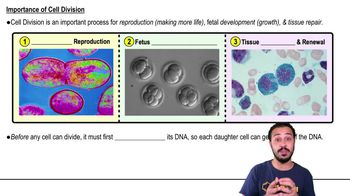
Normal cells divide for growth, reproduction, and tissue repair.
What are kinetochores?
Kinetochores are protein structures on the chromosome where spindle fibers attach during cell division.
What must a cell do first to divide successfully?
A cell must first replicate its DNA to divide successfully.
What occurs during lysis?
During lysis, the cell membrane breaks down, leading to cell death.
Cell division occurs as part of which process?
Cell division occurs as part of growth, reproduction, and tissue repair processes.
What is another name for cell division?
Cytokinesis
How do eukaryotic cells reproduce?
Eukaryotic cells reproduce through mitosis and meiosis.
What is cell division and why is it important for living organisms?
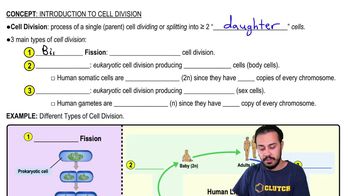
Cell division is the process by which a single parent cell splits into two or more daughter cells. It is essential for reproduction, growth, and tissue repair in living organisms.
Which type of cell division is used by prokaryotic cells such as bacteria?
Prokaryotic cells, such as bacteria, divide by binary fission.
What are daughter cells in the context of cell division?
Daughter cells are the cells that result from the division of a single parent cell.
What is the role of DNA replication in cell division?
Before a cell divides, it must replicate its DNA so that each daughter cell receives a complete copy of the genetic material.
What does it mean for a cell to be diploid?
A diploid cell has two copies of every chromosome, symbolized as 2n.
What does it mean for a cell to be haploid?
A haploid cell has only one copy of each chromosome, symbolized as n.
What is a zygote and how is it formed?
A zygote is the first cell of a new organism, formed by the fusion of two haploid gametes during fertilization.
What is asexual reproduction and what is its genetic outcome?
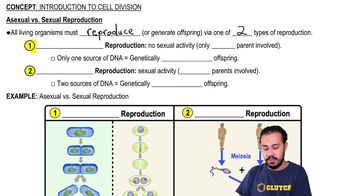
Asexual reproduction involves only one parent and produces offspring that are genetically identical to the parent.
What is sexual reproduction and how does it affect genetic diversity?
Sexual reproduction involves two parents and produces genetically diverse offspring due to the combination of different DNA from each parent.
Why are offspring from sexual reproduction genetically diverse?
Offspring from sexual reproduction are genetically diverse because they inherit different combinations of DNA from two parents.
What must happen to the DNA before a cell divides?
The DNA must be replicated so that each daughter cell receives a complete set of genetic information.
What is the main function of mitosis in multicellular organisms?
The main function of mitosis is to produce new diploid somatic cells for growth, development, and tissue repair.
How does the chromosome number change during mitosis?
The chromosome number remains the same; diploid cells produce diploid daughter cells.
What is the significance of genetic diversity in sexually reproducing populations?
Genetic diversity increases the chances of survival and adaptation in changing environments.
Why are the daughter cells produced by meiosis genetically different from each other?
Meiosis involves processes like crossing over and independent assortment, leading to genetic variation among gametes.
What is the difference between somatic cells and gametes?
Somatic cells are diploid body cells produced by mitosis, while gametes are haploid sex cells produced by meiosis.
What is the relationship between DNA replication and cell division?
DNA replication ensures that each daughter cell receives a complete set of genetic material during cell division.
What is the main purpose of binary fission in prokaryotes?
The main purpose is to reproduce and increase the population by creating genetically identical offspring.
What is the role of mitosis in tissue repair?
Mitosis produces new cells to replace damaged or dead cells, aiding in tissue repair.
What is the significance of the terms '2n' and 'n' in cell division?
'2n' refers to diploid cells with two sets of chromosomes, while 'n' refers to haploid cells with one set.
What would happen if gametes were produced by mitosis instead of meiosis?
Offspring would have double the normal chromosome number, disrupting genetic balance.
What is the main advantage of asexual reproduction?
It allows rapid population growth without the need for a mate.
How do prokaryotic and eukaryotic cell division processes differ?
Prokaryotes use binary fission, while eukaryotes use mitosis and meiosis.
Why is understanding cell division important for studying the life cycle of organisms?
Cell division underlies reproduction, growth, and development, which are key aspects of the life cycle.
What is the relationship between cell division and cancer?
Uncontrolled cell division can lead to cancer, where cells divide excessively and form tumors.
What is the outcome of binary fission in terms of genetic identity?
Binary fission produces two genetically identical daughter cells.
What is the outcome of meiosis in terms of chromosome number and genetic identity?
Meiosis produces four haploid gametes, each genetically unique.
What is the significance of the zygote in the human life cycle?
The zygote is the first diploid cell formed after fertilization, from which all other body cells arise through mitosis.
Why is cell division necessary for the survival of unicellular organisms?
It allows unicellular organisms to reproduce and maintain their populations.
How does the source of DNA differ between asexual and sexual reproduction?
Asexual reproduction uses DNA from one parent, while sexual reproduction combines DNA from two parents.
How does the process of mitosis ensure that each daughter cell receives the correct number of chromosomes?
Mitosis duplicates and evenly divides chromosomes so each daughter cell receives a full set.
 Back
Back
 04:45
04:45