Skip to main content
General Biology
My Course
Learn
Exam Prep
AI Tutor
Study Guides
Textbook Solutions
Flashcards
Explore
Try the app
My Course
Learn
Exam Prep
AI Tutor
Study Guides
Textbook Solutions
Flashcards
Explore
Try the app
Back
Introduction to DNA Cloning quiz #1
You can tap to flip the card.
What is recombinant DNA?
You can tap to flip the card.
👆
What is recombinant DNA?
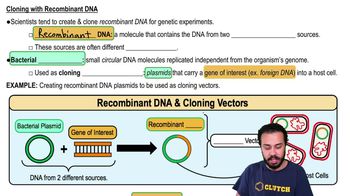
Recombinant DNA is a molecule that contains DNA from two different sources, often from different species.
Track progress
Control buttons has been changed to "navigation" mode.
1/15
Related flashcards
Related practice
Recommended videos
Introduction to DNA Cloning definitions
Introduction to DNA Cloning
18 Terms
Introduction to DNA Cloning exam
Introduction to DNA Cloning
28 Terms
Introduction to DNA Cloning quiz #2
Introduction to DNA Cloning
12 Terms
Introduction to DNA Cloning
18. Biotechnology
3 problems
Topic
Jason
Steps to DNA Cloning
18. Biotechnology
6 problems
Topic
Jason
18. Biotechnology - Part 1 of 2
5 topics
10 problems
Chapter
Jason
18. Biotechnology - Part 2 of 2
5 topics
9 problems
Chapter
Jason
02:25
Introduction to DNA Cloning
6512
views
62
rank
03:41
Cloning with Recombinant DNA
6287
views
62
rank
1
comments
Terms in this set (15)
Hide definitions
What is recombinant DNA?
Recombinant DNA is a molecule that contains DNA from two different sources, often from different species.
What role do bacterial plasmids play in DNA cloning?
Bacterial plasmids are small, circular DNA molecules that can be used as cloning vectors to carry a gene of interest into a host cell.
What is a cloning vector?
A cloning vector is a molecule, such as a plasmid, that can carry foreign DNA into a host cell.
What are the two general steps in DNA cloning?
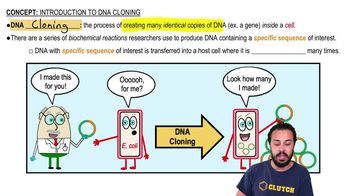
The two general steps in DNA cloning are creating the recombinant DNA molecule and transforming the DNA molecule into a host cell.
What enzyme is used to cut DNA during the creation of recombinant DNA?
Restriction enzymes are used to cut DNA during the creation of recombinant DNA.
What is the function of DNA ligase in DNA cloning?
DNA ligase is an enzyme that pastes or seals together DNA fragments to form a recombinant DNA molecule.
What is transformation in the context of DNA cloning?
Transformation is the process of allowing a bacterial cell to uptake external recombinant DNA.
How can recombinant DNA be used in a host cell?
Recombinant DNA can be used to carry a gene of interest into a host cell, where it can be replicated and expressed.
What is the significance of the gene of interest in DNA cloning?
The gene of interest is the specific gene that scientists want to clone and express in a host cell.
What is the role of bacterial host cells in DNA cloning?
Bacterial host cells uptake recombinant DNA and replicate it, allowing for the production of the gene of interest.
What is the purpose of using a cloning vector in genetic experiments?
The purpose of using a cloning vector is to introduce and replicate foreign DNA within a host cell.
What is the first step in creating recombinant DNA?
The first step in creating recombinant DNA is cutting the DNA using restriction enzymes.
What does the term 'ligation' refer to in DNA cloning?
Ligation refers to the process of pasting or sealing DNA fragments together using DNA ligase.
What is the outcome of successful DNA transformation in bacteria?
The outcome is that the bacteria will contain and replicate the recombinant DNA, producing the gene of interest.
Why are restriction enzymes compared to molecular scissors?
Restriction enzymes are compared to molecular scissors because they cut DNA at specific sites, similar to how scissors cut paper.
 BackBack
 02:25
02:25