 Back
BackIntroduction to DNA Replication definitions


 05:10
05:10
Terms in this set (27)
DNA Replication
The process by which a DNA molecule produces two identical copies, each with one original strand and one newly synthesized strand, ensuring genetic continuity.
Prokaryotic DNA Replication
The process by which a single circular chromosome in prokaryotes is duplicated, starting at a single origin of replication, involving enzymes like helicase, primase, and DNA polymerase.
Eukaryotic DNA Replication
The process by which eukaryotic cells duplicate their DNA, involving multiple origins of replication, various enzymes, and proteins to ensure accurate and complete DNA synthesis.
Semi-Conservative Process
During DNA replication, each original DNA strand serves as a template for a new complementary strand, resulting in two DNA molecules, each with one old and one new strand.
Parental Strands
Original DNA strands that serve as templates for the synthesis of new complementary DNA strands during replication.
DNA Molecule
A double-helix structure composed of nucleotides, carrying genetic instructions for the development, functioning, growth, and reproduction of all known organisms and many viruses.
Complementary Base Pairing
The process where specific nitrogenous bases pair with their complementary counterparts (A with T, and C with G) to ensure accurate DNA replication and transcription.
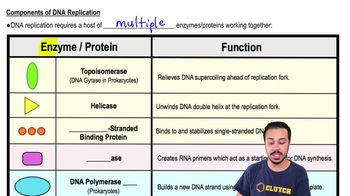
DNA Replication Components
Enzymes and proteins that unwind DNA, stabilize strands, synthesize primers, build new DNA, replace RNA primers, and join Okazaki fragments during DNA replication.
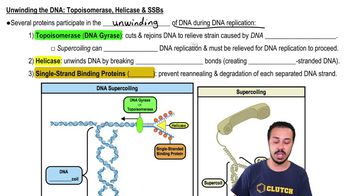
Topoisomerase
An enzyme that alleviates DNA supercoiling ahead of the replication fork by cutting, unwinding, and rejoining DNA strands. It is also termed DNA gyrase.
DNA Supercoiling
The twisting of DNA strands upon themselves creating tension and compact structures, which is relieved by enzymes like topoisomerase during replication.
Replication Fork
The Y-shaped region where DNA is unwound and new strands are synthesized during replication.
Helicase
An enzyme that unwinds the DNA double helix at the replication fork, allowing the strands to be copied.
Single Stranded Binding Proteins
Proteins that bind to and stabilize single-stranded DNA during replication, preventing it from re-annealing or forming secondary structures.
Primase
An enzyme that synthesizes short RNA primers on a DNA template, providing a starting point for DNA polymerase during replication.
RNA Primers
Short RNA sequences synthesized by primase to provide a starting point for DNA polymerase during DNA replication.
DNA Polymerase III
The primary enzyme in prokaryotic DNA replication that synthesizes new DNA strands by adding nucleotides to the 3' end of a pre-existing chain, using the original DNA as a template.
DNA Polymerase 1
An enzyme in prokaryotic DNA replication that removes RNA primers and replaces them with DNA nucleotides.
DNA Ligase
An enzyme that covalently joins Okazaki fragments on the lagging strand during DNA replication.
Okazaki Fragments
Short DNA segments synthesized discontinuously on the lagging strand during DNA replication, later joined by DNA ligase.
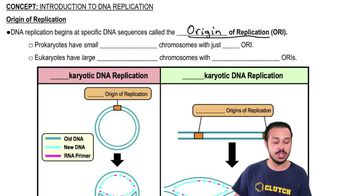
Origin Of Replication
A specific DNA sequence where replication begins, initiating the unwinding and synthesis of new DNA strands. Prokaryotes have one, while eukaryotes have multiple such sites.
Replication Bubble
A region of DNA where the double helix is unwound and replication occurs, forming two replication forks moving in opposite directions.
Replication Forks
The Y-shaped region where the DNA double helix is unwound and new DNA strands are synthesized during replication.
Linear Chromosome
A DNA structure found in eukaryotic cells, characterized by its straight, non-circular form, and containing multiple origins of replication.
Circular Chromosome
A DNA structure found in prokaryotes, consisting of a single, continuous loop of DNA, with one origin of replication, facilitating simpler replication processes compared to linear chromosomes.
DNA Strands
Two complementary, antiparallel sequences of nucleotides forming the double helix structure of DNA, serving as templates for replication and encoding genetic information.
Supercoiling
The overwinding or underwinding of DNA strands due to the helical structure, often relieved by topoisomerase enzymes during replication.
Double Helix Structure
A twisted ladder-like structure formed by two complementary strands of DNA, where the strands are connected by base pairs and coil around a common axis.