 Back
BackIntroduction to Eukaryotic Gene Regulation definitions


 04:22
04:22
Terms in this set (23)
Cellular Differentiation
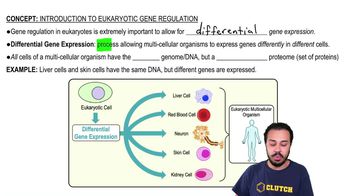
The process by which a cell becomes specialized to perform a specific function, driven by differential gene expression from the same genome.
Multicellular Organism
An organism composed of multiple cells that undergo cellular differentiation, where cells express different genes from the same genome to perform specialized functions.
Differential Gene Expression
The process by which cells with identical genomes express different sets of genes, leading to distinct cell types and functions within a multicellular organism.
Genetic Code
The set of rules by which information encoded in DNA is translated into proteins, determining cellular function and differentiation.
Genome
The complete set of an organism's DNA, including all of its genes, which provides the instructions for building and maintaining that organism.
Eukaryotic Gene Regulation
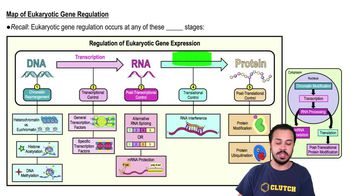
The process by which eukaryotic cells control gene expression at multiple stages, including chromatin modification, transcription, RNA processing, translation, and post-translational modification.
Chromatin Rearrangements
Changes in chromatin structure that regulate gene expression by altering DNA accessibility, involving processes like histone acetylation, DNA methylation, and the transition between heterochromatin and euchromatin.
Chromatin Modifications
Chemical changes to DNA or histone proteins that affect chromatin structure, influencing gene expression without altering the DNA sequence.
Heterochromatin
Densely packed chromatin that is transcriptionally inactive, often involved in maintaining structural integrity and regulating gene expression.
Euchromatin
Loosely packed chromatin that is transcriptionally active, allowing genes to be more accessible for transcription and gene expression.
Histone Acetylation
The addition of acetyl groups to histone proteins, reducing their positive charge, leading to a relaxed chromatin structure and increased gene expression.
DNA Methylation
The addition of methyl groups to DNA, typically at cytosine bases, which can repress gene transcription and play a role in cellular differentiation and gene regulation.
Transcriptional Control
Regulation of gene expression at the transcription stage, involving factors that enhance or inhibit the transcription of specific genes, determining which genes are transcribed into mRNA.
General Transcription Factors
Proteins essential for initiating transcription by helping RNA polymerase bind to the promoter region of DNA in eukaryotic cells.
Specific Transcription
The regulation of gene expression by specific transcription factors binding to DNA sequences, influencing the transcription of particular genes.
mRNA
A molecule that carries genetic information from DNA to the ribosome, where it serves as a template for protein synthesis.
RNA Interference
A biological process where small RNA molecules inhibit gene expression by causing the degradation of specific mRNA molecules or hindering their translation.
Post Translational Control
Regulation of protein function through chemical modifications after translation, affecting activity, stability, and localization.
Protein Modifications
Chemical changes to proteins after synthesis, affecting their function, stability, and interactions, crucial for cellular processes and regulation.
Protein Ubiquitination
Attachment of ubiquitin molecules to a protein, marking it for degradation by the proteasome, thus regulating protein levels and function in the cell.
RNA Processing
Modification of pre-mRNA in the nucleus, including splicing, capping, and polyadenylation, to produce mature mRNA for translation.
mRNA Degradation
The process by which mRNA molecules are enzymatically broken down, regulating gene expression by controlling the lifespan and availability of mRNA for translation.
Translation
The process where ribosomes synthesize proteins using mRNA as a template, converting nucleotide sequences into amino acid sequences.