Introduction to Meiosis quiz #1 Flashcards

Introduction to Meiosis quiz #1
Control buttons has been changed to "navigation" mode.
1/48
  • What are the two rounds of cell division in meiosis called?

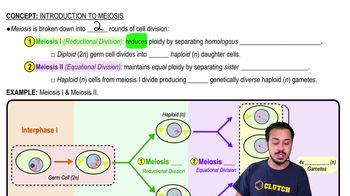
    The two rounds of cell division in meiosis are called meiosis I and meiosis II.

  • Why is meiosis I referred to as reductional division?

    Meiosis I is referred to as reductional division because it reduces the ploidy of the cells, turning a diploid cell into two haploid cells.

  • What is the main difference between meiosis I and meiosis II?

    The main difference is that meiosis I separates homologous chromosomes, while meiosis II separates sister chromatids.

  • What is the significance of interphase before meiosis begins?

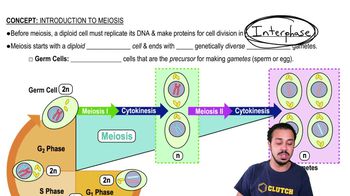
    Interphase is significant because it includes the replication of DNA, which is necessary before meiosis can start.

  • What phases does meiosis I include that are similar to mitosis?

    Meiosis 1 includes prophase 1, metaphase 1, anaphase 1, and telophase 1, similar to the phases in mitosis.

  • How do chromosomes align during metaphase I of meiosis I?

    During metaphase I of meiosis I, homologous chromosomes align in the middle of the cell in two rows.

  • What happens to homologous chromosomes during anaphase I of meiosis I?

    During anaphase I of meiosis I, homologous chromosomes are separated, while sister chromatids remain connected.

  • What is the result of cytokinesis after meiosis I?

    Cytokinesis after meiosis I produces two haploid daughter cells.

  • What is the ploidy of the cells at the end of meiosis II?

    At the end of meiosis II, the cells are haploid.

  • What are gametes and how are they related to meiosis?

    Gametes are sex cells (sperm in males and eggs in females) produced through meiosis.

  • What is the role of the S phase in interphase before meiosis?

    The S phase in interphase is when DNA is synthesized or replicated.

  • How does meiosis contribute to genetic diversity?

    Meiosis contributes to genetic diversity by producing four genetically diverse haploid gametes.

  • What is the difference between diploid and haploid cells?

    Diploid cells have two sets of chromosomes (2n), while haploid cells have one set of chromosomes (n).

  • What is the significance of meiosis in sexual reproduction?

    Meiosis is significant in sexual reproduction because it produces haploid gametes that combine during fertilization to form a diploid zygote.

  • What is the difference between homologous chromosomes and sister chromatids?

    Homologous chromosomes are pairs of chromosomes, one from each parent, while sister chromatids are identical copies of a single chromosome connected by a centromere.

  • homologous chromosomes migrate to opposite poles during _____.
    anaphase I
  • meiosis i produces _____ cells, each of which is _____.
    two, haploid
  • if an organism's diploid number is 12, what would be its haploid number? 3 6 24 48
    6
  • at the end of anaphase i in meiosis, each pole of the cell contains which of the following?
    a haploid set of chromosomes
  • crossing over of chromosomes normally takes place during which of the following processes?
    prophase I
  • which of the following processes occurs in meiosis but not in mitosis?
    synapsis and crossing over
  • which of these best describes the primary goal of meiosis?
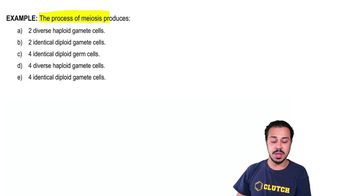
    to produce four genetically diverse haploid gametes
  • how does this compare to the two cells at the end of telophase i and cytokinesis i in male cells?
    Each cell is haploid and genetically diverse.
  • which of the following events occur during prophase i?
    synapsis and crossing over
  • which of the following processes occur during meiosis but not mitosis?
    formation of tetrads and crossing over
  • which of the following occurs during meiosis, but not during mitosis?
    homologous chromosomes pair up and exchange segments
  • nondisjunction of the ______ chromosome during meiosis can produce offspring that are xxx or xxy.
    sex
  • during which of the following phases of meiosis do homologous chromosomes separate?
    anaphase I
  • which process reduces the chromosome number from 2n to n?
    meiosis I
  • which of the following occurs in meiosis, but not mitosis?
    homologous chromosomes pair up and exchange segments
  • crossing over is the process in which ______.
    homologous chromosomes exchange genetic material
  • meiosis i produces _____ cells, each of which is _____
    two, haploid
  • during which stage of meiosis do synapsis and crossing over occur?
    prophase I
  • which of the following results in a situation in which the chromosome number is either 2n+1 or 2nāˆ’1?
    nondisjunction
  • which statement correctly describes the chromosomes in each daughter cell at the end of meiosis i?
    Each daughter cell has a haploid set of chromosomes, each consisting of two sister chromatids.
  • during which phase of meiosis will homologous chromosomes move to opposite poles?
    anaphase I
  • what occurs during meiosis but not mitosis?
    homologous chromosomes pair up and exchange segments
  • how many times will the cell go through pmat in meiosis?
    twice
  • during which of the following processes does independent assortment of chromosomes occur?
    metaphase I
  • during which stage of meiosis do homologous chromosome pairs line up in the middle of the cell?
    metaphase I
  • which of the following events occur during anaphase i?
    homologous chromosomes are pulled to opposite poles
  • at the end of meiosis, _____ form.
    four genetically diverse haploid gametes
  • which is true of anaphase ii?
    sister chromatids separate and move to opposite poles
  • the developing female gametes, as they progress through meiosis i, are called ______.
    oocytes
  • at metaphase i, homologous chromosomes are connected only at what structures?
    chiasmata
  • meiosis usually produces ________ daughter cells.
    four haploid
  • during anaphase ii of meiosis, _____ separate and go to opposite poles.
    sister chromatids
  • during which phase of meiosis do sister chromatids separate and move to opposite poles?
    anaphase II