Photosynthesis occurs in the chloroplasts of plant cells.
What are the main products of photosynthesis?
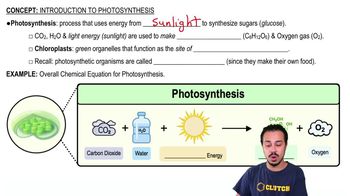
The main products of photosynthesis are glucose (C6H12O6) and oxygen (O2).
What type of organisms are capable of performing photosynthesis?
Autotrophs, such as plants, algae, and some bacteria, are capable of performing photosynthesis.
What does the term 'autotroph' mean?
An autotroph is an organism that can produce its own food from inorganic substances, typically through photosynthesis.
What is the role of sunlight in photosynthesis?
Sunlight provides the energy needed to drive the chemical reactions that convert carbon dioxide and water into glucose and oxygen.
What happens to the oxygen produced during photosynthesis?
The oxygen produced during photosynthesis is released into the environment or used by the plant for cellular respiration.
What is a redox reaction?
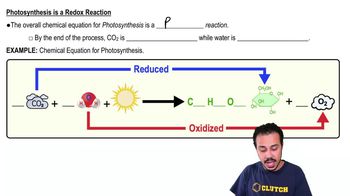
A redox reaction is a chemical reaction that involves the transfer of electrons between molecules, including both oxidation and reduction processes.
Which molecule is reduced during photosynthesis?
Carbon dioxide (CO2) is reduced during photosynthesis, gaining electrons to form glucose.
Which molecule is oxidized during photosynthesis?
Water (H2O) is oxidized during photosynthesis, losing electrons to form oxygen.
How are photosynthesis and cellular respiration related?
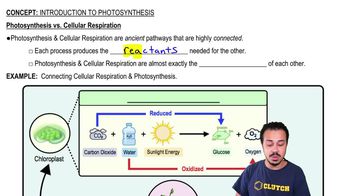
Photosynthesis and cellular respiration are interconnected; the products of one serve as the reactants for the other, making their chemical equations nearly opposite.
What is the main function of chloroplasts?
The main function of chloroplasts is to serve as the site of photosynthesis in plant cells.
What is the main function of mitochondria in cells?
The main function of mitochondria is to carry out cellular respiration, converting glucose and oxygen into ATP, carbon dioxide, and water.
How does the chemical equation for photosynthesis compare to that of cellular respiration?
The chemical equation for photosynthesis is nearly the reverse of cellular respiration; photosynthesis uses CO2 and H2O to produce glucose and O2, while cellular respiration uses glucose and O2 to produce CO2 and H2O.
What is the significance of the phrase 'LEO the lion goes GER' in redox reactions?
'LEO the lion goes GER' helps remember that Losing Electrons is Oxidation (LEO) and Gaining Electrons is Reduction (GER).
Why does carbon dioxide need to be reduced during photosynthesis?
Carbon dioxide needs to be reduced to gain electrons and form the chemical bonds present in glucose.
Why is water oxidized during photosynthesis?
Water is oxidized during photosynthesis to provide the electrons needed to reduce carbon dioxide and form glucose.
What is the role of glucose produced in photosynthesis?
Glucose produced in photosynthesis serves as an energy source for the plant and as a building block for other organic molecules.
How do the products of photosynthesis support cellular respiration?
The glucose and oxygen produced by photosynthesis are used as reactants in cellular respiration to generate ATP.
How do the products of cellular respiration support photosynthesis?
The carbon dioxide and water produced by cellular respiration are used as reactants in photosynthesis.
What is the main energy transformation that occurs during photosynthesis?
During photosynthesis, light energy from the sun is transformed into chemical energy stored in glucose.
What is the main energy transformation that occurs during cellular respiration?
During cellular respiration, chemical energy in glucose is transformed into ATP, a usable form of energy for cells.
Why are photosynthesis and cellular respiration considered complementary processes?
They are complementary because the products of one process are the reactants of the other, facilitating energy flow and matter cycling in ecosystems.
What is the importance of photosynthesis for life on Earth?
Photosynthesis is essential for producing oxygen and organic molecules that sustain most life forms on Earth.
What is the source of the oxygen released during photosynthesis?
The oxygen released during photosynthesis comes from the splitting of water molecules.
What is the role of electrons in the process of photosynthesis?
Electrons are transferred from water to carbon dioxide, reducing CO2 to glucose and oxidizing H2O to O2.
What is the significance of glucose in plant metabolism?
Glucose is a primary energy source and a precursor for synthesizing other organic molecules in plants.
How does the structure of glucose differ from that of carbon dioxide?
Glucose has more chemical bonds and stores more energy than carbon dioxide, which is a simple molecule.
What is the fate of the glucose produced in photosynthesis?
Glucose can be used for energy, stored as starch, or used to build other organic molecules in the plant.
What is the fate of the oxygen produced in photosynthesis?
Oxygen is released into the atmosphere or used by the plant for cellular respiration.
Why is photosynthesis considered an anabolic process?
Photosynthesis is anabolic because it builds complex molecules (glucose) from simpler ones (CO2 and H2O).
Why is cellular respiration considered a catabolic process?
Cellular respiration is catabolic because it breaks down complex molecules (glucose) into simpler ones (CO2 and H2O), releasing energy.
What is the role of ATP in cellular respiration?
ATP is the main energy currency produced during cellular respiration, used to power cellular activities.
What is the main difference in the type of energy involved in photosynthesis versus cellular respiration?
Photosynthesis uses solar energy, while cellular respiration produces ATP energy.
How does the process of photosynthesis contribute to the carbon cycle?
Photosynthesis removes carbon dioxide from the atmosphere and incorporates it into organic molecules.
How does the process of cellular respiration contribute to the carbon cycle?
Cellular respiration releases carbon dioxide back into the atmosphere as glucose is broken down.
What is the importance of the interdependence between photosynthesis and cellular respiration in ecosystems?
Their interdependence ensures a continuous flow of energy and recycling of matter, supporting life in ecosystems.
What is the role of chlorophyll in photosynthesis?
Chlorophyll absorbs light energy, which is used to drive the reactions of photosynthesis.
Why are chloroplasts green?
Chloroplasts are green because they contain chlorophyll, which reflects green light.
What is the significance of the phrase 'synthesis' in photosynthesis?
'Synthesis' refers to the building of sugars, such as glucose, from simpler molecules during photosynthesis.
What is the significance of the phrase 'photo' in photosynthesis?
'Photo' refers to the use of light energy in the process of photosynthesis.
 Back
Back
 03:32
03:32