Skip to main content
General Biology
My Course
Learn
Exam Prep
AI Tutor
Study Guides
Textbook Solutions
Flashcards
Explore
Try the app
My Course
Learn
Exam Prep
AI Tutor
Study Guides
Textbook Solutions
Flashcards
Explore
Try the app
Back
Introduction to Photosynthesis quiz #6
You can tap to flip the card.
How does the process of photosynthesis affect atmospheric oxygen levels?
You can tap to flip the card.
👆
How does the process of photosynthesis affect atmospheric oxygen levels?
Photosynthesis increases atmospheric oxygen levels by producing O2 as a byproduct.
Track progress
Control buttons has been changed to "navigation" mode.
1/40
Related flashcards
Related practice
Recommended videos
Introduction to Photosynthesis definitions
Introduction to Photosynthesis
8 Terms
Introduction to Photosynthesis quiz #1
Introduction to Photosynthesis
35 Terms
Introduction to Photosynthesis exam
Introduction to Photosynthesis
29 Terms
Introduction to Photosynthesis
9. Photosynthesis
4 problems
Topic
Jason
Leaf & Chloroplast Anatomy
9. Photosynthesis
4 problems
Topic
Jason
9. Photosynthesis - Part 1 of 2
6 topics
8 problems
Chapter
Jason
9. Photosynthesis - Part 2 of 2
5 topics
8 problems
Chapter
Jason
Guided course
03:32
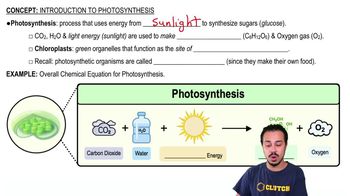
Introduction to Photosynthesis
18420
views
345
rank
Guided course
03:20
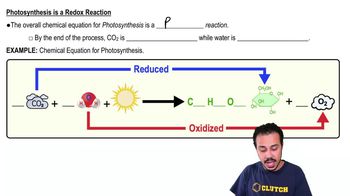
Photosynthesis is a Redox Reaction
15919
views
233
rank
1
comments
Guided course
07:55
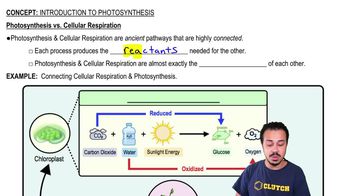
Photosynthesis vs. Cellular Respiration
14680
views
176
rank
Terms in this set (40)
Hide definitions
How does the process of photosynthesis affect atmospheric oxygen levels?
Photosynthesis increases atmospheric oxygen levels by producing O2 as a byproduct.
How does the process of cellular respiration affect atmospheric oxygen levels?
Cellular respiration decreases atmospheric oxygen levels by consuming O2 to produce water.
What is the relationship between the number of carbon dioxide and water molecules used in photosynthesis?
Six molecules of carbon dioxide react with six molecules of water in photosynthesis to produce one glucose and six oxygen molecules.
What is the role of water in photosynthesis?
Water provides electrons for the reduction of carbon dioxide and is oxidized to produce oxygen.
What is the role of carbon dioxide in photosynthesis?
Carbon dioxide is reduced to form glucose during photosynthesis.
Why is photosynthesis essential for heterotrophic organisms?
Photosynthesis produces the organic molecules and oxygen that heterotrophs need for survival.
What is the main difference between autotrophs and heterotrophs?
Autotrophs can produce their own food through processes like photosynthesis, while heterotrophs must consume other organisms for energy.
What are the main reactants and products of photosynthesis?
The main reactants of photosynthesis are carbon dioxide, water, and sunlight, and the products are glucose and oxygen.
How are photosynthesis and cellular respiration chemically related?
Photosynthesis and cellular respiration are nearly opposite processes; the products of one serve as the reactants for the other.
During photosynthesis, which molecule is reduced and which is oxidized?
In photosynthesis, carbon dioxide is reduced to form glucose, while water is oxidized to produce oxygen.
What are the products of photosynthesis?
The products of photosynthesis are glucose (C6H12O6) and oxygen gas (O2).
Where does photosynthesis take place in plant cells?
Photosynthesis takes place in the chloroplasts of plant cells.
What energy transformation occurs during photosynthesis?
Photosynthesis transforms light energy from the sun into chemical energy stored in glucose.
In which organelle does photosynthesis occur?
Photosynthesis occurs in the chloroplast.
What type of energy transformation occurs during photosynthesis?
Light energy is converted into chemical energy during photosynthesis.
What are the raw materials for photosynthesis?
The raw materials for photosynthesis are carbon dioxide (CO2), water (H2O), and sunlight.
Photosynthesis uses sunlight to convert water and carbon dioxide into what products?
Photosynthesis uses sunlight to convert water and carbon dioxide into glucose and oxygen.
What are three sources of carbon dioxide for photosynthesis?
Three sources of carbon dioxide for photosynthesis are the atmosphere, respiration by organisms, and decomposition of organic matter.
What is a product of photosynthesis?
Oxygen gas (O2) is a product of photosynthesis.
What are the two main products of photosynthesis?
The two main products of photosynthesis are glucose and oxygen.
Which gas is removed from the atmosphere during photosynthesis?
Carbon dioxide (CO2) is removed from the atmosphere during photosynthesis.
What is the function of photosynthesis in plants?
The function of photosynthesis is to produce food (glucose) and oxygen for the plant and other organisms.
What types of organisms carry out photosynthesis?
Photosynthesis is carried out by autotrophs such as plants, algae, and some bacteria.
What are two products of photosynthesis?
Two products of photosynthesis are glucose and oxygen.
Where does the carbon that plants need for photosynthesis come from?
The carbon that plants need for photosynthesis comes from carbon dioxide in the atmosphere.
Where does photosynthesis take place in a plant?
Photosynthesis takes place in the chloroplasts of plant cells.
Why is photosynthesis important to living organisms?
Photosynthesis is important because it produces food and oxygen, supporting life on Earth.
What does 'photo' mean in the word photosynthesis?
'Photo' means light, referring to the use of sunlight in photosynthesis.
Photosynthesis takes place in which part of the plant?
Photosynthesis takes place in the chloroplasts within the cells of the plant's leaves.
How do algae make energy-rich carbon compounds?
Algae make energy-rich carbon compounds through photosynthesis.
The carbon that plants need for photosynthesis comes from what source?
The carbon comes from carbon dioxide in the atmosphere.
Which organisms perform photosynthesis?
Plants, algae, and some bacteria perform photosynthesis.
What type of organisms do photosynthesis?
Autotrophs, including plants, algae, and some bacteria, do photosynthesis.
What four substances are recycled during photosynthesis and respiration?
The four substances recycled are carbon dioxide, water, oxygen, and glucose.
What three things are needed for photosynthesis?
Photosynthesis requires carbon dioxide, water, and sunlight.
Which organism performs photosynthesis?
Autotrophic organisms such as plants, algae, and some bacteria perform photosynthesis.
Which organisms do photosynthesis?
Plants, algae, and some bacteria do photosynthesis.
Which best describes the nature of photosynthesis?
Photosynthesis is a redox reaction that converts light energy into chemical energy.
What is the word equation for photosynthesis?
Carbon dioxide + water + sunlight → glucose + oxygen.
Which molecule is used up in photosynthesis?
Carbon dioxide (CO2) is used up in photosynthesis.
 BackBack
 03:32
03:32