Skip to main content
General Biology
My Course
Learn
Exam Prep
AI Tutor
Study Guides
Textbook Solutions
Flashcards
Explore
Try the app
My Course
Learn
Exam Prep
AI Tutor
Study Guides
Textbook Solutions
Flashcards
Explore
Try the app
Back
Introduction to Prokaryotes quiz #2
You can tap to flip the card.
Which organisms are prokaryotes? Archaea, fungi, protists, or plants?
You can tap to flip the card.
👆
Which organisms are prokaryotes? Archaea, fungi, protists, or plants?
Archaea are prokaryotes.
Track progress
Control buttons has been changed to "navigation" mode.
1/38
Related flashcards
Related practice
Recommended videos
Introduction to Prokaryotes quiz #1
Introduction to Prokaryotes
1 Term
Introduction to Prokaryotes quiz #3
Introduction to Prokaryotes
37 Terms
Introduction to Prokaryotes quiz #4
Introduction to Prokaryotes
9 Terms
Introduction to Prokaryotes
26. Prokaryotes
5 problems
Topic
Prokaryote Cell Structures
26. Prokaryotes
4 problems
Topic
Jason
26. Prokaryotes - Part 1 of 2
5 topics
13 problems
Chapter
Jason
26. Prokaryotes - Part 2 of 2
2 topics
5 problems
Chapter
04:39
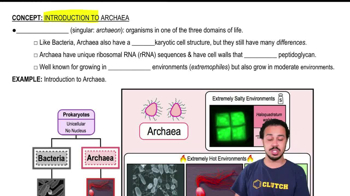
Introduction to Archaea
3284
views
37
rank
05:54
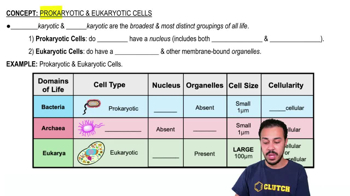
Prokaryotic & Eukaryotic Cells
3964
views
86
rank
03:54
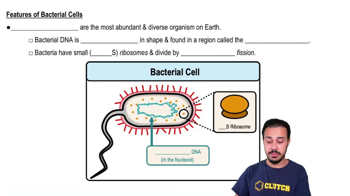
Features of Bacterial Cells
3146
views
51
rank
Terms in this set (38)
Hide definitions
Which organisms are prokaryotes? Archaea, fungi, protists, or plants?
Archaea are prokaryotes.
Which organisms are prokaryotes?
Prokaryotes include bacteria and archaea.
In which kingdom do all organisms have cells that lack a cell wall? Fungi, plants, animals, or bacteria?
Animals have cells that lack a cell wall.
Which domain(s) includes unicellular organisms?
All domains (Bacteria, Archaea, and Eukarya) include unicellular organisms.
Which domains contain prokaryotes?
The domains Bacteria and Archaea contain prokaryotes.
What cellular components can be found in bacteria?
Bacteria have circular DNA, ribosomes, and a cell membrane.
In prokaryotes, what is the shape of their DNA?
Prokaryotic DNA is circular.
Identify the two main domains that contain prokaryotes.
The two main domains that contain prokaryotes are Bacteria and Archaea.
Prokaryotes are classified as belonging to two different domains. What are the domains?
Prokaryotes belong to the domains Bacteria and Archaea.
Which organisms are prokaryotes? Archaea, fungi, protists, or plants?
Archaea are prokaryotes.
Which of the three domains contain(s) prokaryotic organisms?
The domains Bacteria and Archaea contain prokaryotic organisms.
In what ways are archaea similar to bacteria?
Archaea and bacteria both lack a nucleus and membrane-bound organelles, and have circular DNA.
How are archaea most similar to bacteria?
Archaea are similar to bacteria in that both are prokaryotic and lack a nucleus.
What are examples of biofilms?
Biofilms are communities of microorganisms that adhere to surfaces, such as dental plaque.
What characteristics do all members of the domain Bacteria share?
All bacteria lack a nucleus and have circular DNA.
Which prokaryotes are multicellular?
Prokaryotes are generally unicellular; there are no multicellular prokaryotes.
What term refers to a prokaryotic cell that is comma-shaped?
Vibrio refers to a comma-shaped prokaryotic cell.
Which type of microbe does not appear on the tree of life?
Viruses do not appear on the tree of life as they are not considered living organisms.
Which domains of life are classified as prokaryotes?
The domains Bacteria and Archaea are classified as prokaryotes.
How do spirochetes and spirilla differ?
Spirochetes are flexible spiral-shaped bacteria, while spirilla are rigid spiral-shaped bacteria.
What are the only prokaryotes?
The only prokaryotes are bacteria and archaea.
What characterizes the domain Bacteria?
The domain Bacteria is characterized by organisms that lack a nucleus and have peptidoglycan in their cell walls.
What is the definition of generation time in a bacterium?
Generation time is the time it takes for a bacterial population to double.
Which organisms are prokaryotes?
Bacteria and archaea are prokaryotes.
What is true about cyanobacteria?
Cyanobacteria are photosynthetic bacteria that produce oxygen.
What is one way that organisms in the domain Bacteria differ from organisms in the domain Archaea?
Bacteria have peptidoglycan in their cell walls, while archaea do not.
What is the function of a bacterial endospore?
A bacterial endospore allows the bacterium to survive harsh conditions.
What are the prokaryotic domains?
Bacteria and Archaea are prokaryotic domains.
Into which domains can a prokaryotic single-celled organism be classified?
A prokaryotic single-celled organism could be classified into the domains Bacteria or Archaea.
Give an example of a unicellular organism.
Bacteria are examples of unicellular organisms.
Which type of organism would not be included in the domain Eukarya?
Prokaryotic organisms, such as bacteria and archaea, are not included in the domain Eukarya.
Which are prokaryotic organisms that belong to domain Bacteria?
E. coli and Streptococcus are examples of prokaryotic organisms in the domain Bacteria.
What does the term microbiota refer to?
Microbiota refers to the community of microorganisms living in a particular environment, such as the human gut.
Which group of prokaryotes live in extreme environments and are sometimes called extremophiles?
Archaea are prokaryotes that live in extreme environments and are called extremophiles.
Which domains of life contain prokaryotes?
The domains Bacteria and Archaea contain prokaryotes.
What is correct about the genomes of prokaryotes?
Prokaryotic genomes are typically circular and found in the nucleoid region.
What are true characteristics of prokaryotes?
Prokaryotes lack a nucleus and membrane-bound organelles.
Which of the domains of life are all unicellular and prokaryotic?
The domains Bacteria and Archaea are all unicellular and prokaryotic.
 BackBack
 04:39
04:39