 Back
BackIsotopes definitions


 06:50
06:50
Terms in this set (10)
Atomic Number
The number of protons in the nucleus of an atom, determining the element's identity and position in the periodic table.
Mass Number
Sum of protons and neutrons in an atom's nucleus, determining its isotope.
Protons
Positively charged subatomic particles located in the nucleus of an atom, determining the atomic number and identity of the element.
Neutrons
Subatomic particles in an atom's nucleus with no electric charge, contributing to the atom's mass and differing in number among isotopes of the same element.
Atomic Nucleus
The central part of an atom containing protons and neutrons, determining the atom's mass and identity.
Isotopes
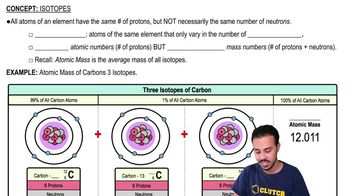
Atoms of the same element with different numbers of neutrons, resulting in different mass numbers.
Carbon 14
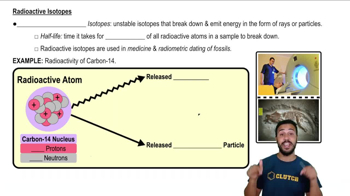
A radioactive isotope with a half-life of 5,730 years, used in dating organic materials by measuring the remaining amount in a sample.
Half Life
The time required for half of a radioactive substance to decay into a more stable form.
Radioactive Isotopes
Unstable isotopes that decay over time, emitting radiation and transforming into different elements or isotopes, characterized by a specific half-life.
Unstable
Prone to decay or change, often referring to radioactive isotopes that break down over time, releasing energy and particles.