 Back
BackKrebs Cycle exam


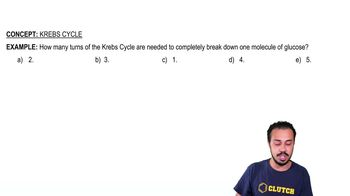
 01:20
01:20
Terms in this set (27)
Krebs Cycle
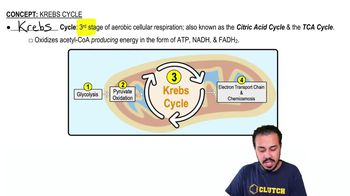
The third stage of aerobic cellular respiration, also known as the citric acid cycle or tricarboxylic acid (TCA) cycle.
What is the first phase of the Krebs Cycle?
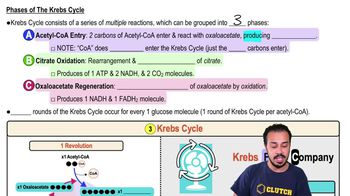
Acetyl CoA Entry
Acetyl CoA
A molecule that enters the Krebs Cycle and reacts with oxaloacetate to form citrate.
What are the key outputs of the Krebs Cycle per glucose molecule?
2 ATP, 6 NADH, 2 FADH2, and 4 CO2
Citrate
The first molecule produced in the Krebs Cycle when Acetyl CoA reacts with oxaloacetate.
What happens during citrate oxidation?
Citrate is rearranged and oxidized, producing 1 ATP, 2 NADH, and 2 CO2.
Oxaloacetate
A molecule that reacts with Acetyl CoA to form citrate and is regenerated at the end of the Krebs Cycle.
What is the purpose of oxaloacetate regeneration?
To regenerate oxaloacetate, allowing the Krebs Cycle to continue.
NADH
An electron carrier molecule produced during the Krebs Cycle.
What is the total output of ATP from the Krebs Cycle per glucose molecule?
2 ATP
FADH2
An electron carrier molecule produced during the Krebs Cycle.
What mnemonic can help remember the products of the Krebs Cycle?
Krebs Fan Company (FANCO): FADH2, ATP, NADH, CO2
CO2
A waste product of the Krebs Cycle that is exhaled.
What is the significance of the number 2264 in the Krebs Cycle?
It represents the total output: 2 FADH2, 2 ATP, 6 NADH, and 4 CO2.
Substrate-level phosphorylation in Kreb's cycle
Succinyl-CoA is converted to succinate, generating 1 ATP
What happens to the CoA portion of Acetyl CoA in the Krebs Cycle?
It does not enter the Krebs Cycle and is recycled.
Electron Transport Chain (ETC)
The final stage of aerobic cellular respiration where NADH and FADH2 are used to produce ATP.
How many revolutions of the Krebs Cycle occur per glucose molecule?
Two revolutions
Pyruvate oxidation
The process that converts pyruvate into Acetyl CoA before entering the Krebs Cycle.
What is produced during oxaloacetate regeneration?
1 NADH and 1 FADH2
Aerobic cellular respiration
A process that includes glycolysis, pyruvate oxidation, the Krebs Cycle, and the electron transport chain.
What is the main purpose of the Krebs Cycle?
To produce electron carriers (NADH and FADH2) for the electron transport chain.
Citric acid cycle
Another name for the Krebs Cycle, named after the first molecule produced, citrate.
What is the significance of citrate in the Krebs Cycle?
It is the first molecule produced when Acetyl CoA reacts with oxaloacetate.
TCA cycle
Another name for the Krebs Cycle, standing for tricarboxylic acid cycle.
What is the output of NADH from one revolution of the Krebs Cycle?
3 NADH
Phase b of the Krebs Cycle
Citrate oxidation