Where are chloroplasts mainly located within a leaf, and why?
Chloroplasts are mainly located within the mesophyll cells of the leaf because these cells are responsible for carrying out photosynthesis.
Describe the structure of a chloroplast.
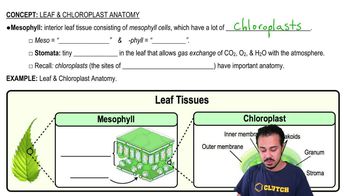
A chloroplast has an outer and inner membrane, contains stacks of thylakoids called grana, and has a fluid-filled region called the stroma.
Differentiate between stroma and stomata.
The stroma is the fluid-filled space inside a chloroplast, while stomata are pores on the leaf surface that control gas exchange.
How do stomata contribute to photosynthesis?
Stomata allow carbon dioxide to enter the leaf, which is necessary for photosynthesis, and enable the release of oxygen produced during the process.
Explain the relationship between mesophyll cells and photosynthesis.
Mesophyll cells contain numerous chloroplasts, making them the primary site for photosynthesis in the leaf.
Why is it important not to confuse the terms 'stroma' and 'stomata'?
It is important because 'stroma' refers to the fluid inside chloroplasts, while 'stomata' are pores on the leaf surface with entirely different functions.
How does the anatomy of the leaf facilitate efficient photosynthesis?
The leaf's anatomy, with mesophyll cells packed with chloroplasts and stomata for gas exchange, maximizes light absorption and the intake of carbon dioxide for efficient photosynthesis.
Where within a leaf are chloroplasts primarily found, and what is their main function there?
Chloroplasts are primarily found in the mesophyll cells of the leaf, where they serve as the site of photosynthesis.
What are the main structural components of a chloroplast?
A chloroplast has an outer and inner membrane, contains stacks of thylakoids called grana, and has a fluid-filled region called the stroma.
How do stomata and stroma differ in location and function?
Stomata are pores on the leaf surface that control gas exchange, while the stroma is the fluid-filled space inside a chloroplast where part of photosynthesis occurs.
Where in a plant does photosynthesis primarily occur?
Photosynthesis primarily occurs in the mesophyll tissue of the leaf, which contains many chloroplasts.
What is the main site of photosynthesis within a plant cell?
The main site of photosynthesis within a plant cell is the chloroplast.
Which part of the leaf contains the most chloroplasts and is responsible for photosynthesis?
The mesophyll, the interior tissue of the leaf, contains the most chloroplasts and is responsible for photosynthesis.
What are stomata and what is their function in the leaf?
Stomata are tiny pores on the leaf surface that regulate gas exchange, allowing carbon dioxide in and oxygen out.
What is the function of chloroplasts in plant cells?
Chloroplasts are the organelles where photosynthesis takes place, converting light energy into chemical energy.
What is the structure and function of grana in chloroplasts?
Grana are stacks of thylakoids within chloroplasts that increase the surface area for light absorption during photosynthesis.
How does the leaf's structure facilitate photosynthesis?
The leaf's mesophyll tissue is rich in chloroplasts for photosynthesis, and stomata allow for gas exchange necessary for the process.
What is the role of thylakoids in photosynthesis?
Thylakoids are membrane-bound structures within chloroplasts where the light-dependent reactions of photosynthesis occur.
What is the stroma in a chloroplast?
The stroma is the fluid-filled space within a chloroplast, surrounding the thylakoids, where the Calvin cycle takes place.
How do chloroplasts capture energy for photosynthesis?
Chloroplasts capture energy for photosynthesis by absorbing electromagnetic wavelengths of light.
What is the difference between stomata and stroma?
Stomata are pores on the leaf surface for gas exchange, while the stroma is the fluid-filled region inside the chloroplast.
Why are leaves typically the main site of photosynthesis in plants?
Leaves are the main site of photosynthesis because their mesophyll tissue contains many chloroplasts and their structure maximizes light absorption and gas exchange.
What is the function of the outer and inner membranes of the chloroplast?
The outer and inner membranes of the chloroplast enclose and protect the organelle, maintaining the environment needed for photosynthesis.
What gases are exchanged through the stomata during photosynthesis?
Carbon dioxide enters and oxygen exits through the stomata during photosynthesis.
What is the significance of the mesophyll in the process of photosynthesis?
The mesophyll is significant because it contains cells packed with chloroplasts, making it the primary tissue where photosynthesis occurs in the leaf.
 Back
Back

 08:18
08:18