 Back
BackLife's Organizational Hierarchy definitions

 09:50
09:50
Terms in this set (19)
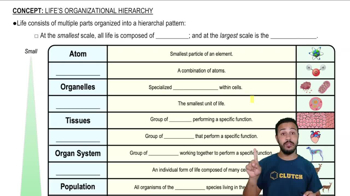
Atom
The smallest unit of matter, consisting of a nucleus surrounded by electrons, forming the basic building block of both living and non-living things.
Molecules
Combinations of atoms bonded together, forming the basic chemical units of a substance, essential in both living and non-living matter.
Organelles
Specialized structures within cells that perform distinct functions necessary for cellular life.
Cell
The smallest unit of life, capable of performing all essential life processes, including metabolism, growth, and reproduction.
Tissue
A group of identical cells working together to perform a specific function.
Organ
A structure composed of multiple tissues working together to perform specific functions within an organism.
Organ System
A group of organs working together to perform complex functions essential for the survival and efficiency of an organism.
Multicellular Organism
An entity composed of multiple cells that work together, each specialized for different functions, forming tissues, organs, and organ systems to sustain life.
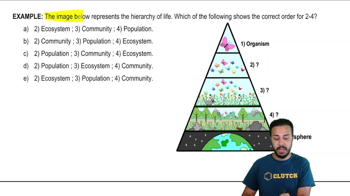
Population
A group of individuals of the same species living in a specific area, capable of interbreeding and sharing a common gene pool.
Community
A group of interacting populations of different species living in the same area.
Ecosystem
A system comprising a community of living organisms interacting with their physical environment, including both biotic and abiotic components.
Biosphere
The global sum of all ecosystems, encompassing all living organisms and their interactions with the abiotic environment, forming the largest scale of life's organizational hierarchy.
Cellular Level
The smallest unit of life where biological processes occur, composed of organelles and capable of independent function and reproduction.
Circulatory System
A system comprising the heart, blood, and blood vessels, responsible for transporting nutrients, gases, hormones, and wastes throughout the body.
Digestive System
A system of organs working together to convert food into energy and nutrients, absorb them, and expel waste, essential for maintaining homeostasis and supporting cellular functions.
Immune System
A complex network of cells, tissues, and organs that work together to defend the body against harmful pathogens and maintain overall health.
Nervous System
A complex network of cells and fibers that transmits signals between different parts of the body, enabling coordination, sensation, and response to stimuli.
Abiotic
Non-living physical and chemical components of an environment, such as sunlight, temperature, water, and minerals, that influence living organisms and ecosystems.
Biotic
Refers to the living components of an ecosystem, including all organisms such as plants, animals, fungi, and microorganisms.