 Back
BackMeiosis II definitions

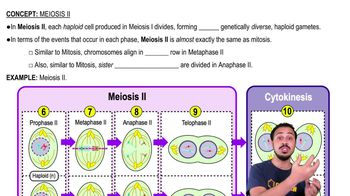
 06:17
06:17
Terms in this set (11)
Anaphase II
During this phase of meiosis, sister chromatids are pulled apart to opposite poles, similar to what occurs in mitosis.
Meiosis I
The phase of cell division where homologous chromosomes are separated, resulting in two haploid cells, each with half the original chromosome number.
Meiosis II
The phase in cellular division where sister chromatids are separated, resembling mitosis, following the separation of homologous chromosomes in the prior division.
Cellular Division
The process where a single cell divides to form two or more daughter cells, involving the separation of sister chromatids or homologous chromosomes.
Mitosis
A process of cell division where sister chromatids separate, resulting in two genetically identical daughter cells, crucial for growth, repair, and asexual reproduction.
Sister Chromatids
Identical copies of a chromosome connected by a centromere, which separate during anaphase of mitosis and anaphase II of meiosis.
Homologous Chromosomes
Pairs of chromosomes, one from each parent, that are similar in shape, size, and genetic content, and separate during meiosis I.
Cytoplasm
The gel-like substance within the cell membrane, excluding the nucleus, where organelles are suspended and various cellular processes occur.
Cytokinesis
The process where the cytoplasm divides, resulting in two daughter cells, typically occurring after mitosis or meiosis.
Daughter Nuclei
Nuclei formed after telophase, containing identical sets of chromosomes, resulting from the division of a single nucleus.
Telophase
The stage in cell division where daughter nuclei reform chromosomes decondense, and the nuclear envelope reassembles, marking the end of nuclear division.