 Back
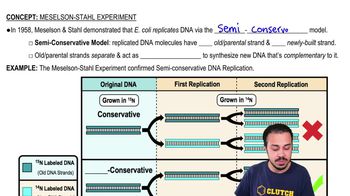
BackMeselson-Stahl Experiment definitions


 09:03
09:03
Terms in this set (15)
Semi Conservative DNA replication method
where each new double helix consists of one original strand and one newly synthesized strand.
Phage
A virus that infects and replicates within bacteria by injecting its DNA, leaving its protein coat outside the host cell.
Protein Coat
A protective shell composed of protein subunits that encases the genetic material of a virus, remaining outside the host cell during infection.
Viral DNA
Genetic material from a virus that, once injected into a host cell, directs the host's machinery to replicate new viral particles.
Host
An organism or cell that provides resources and environment for a virus, parasite, or symbiont to live, reproduce, or carry out its life cycle.
Replicate
To produce an exact copy of genetic material, ensuring the transmission of genetic information during cell division or viral infection.
Virus
A microscopic infectious agent that injects its genetic material into a host cell, hijacking the host's machinery to replicate itself, often leaving its protein coat outside the host.
Double Helix
A structure of DNA consisting of two intertwined strands forming a spiral, with strands running in opposite directions and held together by complementary base pairs.
Anti Parallel
Refers to the opposite orientation of the two strands of DNA, where one strand runs 5' to 3' and the other runs 3' to 5'.
Chargaff
Discovered that in DNA, the amount of adenine equals thymine, and the amount of guanine equals cytosine, indicating base pairing rules.
Adenine
A purine base in DNA and RNA that pairs with thymine in DNA and uracil in RNA, maintaining the structure and function of genetic material.
Thymine
A pyrimidine base in DNA that pairs with adenine, maintaining equal proportions as per Chargaff's rules.
Guanine
A purine base in DNA and RNA that pairs with cytosine through three hydrogen bonds, maintaining the structure of the double helix.
Cytosine
A nitrogenous base in DNA and RNA that pairs with guanine through three hydrogen bonds, playing a crucial role in the structure and function of genetic material.
Complementary Base Pairs
Nitrogenous bases in DNA pair specifically (A with T, G with C) due to hydrogen bonding, ensuring accurate replication and transcription.