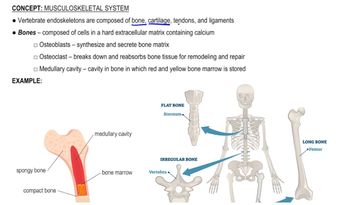
The support structure of an organism, composed of mineralized tissues like bone, working with muscles to enable movement and protect internal organs.
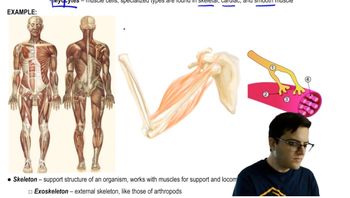
Myocytes
Specialized cells in muscle tissue capable of contraction, containing multiple nuclei and packed with myofibrils composed of actin and myosin for movement.
Myofibrils
Rod-like protein structures in muscle cells composed of actin and myosin, organized into sarcomeres, responsible for muscle contraction.
Sarcomeres
Contractile units in muscle fibers, composed of actin and myosin filaments, arranged between Z discs, responsible for muscle contraction and giving striated muscle its characteristic appearance.
Myofilaments
Protein structures in muscle cells, composed of actin (thin) and myosin (thick), that slide past each other to enable muscle contraction.
Endoskeleton
An internal support structure made of mineralized tissues like bone, providing shape, protection, and enabling movement in vertebrates.
Actin
A protein forming thin filaments in muscle fibers, interacting with myosin for muscle contraction, regulated by tropomyosin and troponin, and essential for the sliding filament model.
Myosin
A motor protein in muscle cells that interacts with actin to produce contraction through ATP-dependent movements, forming thick filaments in sarcomeres.
Tropomyosin
A protein that wraps around actin filaments, blocking myosin binding sites, and moves to expose these sites when troponin binds calcium, facilitating muscle contraction.
Troponin
A calcium-sensitive protein that, upon binding calcium, causes tropomyosin to move, exposing myosin binding sites on actin filaments, facilitating muscle contraction.
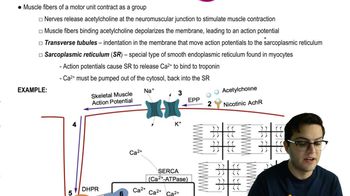
Sarcoplasmic Reticulum
A specialized smooth endoplasmic reticulum in muscle cells that stores and releases calcium ions to trigger muscle contraction.
Myoglobin
A muscle protein that stores oxygen, aiding in high-demand situations by providing an additional oxygen reserve when hemoglobin supply is insufficient.
 Back
Back
 03:14
03:14