 Back
BackNegative & Positive Feedback definitions



 02:19
02:19
Terms in this set (11)
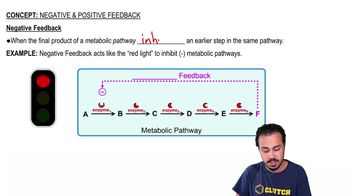
Negative Feedback
A regulatory mechanism where the end product of a metabolic pathway inhibits an earlier step, slowing or stopping the pathway to prevent overproduction.
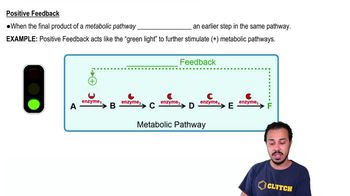
Positive Feedback
A process where the end product of a pathway amplifies its own production, leading to an increased rate of the pathway's activity.
Metabolic Pathway
A series of chemical reactions within a cell where the product of one reaction serves as the substrate for the next, often regulated by feedback mechanisms.
Enzyme
A biological catalyst that accelerates chemical reactions by lowering activation energy, often regulated by feedback mechanisms to control metabolic pathways.
End product Inhibition
The process where a product of a metabolic pathway binds to an enzyme at a site other than the active site, reducing the pathway's activity to regulate product levels.
Product
The final substance produced in a metabolic pathway, which can regulate the pathway by inhibiting earlier steps through feedback mechanisms.
Feedback Inhibition
A process where the end product of a metabolic pathway inhibits an earlier step, reducing the pathway's activity and preventing overproduction.
Pathway
A series of biochemical reactions where the product of one reaction serves as the substrate for the next, often regulated by feedback mechanisms.
Regulation
The process by which a final product inhibits an earlier step in its own metabolic pathway to control its production.
Physiological Importance
The role of a biological process in maintaining homeostasis and regulating metabolic pathways to ensure optimal function and balance within an organism.
Inhibitor
A molecule that binds to an enzyme, reducing its activity and slowing down or halting a metabolic pathway, often through feedback mechanisms.