 Back
BackNitrogen Fixation definitions

 06:31
06:31
Terms in this set (14)
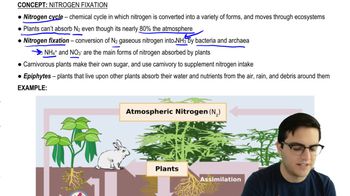
Nitrogen
A vital element for life, integral to nucleic acids and proteins, cycling through ecosystems via fixation by bacteria and archaea, making it accessible to plants and animals.
Nucleic Acids
Molecules essential for storing and transmitting genetic information, composed of long chains of nucleotides, which include DNA and RNA.
Proteins
Large, complex molecules made of amino acids that perform various functions in organisms, including catalyzing reactions, signaling, and providing structural support.
Nitrogen Cycle
The process by which nitrogen is converted between its various chemical forms, primarily through the actions of bacteria and archaea, making it accessible to plants and other organisms.
Ammonia
A nitrogenous compound produced by nitrogen-fixing bacteria, crucial for plant nutrition, often converted to ammonium for absorption.
Ammonium
A positively charged ion formed when ammonia picks up a proton, crucial for plant nitrogen absorption.
Nitrates
Compounds containing nitrogen and oxygen, crucial for plant nutrition, absorbed from soil after conversion by bacteria from atmospheric nitrogen.
Archaea
Microorganisms distinct from bacteria and eukaryotes, often found in extreme environments, that play a crucial role in nitrogen fixation by converting atmospheric nitrogen into ammonia.
Nitrogenase
An enzyme complex in bacteria and archaea that converts atmospheric nitrogen (N₂) into ammonia (NH₃), enabling nitrogen fixation, a crucial process for plant nutrient uptake.
Legumes
Flowering plants in the Fabaceae family that form root nodules housing rhizobia bacteria, which fix atmospheric nitrogen into a form usable by the plant.
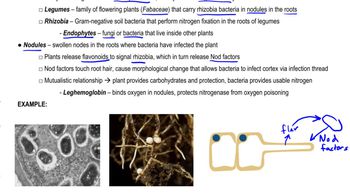
Rhizobia
Gram-negative soil bacteria that form nodules in legume roots, performing nitrogen fixation to convert atmospheric nitrogen into a form usable by plants.
Nodules
Swollen root structures where symbiotic bacteria fix atmospheric nitrogen into a form usable by plants, often seen in legumes.
Flavonoids
Plant-released chemicals that signal rhizobia bacteria to initiate nitrogen-fixing nodules in roots, aiding mutualistic relationships for nitrogen acquisition.
Mycorrhizae
Symbiotic associations between plant roots and fungi that enhance nutrient absorption, particularly nitrogen and phosphorus, by increasing surface area and breaking down organic matter.