Skip to main content
General Biology
My Course
Learn
Exam Prep
AI Tutor
Study Guides
Textbook Solutions
Flashcards
Explore
Try the app
My Course
Learn
Exam Prep
AI Tutor
Study Guides
Textbook Solutions
Flashcards
Explore
Try the app
Back
Phylogenetics and Genome Evolution definitions
You can tap to flip the card.
Phylogenetic Tree
You can tap to flip the card.
👆
Phylogenetic Tree
A branching diagram showing evolutionary relationships based on shared ancestry and homologous traits.
Track progress
Control buttons has been changed to "navigation" mode.
1/15
Related flashcards
Related practice
Recommended videos
Phylogenetics and Genome Evolution quiz
Phylogenetics and Genome Evolution
15 Terms
Phylogenetics and Genome Evolution
25. Phylogeny
4 problems
Topic
Cladistics
25. Phylogeny
4 problems
Topic
25. Phylogeny - Part 1 of 2
4 topics
10 problems
Chapter
Jason
25. Phylogeny - Part 2 of 2
1 topic
2 problems
Chapter
Guided course
05:13
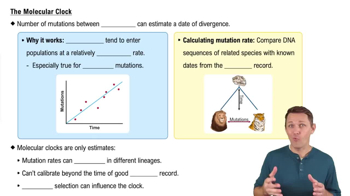
The Molecular Clock
2352
views
13
rank
Guided course
05:29
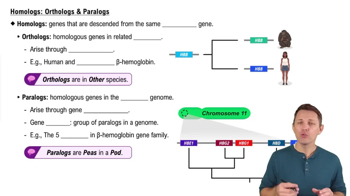
Homologs: Orthologs & Paralogs
2322
views
14
rank
Terms in this set (15)
Hide definitions
Phylogenetic Tree
A branching diagram showing evolutionary relationships based on shared ancestry and homologous traits.
Homologous Trait
A characteristic inherited from a common ancestor, indicating evolutionary relatedness among organisms.
Homologue
A gene descended from the same ancestral gene, present in different species or within the same genome.
Ortholog
A gene in different species that originated from a common ancestor due to speciation events.
Paralog
A gene within the same genome that arose from duplication, potentially evolving new or related functions.
Gene Duplication
A process where a segment of DNA is copied, resulting in multiple gene copies within a genome.
Gene Family
A group of related genes within a genome, all originating from repeated duplication events.
Speciation
An evolutionary process resulting in the formation of new, distinct species from a common ancestor.
Molecular Clock
A method estimating divergence times by comparing mutation numbers and using known mutation rates.
Mutation Rate
The frequency at which genetic changes occur in a DNA sequence over a specific period.
Fossil Record
Historical evidence from preserved remains used to calibrate evolutionary timelines and mutation rates.
Neutral Mutation
A genetic change with no effect on fitness, unaffected by natural selection, useful for molecular clock estimates.
Natural Selection
A process influencing which genetic variants persist, potentially altering mutation rate estimates.
Lineage
A sequence of species or populations tracing descent from a common ancestor.
Divergence Date
The estimated time when two lineages last shared a common ancestor, often inferred from genetic data.
 BackBack
 05:13
05:13