The main photosynthetic pigment found within chloroplasts, primarily responsible for absorbing light to drive photosynthesis.
What are accessory pigments?
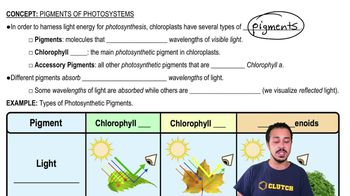
Accessory pigments are photosynthetic pigments other than chlorophyll a, such as chlorophyll b and carotenoids, that help capture additional wavelengths of light.
Absorption spectrum
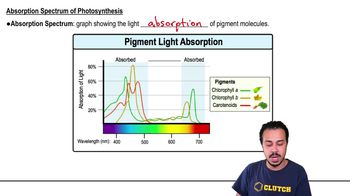
A graph showing the light absorption of pigment molecules at different wavelengths.
What is the role of carotenoids in photosynthesis?
Carotenoids are accessory pigments that reflect orange, red, and yellow wavelengths of light and help in capturing additional light energy for photosynthesis.
Photosystems
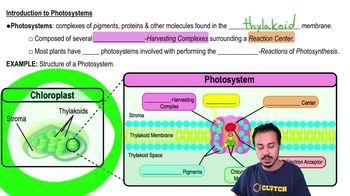
Complexes of pigments, proteins, and other molecules found in the thylakoid membrane that facilitate the light reactions of photosynthesis.
What is the function of the reaction center in a photosystem?
The reaction center contains chlorophyll a molecules and a primary electron acceptor, playing a crucial role in converting light energy into chemical energy.
Thylakoid membrane
The membrane within chloroplasts where photosystems are located and light reactions of photosynthesis occur.
What wavelengths of light does chlorophyll b reflect?
Chlorophyll b mainly reflects yellow and green wavelengths of light.
Chloroplast
An organelle in plant cells that serves as the site of photosynthesis.
What is the significance of light harvesting complexes?
Light harvesting complexes contain accessory pigments that absorb photons of light, aiding in the efficient capture of light energy.
Chlorophyll b
An accessory pigment found in chloroplasts that reflects yellow and green wavelengths of light.
What is the primary pigment involved in photosynthesis?
Chlorophyll a is the primary pigment involved in photosynthesis.
Carotenoids
Accessory pigments that reflect orange, red, and yellow wavelengths of light and assist in light absorption for photosynthesis.
What is the role of the thylakoid space?
The thylakoid space is the interior of the thylakoid where the light reactions of photosynthesis take place.
Light reactions
The phase of photosynthesis where light energy is converted into chemical energy, occurring in the thylakoid membranes.
What is the absorption spectrum used for?
The absorption spectrum is used to show the light absorption of different pigment molecules at various wavelengths.
Photosynthesis
The process by which plants convert light energy into chemical energy, primarily using chlorophyll a and other pigments.
What are the two main types of chlorophyll?
The two main types of chlorophyll are chlorophyll a and chlorophyll b.
Reflection of light
The process by which certain wavelengths of light are not absorbed by pigments but are instead reflected, contributing to the color we see in plants.
What is the function of chlorophyll a in the reaction center?
Chlorophyll a in the reaction center absorbs light and helps convert it into chemical energy during photosynthesis.
Pigments
Molecules that absorb specific wavelengths of visible light, essential for capturing light energy in photosynthesis.
What is the primary electron acceptor?
The primary electron acceptor is a molecule in the reaction center that captures excited electrons during the light reactions of photosynthesis.
Mesophyll cells
Cells in the leaf tissue where chloroplasts are primarily located, facilitating photosynthesis.
What is the role of the stroma in chloroplasts?
The stroma is the fluid-filled space surrounding the thylakoids in chloroplasts, where the Calvin cycle of photosynthesis occurs.
Visible light
The portion of the electromagnetic spectrum that is visible to the human eye and is absorbed by photosynthetic pigments.
What is the significance of the green color in plants?
The green color in plants is due to the reflection of green wavelengths of light by chlorophyll a.
Photon
A particle representing a quantum of light, which is absorbed by pigments during photosynthesis.
What are the two photosystems in plants?
Most plants have two photosystems, Photosystem I and Photosystem II, involved in the light reactions of photosynthesis.
 Back
Back
 05:58
05:58