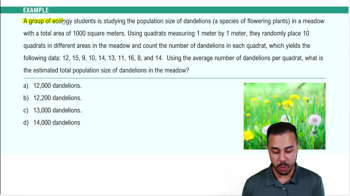
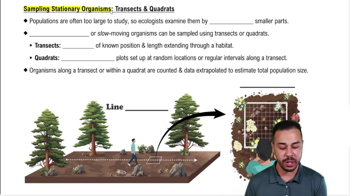
What are transects and quadrats, and how are they used to estimate the population size of stationary organisms?
Transects are lines of known length through a habitat along which organisms are counted, while quadrats are rectangular plots placed at random or regular intervals to count organisms within them. Both methods allow ecologists to sample a portion of the population and extrapolate to estimate the total population size of stationary or slow-moving organisms.
Why are transects and quadrats not suitable for sampling mobile organisms?
Transects and quadrats are not suitable for mobile organisms because these organisms can move away from the sampling area, leading to inaccurate counts and unreliable population estimates.
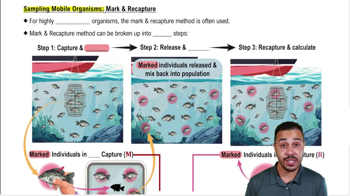
Describe the steps involved in the mark and recapture method for estimating the population size of mobile organisms.
The mark and recapture method involves: 1) capturing and marking a subset of the population, 2) releasing the marked individuals and allowing them to mix back into the population, and 3) recapturing a new sample and counting how many are marked. The data are then used to estimate the total population size.
What is the formula used in the mark and recapture method, and what does each variable represent?
The formula is m/n = r/c, where m is the number of marked individuals in the first capture, n is the total population size, r is the number of marked individuals in the second capture, and c is the total number of individuals captured in the second sample.
List and explain the three main assumptions that must be met for the mark and recapture method to provide accurate population estimates.
The three assumptions are: 1) marked individuals must fully mix with the population between captures, 2) marked and unmarked individuals must be equally likely to be captured, and 3) the population size must remain stable during sampling (no significant births, deaths, immigration, or emigration).
How can molecular tools be used to estimate population size, and what does high or low genetic diversity indicate?
Molecular tools involve analyzing DNA from sampled individuals. High genetic diversity indicates a large population size with distantly related individuals, while low genetic diversity suggests a small population with closely related individuals.
Why is it important for ecologists to use sampling methods rather than counting every individual in a population?
Populations are often too large to study in their entirety, so ecologists use sampling methods to efficiently estimate population size and characteristics without needing to count every individual.
What are transects and quadrats, and how do ecologists use them to estimate the population size of stationary organisms?
Transects are lines of known length through a habitat along which organisms are counted, while quadrats are rectangular plots placed at random or regular intervals to count organisms within them. Ecologists use the counts from these samples to estimate the total population size without counting every individual.
What are the three main assumptions that must be met for the mark and recapture method to provide accurate population estimates?
The three assumptions are: marked individuals must fully mix with the population between captures, marked and unmarked individuals must be equally likely to be captured, and the population size must remain stable during sampling (no significant births, deaths, immigration, or emigration).
How can molecular tools be used to estimate population size, and what does high or low genetic diversity indicate?
Molecular tools analyze DNA from sampled individuals to assess genetic diversity. High genetic diversity suggests a large population with distantly related individuals, while low genetic diversity indicates a small population with closely related individuals.
What is the difference between a population and a sample in biological studies?
A population refers to the entire group of organisms of interest in a study, while a sample is a smaller subset of that population selected for observation or measurement to make inferences about the whole population.
How does a population differ from a sample in the context of population sampling methods?
A population includes all individuals of a species in a defined area, whereas a sample consists of a manageable number of individuals taken from the population to estimate characteristics of the whole group.
How is a sample related to a population in ecological research?
A sample is a representative subset of a population, used by ecologists to estimate population parameters when studying the entire population is impractical.
What is the population of interest in population sampling methods?
The population of interest is the entire group of organisms or individuals that researchers aim to study or make inferences about using sampling techniques.
How can population density per square mile be calculated using sampling methods?
Population density per square mile can be calculated by counting the number of individuals within a sampled area (such as a quadrat), then dividing that count by the area sampled, and scaling up to one square mile if necessary.
What are transects and quadrats, and how are they used in sampling stationary organisms?
Transects are lines of known length through a habitat used to count organisms along or near the line, while quadrats are rectangular or square plots placed at random or regular intervals to count organisms within the plot; both methods help estimate population size of stationary organisms.
What is the mark and recapture method, and what assumptions must be met for it to accurately estimate population size?
The mark and recapture method involves capturing, marking, and releasing individuals, then recapturing to estimate population size using the formula m/n = r/c. Assumptions include: marked individuals mix fully, marked and unmarked individuals are equally likely to be captured, and the population size remains stable during sampling.