 Back
BackProkaryotic Gene Regulation via Operons definitions


 04:25
04:25
Terms in this set (23)
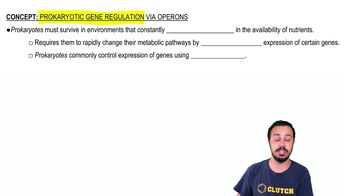
Prokaryotic
Single-celled organisms without a nucleus or membrane-bound organelles, relying on operons for gene regulation to adapt quickly to environmental changes.
Gene Regulation
The process by which cells control the timing, location, and amount of gene expression, often through mechanisms like operons in prokaryotes, to adapt to environmental changes and maintain homeostasis.
Operons
A cluster of genes in prokaryotes regulated together by a single promoter and regulatory sequences, allowing simultaneous transcription of multiple functionally related genes.
Metabolic Pathways
Sequences of biochemical reactions in cells, regulated by enzymes, converting substrates into products to sustain life.
Expression
The process by which information from a gene is used to synthesize a functional gene product, typically a protein.
Genes
Segments of DNA that encode instructions for synthesizing proteins or RNA molecules, influencing an organism's traits and functions.
Transcription
The process where RNA polymerase synthesizes RNA from a DNA template, producing mRNA, tRNA, or rRNA, essential for protein synthesis.
Promoter
A DNA sequence where RNA polymerase binds to initiate transcription of a gene or operon.
Regulatory Sequences
DNA regions that control gene expression by interacting with proteins to increase or decrease transcription.
Proteins
Molecules composed of amino acids that perform a vast array of functions within organisms, including catalyzing metabolic reactions, DNA replication, responding to stimuli, and transporting molecules.
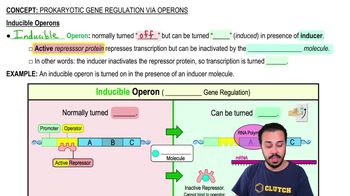
Inducible Operons
Operons that are typically off but can be activated by an inducer molecule, which inactivates the repressor protein, allowing gene transcription.
Inducer
A molecule that binds to a repressor protein, inactivating it and allowing gene transcription in an inducible operon.
Repressor Protein
A protein that binds to the operator region of an operon, blocking RNA polymerase and preventing transcription of the associated genes.
RNA Polymerase
An enzyme that synthesizes RNA from a DNA template during transcription, facilitating gene expression by binding to the promoter region and unwinding the DNA strand.
mRNA
A molecule that carries genetic information from DNA to the ribosome, where it serves as a template for protein synthesis.
Translation
The process where mRNA is decoded by ribosomes to synthesize proteins, using tRNA to match amino acids to the mRNA codons.
Positive Gene Regulation
Activation of gene expression by regulatory proteins that bind to DNA, enhancing RNA polymerase binding and transcription initiation.
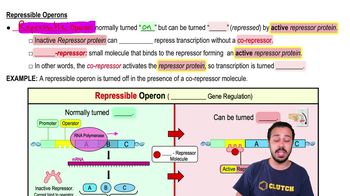
Repressible Operons
Operons that are typically active but can be deactivated when a corepressor binds to a repressor protein, inhibiting transcription.
Co-Repressor
A small molecule that binds to a repressor protein, activating it to inhibit gene transcription in repressible operons.
Negative Gene Regulation
The process where a repressor protein binds to DNA, preventing transcription of a gene or operon, thus inhibiting gene expression.
Gene Products
Proteins or RNA molecules produced by gene expression, essential for cellular structure, function, and regulation.
Operator
A DNA segment within an operon where a repressor protein binds to inhibit transcription of adjacent genes.
Enhancer Segments
DNA regions where activator proteins bind to increase the transcription of associated genes.