 Back
BackProteins definitions

 08:02
08:02
Terms in this set (24)
Amino Acids
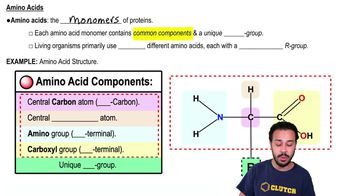
Organic compounds with a central carbon, an amino group, a carboxyl group, a hydrogen atom, and a variable R group; they are the building blocks of proteins.
Monomers
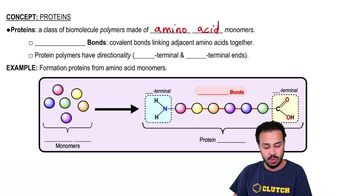
Small molecules that can join together to form larger polymers, such as amino acids forming proteins.
Proteins
Complex molecules composed of one or more long chains of amino acids, essential for various biological functions, including catalysis, structure, and regulation.
Central Carbon
A carbon atom in an amino acid bonded to a hydrogen atom, an amino group, a carboxyl group, and a variable R group.
Hydrogen
The simplest and most abundant element, essential in forming water and organic compounds, and involved in bonding critical for protein structure.
Carboxyl Group
A functional group consisting of a carbon atom double-bonded to an oxygen atom and single-bonded to a hydroxyl group (-COOH), crucial in amino acids and organic acids.
Amino Group
A functional group consisting of a nitrogen atom bonded to two hydrogen atoms, commonly found in amino acids and essential for forming peptide bonds in proteins.
R Group
The variable side chain in an amino acid that determines its unique properties and influences protein structure and function.
Polypeptide
A chain of more than 50 covalently linked amino acids forming the primary structure of proteins.
Peptide
A short chain of amino acids, typically fewer than 50, linked by peptide bonds between the carboxyl group of one amino acid and the amino group of another.
Hydrolysis
The process of breaking down a polymer or biological molecule by adding water, resulting in the cleavage of chemical bonds.
Polymer
A large molecule composed of repeating structural units (monomers) covalently bonded together, forming complex structures like proteins, nucleic acids, or synthetic materials.
Biological Molecule
A complex molecule essential for life, composed of smaller units like amino acids, nucleotides, or monosaccharides, forming proteins, nucleic acids, or polysaccharides through covalent bonds.
Amine Group
A functional group consisting of a nitrogen atom bonded to one or more hydrogen atoms, commonly found in amino acids and involved in forming peptide bonds.
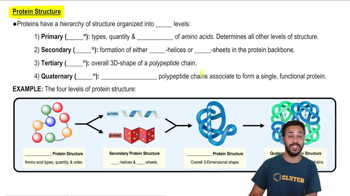
Secondary Protein Structure
Hydrogen bonds between the atoms of the peptide backbone form alpha helices and beta pleated sheets, creating this level of protein structure.
Alpha Helices
A coiled secondary protein structure stabilized by hydrogen bonds between the backbone atoms of the polypeptide chain.
Beta Pleated Sheets
A type of secondary protein structure formed by hydrogen bonds between the backbone atoms, creating a zigzag pattern.
Hydrogen Bonding
Attraction between a hydrogen atom covalently bonded to an electronegative atom and another electronegative atom, crucial in stabilizing protein structures like alpha helices and beta sheets.
Peptide Backbone
A repeating sequence of nitrogen, carbon, and oxygen atoms in a protein, formed by peptide bonds between amino acids' carboxyl and amino groups, excluding the variable R groups.
Tertiary Structure
The three-dimensional folding of a single polypeptide chain, stabilized by interactions among R groups, including hydrogen bonds, ionic bonds, hydrophobic interactions, and disulfide bridges.
Quaternary Structure
The level of protein structure involving the assembly of multiple polypeptide chains into a functional protein complex.
Chaperone Protein
Proteins that assist in the proper folding or refolding of other proteins, especially after denaturation, ensuring they achieve their functional conformation.
Denaturing
Loss of a protein's functional shape due to environmental changes like temperature or pH, leading to loss of function.
Renaturing
The process by which a denatured protein regains its native structure and function, often with the help of chaperone proteins.